For a reversible adiabatic process of an ideal gas, and . At fixed composition and constant sample heat capacity at constant volume ,Mayer's relation gives , so is constant andThe finite-path power law requires approximately constant heat capacities as well as reversibility. When rotational or vibrational populations change appreciably, use instead; the local isentropic pressure exponent remains .
For an intact heteronuclear diatomic gas, quantum excitation progressively activates molecular motion. With rotational and vibrational modes frozen, the three translational degrees of freedom give and . Two active rotations add , giving and . One active harmonic vibration contributes a further , through kinetic and potential terms, giving and .
For molecular moment of inertia , the rigid rotor levels are , so the rotational excitation scale isThe first gap corresponds to , so the crossover occurs at temperatures of that order. For bond force constant and reduced molecular mass , the vibrational scale isTypically . Real gases may condense at the low-temperature end or dissociate and excite electronic states at the high-temperature end; the three plateau values describe the ideal intact-molecule model.
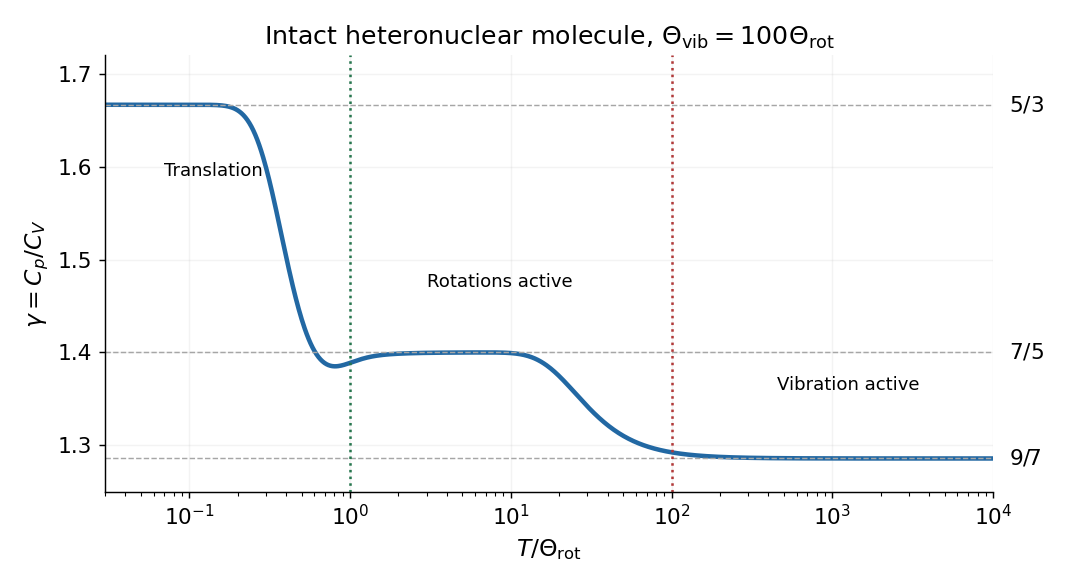
Translational, rotational and vibrational regimes of the heat capacity ratio
. Original rigid-rotor and harmonic-oscillator calculation with an illustrative ratio of vibrational to rotational temperatures of 100. The three limiting heat capacity ratios are marked; detailed crossover shapes are not universal. Details.
For the piston apparatus, mechanical equilibrium requires , hence . Let be a small upward displacement, so . The local isentropic compressibility givesConsequently the adiabatic gas-spring piston period isThis neglects friction, gas inertia, leakage and dissipation, with internal equilibration much faster than the oscillation and external thermal equilibration much slower. The small oscillation probes locally; it need not keep constant over a large temperature interval.
With , the supplied dimensions give and . ThusHelium is close to the monatomic ideal gas value ; NO is close to the diatomic gas value , with rotations active and vibration largely frozen. The numbers are approximate experimental inferences, rather than exact rational values.
Articles by others on the same topic
There are currently no matching articles.