A state function is determined by the equilibrium state, rather than the path used to reach it. Its differential is exact and its change around a closed thermodynamic cycle is zero. Internal energy, entropy and enthalpy are examples; transferred heat and work are not state functions.
For slow expansion in contact with a large thermal reservoir, the fixed temperature of that reservoir maintains an isothermal process. For a fixed amount of ideal gas, internal energy and enthalpy depend only on temperature, soThe ideal gas law also gives . For a reversible expansion the absorbed heat equals the work done by the gas, while its entropy increases by ; constant internal energy does not mean zero heat transfer.
With a thermally insulating boundary, . If the slow piston motion is frictionless and reversible, it is an isentropic process:The first law of thermodynamics gives , so expansion lowers the internal energy and temperature. For constant heat capacity ratio , and are constant combinations of state functions. Insulation alone does not guarantee constant entropy: an irreversible adiabatic process can produce entropy. The conclusion uses the intended reversible, quasistatic piston idealization.
For steady insulated flow through a porous plug, neglect changes of bulk kinetic energy and gravitational potential energy, and allow no shaft work. Each amount of gas brings flow work upstream and delivers downstream. The steady energy conservation balance isThus enthalpy is conserved in this Joule-Thomson effect. For an ideal gas, , so and as well. The entropy increases:The porous-plug process is irreversible despite being slow and insulated; it is not the reversible expansion of the preceding part.
In the one-mole Van der Waals equation, represents excluded volume: the volume available to molecular motion is , rather than . Subtracting in the denominator therefore increases the repulsive contribution to pressure. The term represents intermolecular attraction, which reduces the outward momentum flux at a wall and hence appears as the negative correction . The two minus signs do not mean that both physical effects lower pressure.
For a reversible isothermal process along a homogeneous gas branch with , the work done by the gas isTo find the internal energy change without guessing a caloric law, combine with the Helmholtz free energy Maxwell relation . This givesThereforeThe attractive contribution becomes less negative as the gas expands: separating attracting particles requires energy. This differs from the ideal gas result at fixed temperature. The required heat is . Below the critical temperature, an equilibrium path crossing a liquid–gas coexistence region needs the equilibrium coexistence construction rather than the unstable homogeneous Van der Waals isotherm.
The Clapeyron equation for molar latent heat is . Neglect the liquid molar volume, treat the vapor as an ideal gas, and approximate as constant over the interval. ThenUsing one atmosphere as givesThis is the effective molar enthalpy of vaporization inferred from the Integrated Clausius-Clapeyron relation. If varies with temperature, the inferred value is weighted by , not an unweighted arithmetic mean. Real helium is not exactly an ideal gas over the whole interval, and its liquid changes superfluid state within it, so this is an estimate under the stated approximations rather than a precise temperature-independent material constant.
A magnetic field favors alignment of the magnetic moments of a paramagnet, reducing the number of substantially occupied magnetic configurations at fixed temperature. Its magnetic entropy therefore decreases as the field magnitude increases, explaining the negative sign of .
Choose the magnetic Helmholtz free energy convention . Equality of its mixed partial derivatives gives the magnetic Maxwell relationThe magnetic moment inferred from an entropy derivative, integrated at fixed , isThe given entropy derivative alone cannot determine the temperature-independent function . With the usual independent-paramagnet condition as at fixed , , giving Curie's law, . The sketch uses that additional condition. The inverse- expression applies in the weak-field regime; its divergence cannot describe the actual low-temperature saturation of a finite set of magnetic moments.
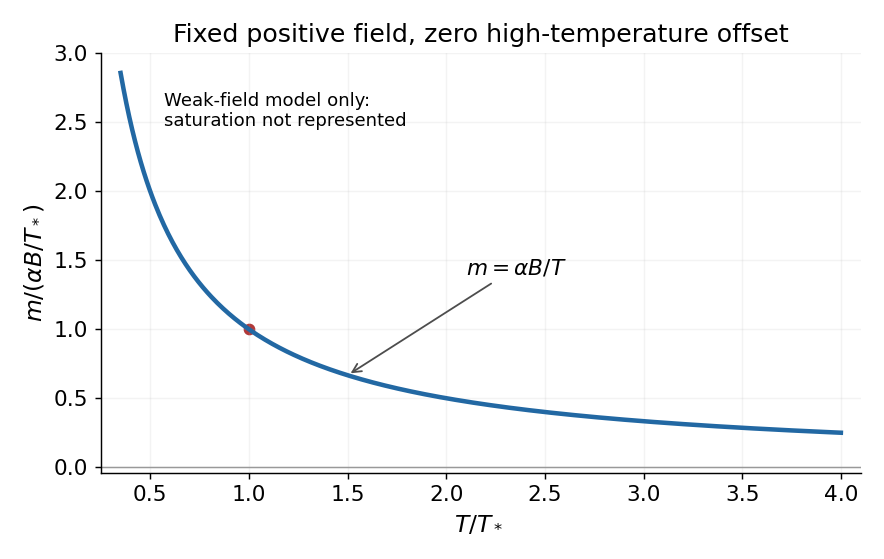

For reversible quasistatic thermal isolation, . With positive field-dependent heat capacity ,Reducing a positive therefore lowers : this is adiabatic demagnetization. Equivalently, reducing cools for either field sign. Reduced alignment would raise magnetic entropy at fixed ; cooling compensates so total entropy remains constant. Insulation without reversibility would allow additional entropy production and need not follow this adiabat exactly.
Assume a stationary temperature profile, spatially uniform mass density and radioactive heat generation rate, constant thermal conductivity, isotropic solid thermal conduction, and blackbody emission into effectively cold surroundings. The volumetric source isTotal radiogenic power equals the surface blackbody radiation loss. The Stefan–Boltzmann law givesFor steady radiogenic heating of a conducting sphere, the interior heat equation isRegularity at the centre removes the integration term and yields . Matching givesThe high central temperature is compatible with a cold surface because finite thermal conductivity requires a large temperature gradient to carry the accumulated interior heat. A nonzero background radiation temperature replaces by in the surface balance. The calculation neglects convection, stored transient heat, changing radioactive abundances, phase changes and any substantial external irradiation.
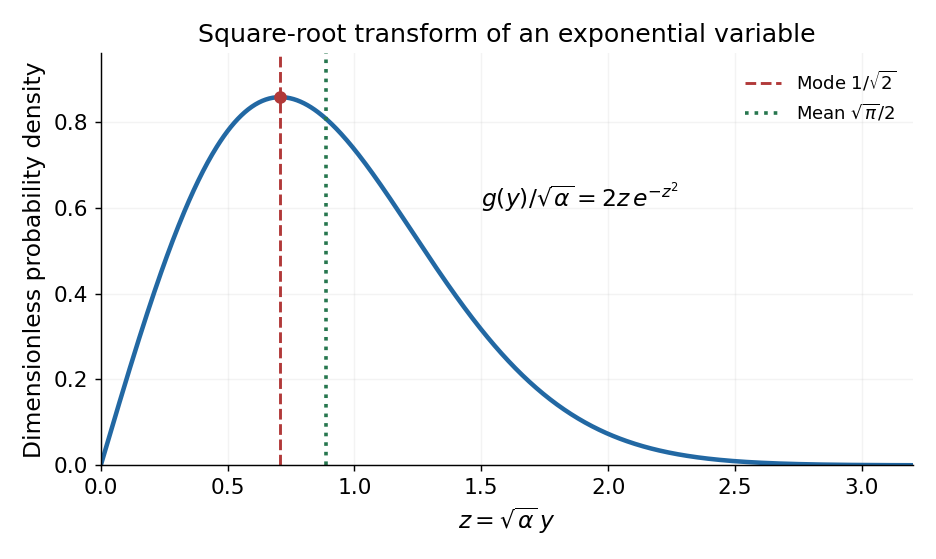
Normalize the probability density function on :For , the change of variables is , . Conservation of probability gives the transformed probability density functionIt is a Rayleigh distribution with scale . Its derivative is , so it rises from zero, has one maximum, and then decays:The expected value follows by putting :Here , obtained from the Gaussian integral by integration by parts. In particular , and the mode changes under a nonlinear variable transformation because a density includes its Jacobian determinant.

Let the gas have a small bulk velocity , an approximately isotropic local thermal velocity distribution, and a mean free path short compared with the flow-gradient scale. A molecule transports the mean streamwise momentum acquired near its previous collision. To first order, its nonequilibrium momentum relative to the destination layer is approximately . The resulting transverse momentum flux isThus the dynamic viscosity is . With isotropy, a representative collision time , and a chosen thermal speed average, this has the formThe dimensionless depends on how speeds and collision times are averaged; a simple one-speed estimate gives . Assumptions include dilute binary collisions, a locally equilibrated distribution, weak shear, and negligible boundary slip. The kinetic theory identity then givesFor the Maxwell speed distribution, , soThis explains both the units of inverse time and the relation to molecular collision frequency, up to the averaging convention.
In the cylinder apparatus, distinguish the vector mean molecular velocity, , from the mean thermal speed . For a slow nearly isothermal Couette flow, the thermal speed is approximately position-independent, whereas the bulk mean is azimuthal and changes from the local rotating-wall speed to zero at the fixed wall. In the side gap, with measured radially from the inner wall,Across either end gap, at cylindrical radius , the corresponding profile is , with measured away from the moving end face. The no-slip boundary condition and small underlie these linear profiles.
The side-wall shear stress has magnitude , producing resisting torque . The original diagram also has a gap at both circular end faces. At either face, the stress is and its ring contribution isAdding the side and both ends gives the end-face torque in narrow-gap cylindrical viscometry:The motor supplies the opposite of this viscous resisting torque. Corner flow and the small axle area are neglected. Retaining only the cylindrical wall would omit the term shown by the actual closed-ended geometry.
For hard-sphere Ar atoms of collision diameter , and . ThereforeUsing , and the simple estimate givesThis is a kinetic estimate with a model-dependent numerical prefactor, rather than a precise atomic size measurement. Since the density cancels and the hard-sphere collision diameter is taken constant, the prediction is . The collision cross-section of a real atom can vary with speed, so its exact temperature dependence need not follow this power law.
For a reversible adiabatic process of an ideal gas, and . At fixed composition and constant sample heat capacity at constant volume ,Mayer's relation gives , so is constant andThe finite-path power law requires approximately constant heat capacities as well as reversibility. When rotational or vibrational populations change appreciably, use instead; the local isentropic pressure exponent remains .
For an intact heteronuclear diatomic gas, quantum excitation progressively activates molecular motion. With rotational and vibrational modes frozen, the three translational degrees of freedom give and . Two active rotations add , giving and . One active harmonic vibration contributes a further , through kinetic and potential terms, giving and .
For molecular moment of inertia , the rigid rotor levels are , so the rotational excitation scale isThe first gap corresponds to , so the crossover occurs at temperatures of that order. For bond force constant and reduced molecular mass , the vibrational scale isTypically . Real gases may condense at the low-temperature end or dissociate and excite electronic states at the high-temperature end; the three plateau values describe the ideal intact-molecule model.
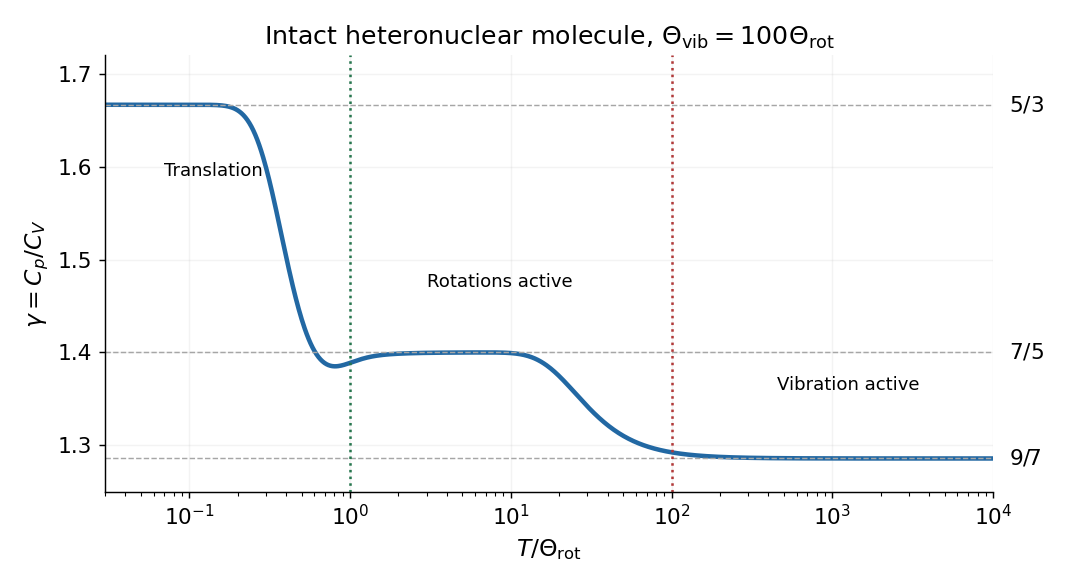
Translational, rotational and vibrational regimes of the heat capacity ratio
. Original rigid-rotor and harmonic-oscillator calculation with an illustrative ratio of vibrational to rotational temperatures of 100. The three limiting heat capacity ratios are marked; detailed crossover shapes are not universal. Details.
For the piston apparatus, mechanical equilibrium requires , hence . Let be a small upward displacement, so . The local isentropic compressibility givesConsequently the adiabatic gas-spring piston period isThis neglects friction, gas inertia, leakage and dissipation, with internal equilibration much faster than the oscillation and external thermal equilibration much slower. The small oscillation probes locally; it need not keep constant over a large temperature interval.
With , the supplied dimensions give and . ThusHelium is close to the monatomic ideal gas value ; NO is close to the diatomic gas value , with rotations active and vibration largely frozen. The numbers are approximate experimental inferences, rather than exact rational values.
For a single-particle state of energy , put . The equilibrium mean occupancies areThe Maxwell-Boltzmann distribution is the dilute classical limit. The Fermi-Dirac distribution applies to identical fermions with at most one particle in each complete single-particle state by the Pauli exclusion principle. The Bose-Einstein distribution applies to identical bosons with no such upper occupation bound. The chemical potential fixes total particle number; these are mean state occupancies, not three separately normalized single-particle probability densities. For a number-conserving ideal Bose gas, cannot exceed the lowest single-particle energy.
Take to be a wavevector and count periodic-box states with cell volume in momentum space, parameterized by . Write for internal degeneracy. The number of states in a spherical shell is . Since ,Thus the one-particle canonical partition function isHere , for one nondegenerate branch, and for the spin-half case below. The integral uses . For classical indistinguishable particles, , givingThe factor three in the energy arises from the linear dispersion relation and three-dimensional state counting; the usual nonrelativistic quadratic-dispersion value does not apply.
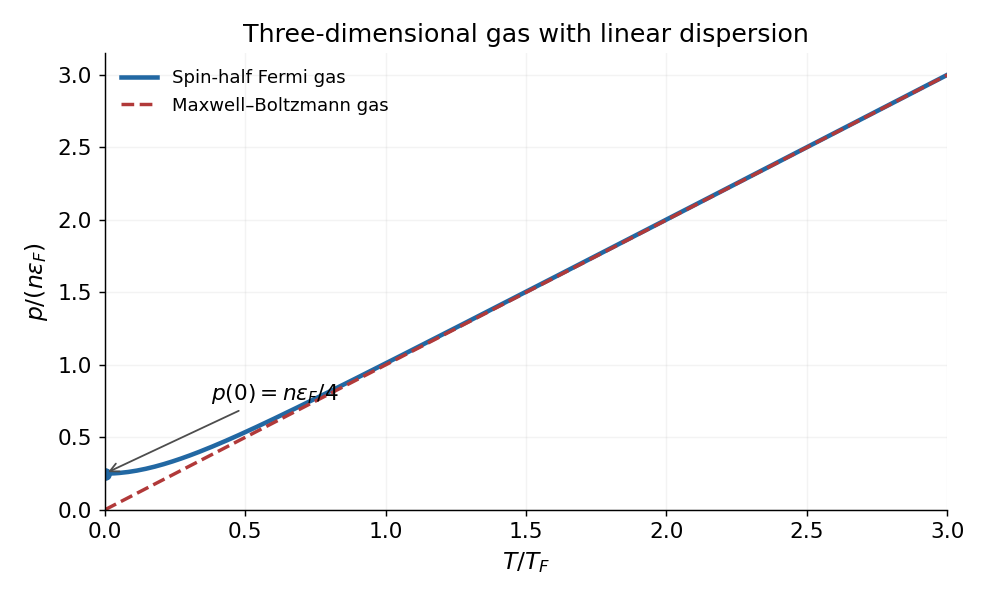
For spin-half fermions at , all states up to the Fermi energy are occupied. With ,Integrating the occupied energy states givesThese are the corresponding ultrarelativistic ideal Fermi gas formulae with general slope . The nonzero ground-state internal energy and degeneracy pressure reflect the Pauli exclusion principle: particles cannot all occupy the lowest-momentum state. Formally extrapolating the classical equations gives , but Maxwell–Boltzmann statistics is not valid at fixed positive as .
At large , the number equation gives , so expanding the Fermi-Dirac distribution recovers the Maxwell-Boltzmann distribution. A convenient crossover scale is the Fermi temperature,For , both gases have . At fixed , the Fermi curve begins at , has zero initial slope, lies above the classical line, and approaches it at high temperature. For example its low-temperature expansion is . The plot evaluates the finite-temperature occupation integrals at fixed number density.

If the source's symbol is interpreted literally as momentum rather than a wavevector, the state-space cell is . In that convention replace in the wavevector-based coefficients and energy scales above by . The dimensionless thermodynamics and the relation are unchanged.
The Second law of thermodynamics states that total entropy of an isolated composite system cannot decrease. For a cyclic heat engine exchanging heat only with reservoirs at , it gives . Since ,The bound is attained by a reversible heat engine: no friction, no finite-temperature-difference heat exchange and no other entropy production. A Carnot cycle provides an implementation with two reversible isotherms and two reversible adiabats. All temperatures in these ratios are absolute.
Let be the fixed gas amount, , , and let denote the heat capacity of the whole sample. First take the unregenerated Stirling cycle, so that heat rejected during isochoric cooling is not stored and returned during isochoric heating. The reversible quasistatic gas work iswhile the heat inputs are and . HenceThe strict inequality follows because adds heat input without additional work. Quasistatic motion alone does not make heat exchange with a single hot or cold reservoir reversible while the gas temperature changes on an isochore. Indeed, using those two reservoirs gives total external entropy production per cycle.
The strict comparison requires the no-regeneration assumption. A perfect reversible regenerator stores during and returns it during ; only the isothermal heat transfers then enter the external heat budget, giving exactly. For example, perfect regeneration with , and gives . Thus the four gas paths by themselves do not enforce an efficiency strictly below the Carnot bound.
For the gas itself, the four entropy changes areExpansion increases the available positional states; compression reverses that change. Isochoric cooling reduces thermal populations and isochoric heating restores them. The sum is zero because entropy is a state function. This does not imply zero total entropy production in the gas plus external reservoirs.
Taking as reference, the isotherms are horizontal on a – diagram. The isochore through state 1 obeys , and the isochore through state 2 is shifted right by . For the internally reversible quasistatic gas paths, , soThe enclosed area is the net work per engine cycle, with a clockwise orientation. It is not the total heat input.
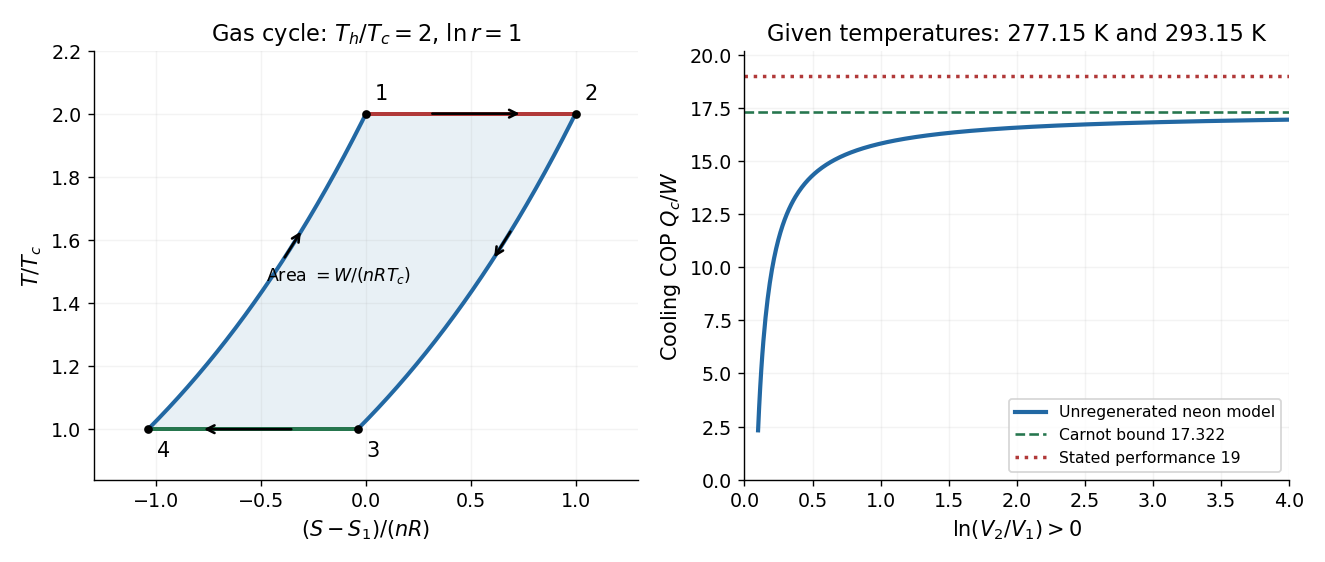

For the refrigerator, the stated rates give the cooling coefficient of performance . But the absolute reservoir temperatures are and , so Carnot's theorem requiresAt input the largest allowed cooling rate is only . Equivalently the stated heat rejection gives the reservoir entropy ratea direct violation of the Second law of thermodynamics for this cyclic two-reservoir device.
The unregenerated neon model makes the algebraic obstruction explicit. With , reversing the cycle givesSetting this to 19 produces , or , contradicting the required expansion ratio . Perfect regeneration can raise performance only to the Carnot bound and does not fix the problem. There is no physically admissible for the stated data.
Articles by others on the same topic
There are currently no matching articles.