A large initial biological population maps to a very small positive biological population because at large : the initial slump is followed by recovery. Cobwebbing alternates a vertical step from to with a horizontal step to the diagonal at . The figure uses the explicit illustrative choice .
For , every positive orbit subsequently lies below the maximum . On the map is increasing, with the unique positive fixed point . Below that point and ; above it and . Therefore the trapped iterates approach the fixed point monotonically from whichever side they enter. In particularThe extinction initial value remains zero, but exact extinction is never reached from a positive finite biological population in this deterministic model.
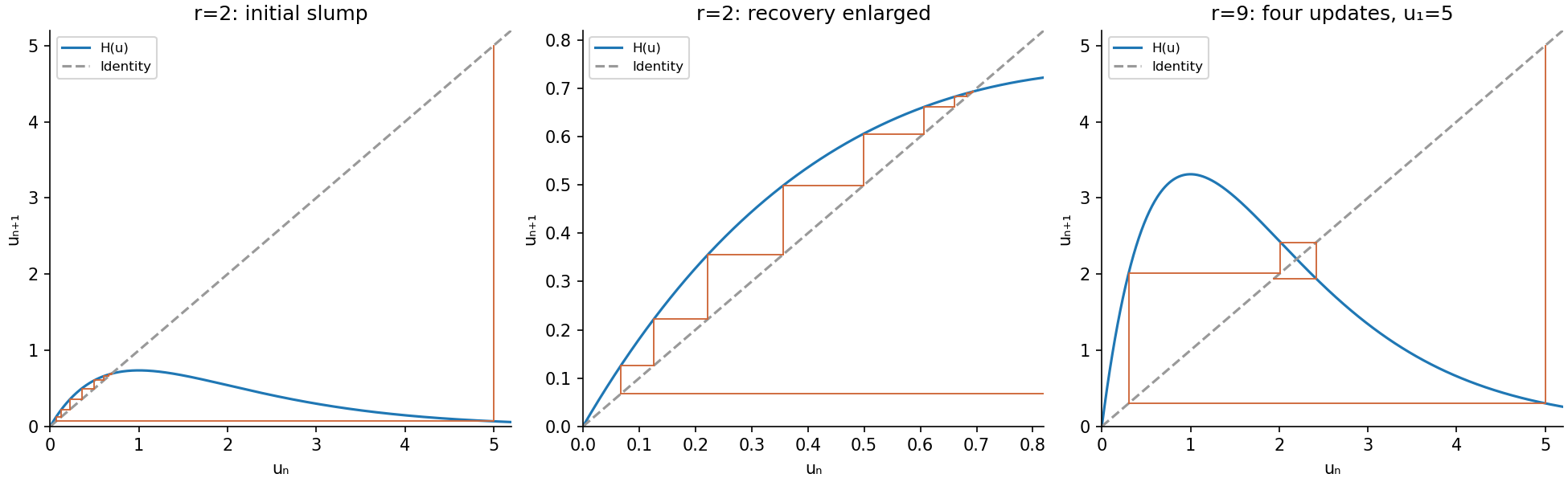

Apply the same vertical-then-horizontal cobweb construction to . Since no numerical value of the large initial biological population is prescribed, an exact five-generation list is , , , , . For the plotted example , these values areThe initial slump is followed by rapid growth and an alternating overshoot about , which is now unstable because its periodic-orbit multiplier . A still larger initial biological population can remain extremely small for more than these four updates; the example illustrates the requested construction without imposing an unstated universal numerical starting value.
Articles by others on the same topic
There are currently no matching articles.