For the Ricker population map , fixed points satisfy or . Thus zero exists for all , while is positive exactly when . Since , the respective periodic-orbit multipliers are and .
Consequently zero is linearly attracting for and repelling for ; the positive biological population is linearly attracting for and repelling for . The periodic-orbit multiplier of the positive point is positive below and negative above it, distinguishing monotone from alternating local convergence. At , the coincident zero state has unit periodic-orbit multiplier but for every , giving nonlinear attraction from the physical right side. At the periodic-orbit multiplier is and linearization is inconclusive. Writing , the second iterate has expansion , so the critical point is weakly attracting; beyond it a period-doubling instability occurs.
A large initial biological population maps to a very small positive biological population because at large : the initial slump is followed by recovery. Cobwebbing alternates a vertical step from to with a horizontal step to the diagonal at . The figure uses the explicit illustrative choice .
For , every positive orbit subsequently lies below the maximum . On the map is increasing, with the unique positive fixed point . Below that point and ; above it and . Therefore the trapped iterates approach the fixed point monotonically from whichever side they enter. In particularThe extinction initial value remains zero, but exact extinction is never reached from a positive finite biological population in this deterministic model.
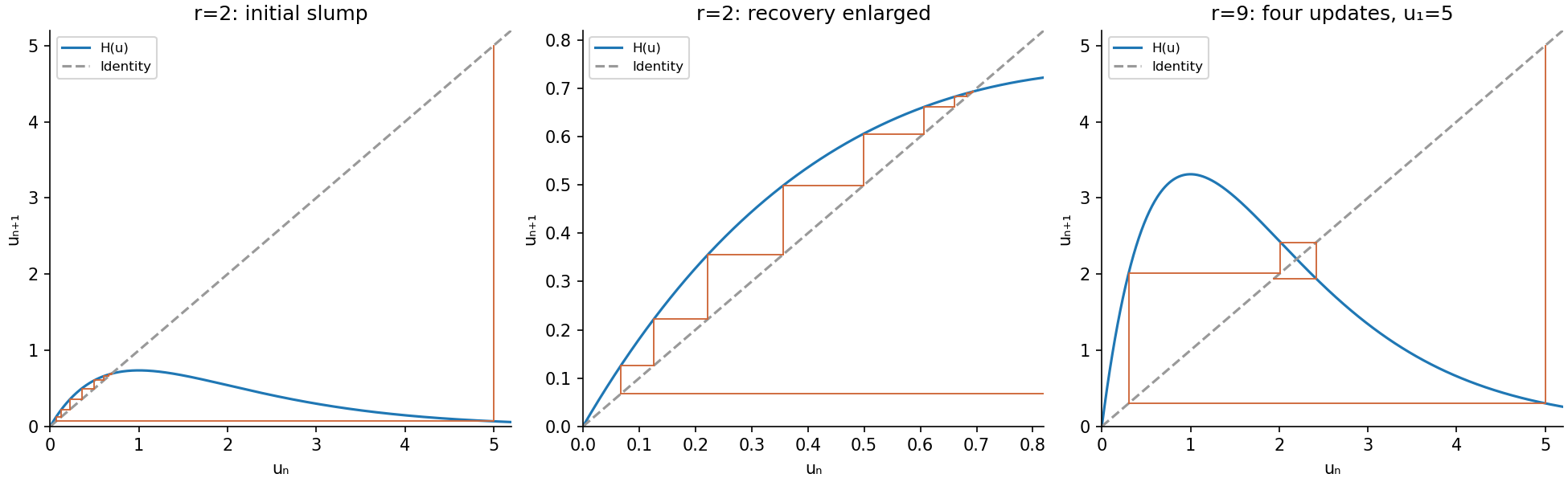

Apply the same vertical-then-horizontal cobweb construction to . Since no numerical value of the large initial biological population is prescribed, an exact five-generation list is , , , , . For the plotted example , these values areThe initial slump is followed by rapid growth and an alternating overshoot about , which is now unstable because its periodic-orbit multiplier . A still larger initial biological population can remain extremely small for more than these four updates; the example illustrates the requested construction without imposing an unstated universal numerical starting value.
For , the second-iterate equation is equivalent to . Write and let paired points be . The condition becomes . At , , so strict concavity of the positive hyperbolic tangent gives one nonzero positive , as well as . Here it is exactly .
Thus the four nonnegative fixed points of areZero has periodic-orbit multiplier and the central point has periodic-orbit multiplier , so both are unstable. The outer two points are exchanged by , since and . Their common second-iterate periodic-orbit multiplier isIts magnitude is below one, so both outer fixed points of are stable. This verifies the crossings and stability in the supplied graph rather than reading stability from crossing direction alone.
The Ricker population map two-cycle consists of the two stable points of the second iterate, exchanged by the original map. Thus generic positive orbits approach alternating valuesThere are exceptions: zero stays extinct, while an orbit starting at or at one of its finite preimages eventually stays at that unstable fixed point.
To justify the large-time conclusion, put and . Every first image is at most . A positive orbit below grows until it enters ; if it never entered, its monotone limit below would contradict the fixed-point equation. The interval is invariant. On it is decreasing, so is increasing. Its only fixed points there are the three positive points already found; its graph signs make iterations below the unstable middle point converge to the lower stable point, and those above converge to the upper stable point. Interchanging even and odd subsequences under then gives the stated two-cycle. This is regular period-two behaviour, not chaos at this parameter.
Let . The given expansion implies and thereforeUsing gives preciselyThe paired low value is . It is small, so andBy the chain rule the second-iterate periodic-orbit multiplier is their product:Since while , this tends to and eventually has magnitude above one. Thus the large second-iterate fixed point, and hence its associated two-cycle, is unstable for sufficiently large . The high state's small derivative alone does not imply stability: the low state's derivative supplies the compensating factor of order .
Articles by others on the same topic
There are currently no matching articles.