An automorphism is an isomorphism : a structure-preserving self-map that can be undone by another structure-preserving self-map. Equivalently, it is an invertible endomorphism. Its inverse satisfieswhere is the identity morphism. Both maps must be morphisms in the chosen category. For ordinary groups, rings, and vector spaces over a fixed field, a bijective morphism automatically has a compatible inverse. For topological spaces, an automorphism is a homeomorphism from the space to itself: a continuous bijection needs a continuous inverse as well. See Riehl, Category Theory in Context, Definition 1.1.10 and Example 1.1.11.
For example, is an automorphism of the vector space over the real numbers, with inverse . Both are linear maps. The linear endomorphism from endomorphism preserves addition and scalar multiplication too, but discards a coordinate and cannot be undone. Preserving the structure and preserving enough information for reversal are separate requirements.
The automorphisms of a fixed object in a locally small category form a group under composition in a category: the identity morphism is the identity element, and the inverse element of a composite reverses the order of its factors. This makes reversible internal changes calculable. For a group, the resulting automorphism group records which relabelings preserve all products; the examples in group automorphism show how restrictive that condition can be.
A group automorphism is a bijective group homomorphism . It preserves the group operation, the identity element, and inverse elements; its inverse is another group homomorphism. Thus it is a group isomorphism with identical source and target. These maps form the automorphism group under function composition.[ref]
For the additive finite cyclic group , take . Its output list on is , a permutation of all six elements. It preserves addition because , and applying it twice gives . Hence it is a group automorphism and its own inverse function. Compare the collapsing in the figure under endomorphism. The general criterion under endomorphism of a finite cyclic group says exactly when such a map is reversible: its multiplier must be coprime to the size of the finite cyclic group.
A permutation need not be a group automorphism, even if it fixes the identity element. Let exchange and in and fix . It is a bijection, and , butThus it fails to preserve addition and is not even a group homomorphism. Reversibility alone does not preserve the group operation.
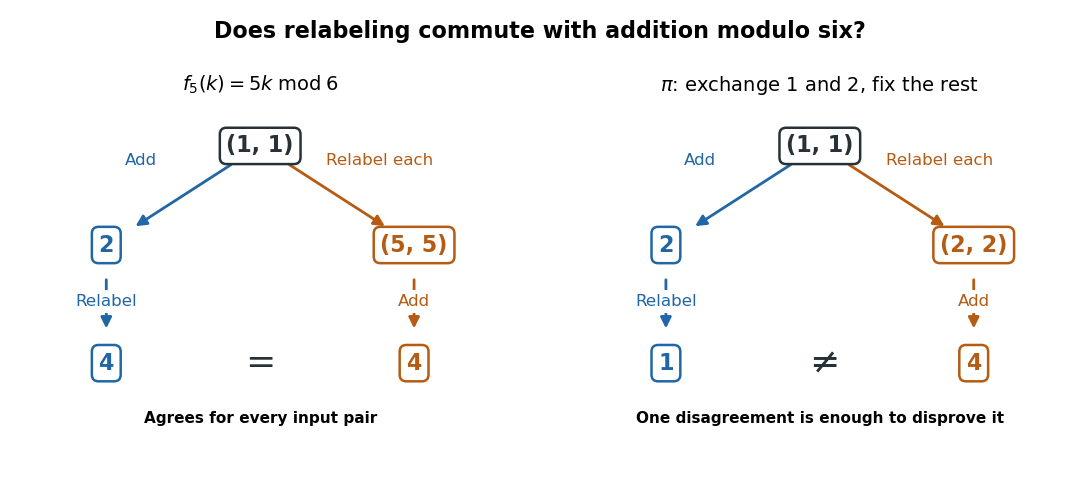
A group automorphism carries each cyclic subgroup onto the cyclic subgroup generated by the image of its defining element, preserving the order of a group element. In particular, it carries a generator of a group to another generator of a group. For , the existing calculation of generators of a finite cyclic group leaves only the images and for , so its automorphism group consists exactly of the identity function and . This turns the problem of compatible relabeling into a much smaller choice than enumerating arbitrary permutations.
A subgroup is characteristic when every automorphism of the ambient group maps it to itself. A uniquely determined subgroup of a given order or structural type is characteristic.
A nontrivial group with no proper nontrivial characteristic subgroup. A minimal nontrivial normal subgroup of a finite group has this property: every characteristic subgroup of it is normal in the ambient group.
Articles by others on the same topic


An **automorphism** is a special type of isomorphism in the context of mathematical structures. More specifically, it is a bijective (one-to-one and onto) mapping from a mathematical object to itself that preserves the structure of that object. ### Key Points: 1. **Mathematical Structures**: Automorphisms can exist in various mathematical contexts, such as groups, rings, vector spaces, graphs, and more.