Choose an orientation for each simplex. The chain group is the free abelian group on the oriented -simplices, with orientation reversal changing sign. On an ordered simplex setIts face maps respect the identifications in a Delta-complex. In , deleting any pair of vertices occurs in the two possible orders with signs and , which cancel. Hence . The groups of homological cycles and boundaries are and ; the identity just proved gives , so is defined. Mod-two homology uses the same chain complex with coefficients reduced modulo two.
Here the edge identifications put all six vertices into one vertex class. Let the three boundary edge classes be in cyclic order, and orient the internal diagonals as , , . With the four face orientations listed in the source, the boundaries areThus , , , and . The Euler characteristic isThe face-boundary map is injective over the integers: coefficients of force the first three face coefficients to vanish, after which the diagonal coefficients force the fourth to vanish. Its cokernel eliminates and leaves generators with the single relation . Since is primitive in , this cokernel is . ThereforeModulo two the first three face-boundary columns are , and the last is their sum. The rank is three, the kernel is one-dimensional, and the edge quotient has dimension three. ConsequentlyThe top mod-two class is the sum of all four faces. Integral homology has no such top class, reflecting nonorientability.
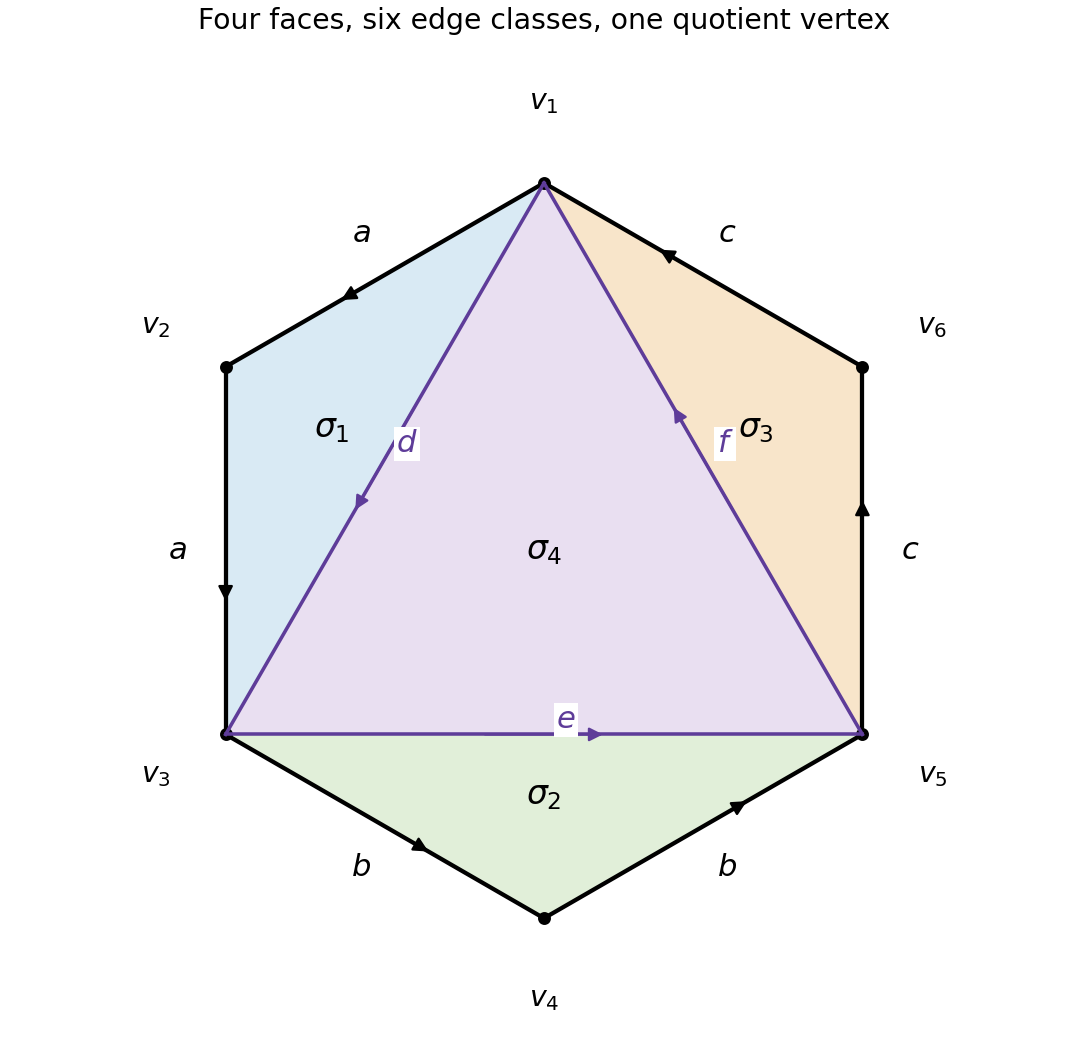
The hexagon complex and its face boundaries
. Paired boundary edges have labels a, b, c. The three internal diagonal classes are d, e, f; all displayed vertices become one vertex after identification. Details.
For an open cover , the Mayer–Vietoris theorem gives the long exact sequenceIt ends in . To prove it, let be the subcomplex generated by singular simplices lying wholly in or wholly in . There is a short exact sequence of chain complexesExactness follows from the singular-simplex bases: the intersection of the two chain subgroups consists exactly of simplices lying in both sets. The small-chain locality theorem for singular homology says the inclusion of this small-chain complex into induces an isomorphism on homology; barycentric subdivision is its standard justification. The long exact sequence of a short exact sequence of chain complexes now proves the theorem. For a homological cycle represented as , the connecting map is , since lies in the intersection. This also identifies the displayed maps and their signs.
For the glued solid tori, use open collar enlargements of the two halves. Each retracts to a circle; the overlap retracts to their boundary torus. Thus the halves have and higher homology zero, while the overlap has and . In the overlap choose longitude and meridian generators. The meridian bounds a disk in each solid torus and the longitude generates each first homology, so the map on isIts kernel is the meridian copy of and its cokernel is . The map on is the injective map . Exactness therefore gives and . The preceding segment is , giving . Connectedness gives , and all higher groups vanish. HenceAs a geometric check, the identity boundary gluing identifies the product with .
For ordered simplicial cochains, define the Alexander-Whitney cup product byusing the front and back faces of each characteristic simplex. Write for the coboundary, . Expanding the face-boundary formula gives the graded Leibniz identityIn this expansion, face omissions on the front and back portions supply the two displayed terms, and their extra terms at the shared vertex cancel with opposite signs. Hence the cup of cocycles is a cocycle. If changes by , its product with a cocycle changes by ; changing by changes it by . The product therefore descends to cohomology. It is associative by the three consecutive-face formula and has the constant degree-zero cochain as unit.
In the wedge, every positive-dimensional simplex belongs to exactly one factor. Restricting positive-degree cochains therefore gives a direct sum of the two cochain groups and splits the coboundaries in degrees above one. In degree one, the same splitting of coboundaries holds: any pair of degree-zero cochains on the factors can have their values at the glued vertices made equal by adding a constant to one factor, which does not change its coboundary. Thus restriction inducesRepresent classes from the two factors by cochains extended by zero on the other factor. If both degrees are positive, a simplex lies wholly in one factor, so one of the front or back evaluations is zero. Their cup product is already zero as a cochain. This proves all the stated mixed products vanish.
For the indicated wedge there is one unit in degree zero, two generators in degree one, and one generator in degree two; higher groups vanish. Every product of positive-degree elements is zero. Its ring is thereforeThe torus has the same additive groups, but its degree-one generators have nonzero cup product generating degree two. The two graded rings are not isomorphic. Since a homotopy equivalence induces a cohomology-ring isomorphism, the torus and this wedge are not homotopy equivalent.
With the usual second-countability convention, an -manifold is a Hausdorff second-countable space in which every point has a neighbourhood homeomorphic to an open subset of . A local orientation of a manifold at is a choice of generator ofExcision and a coordinate ball identify this relative group with . An orientation of a topological manifold is a coherent choice of such generators: near each point the choices are induced by one relative class on a neighbourhood, equivalently by an atlas with orientation-preserving transition maps.
For a connected closed oriented manifold, its fundamental class is the unique class mapping to every chosen local generator. Here closed means compact without boundary. Poincare duality states that cap product with this class is an isomorphismOver rational coefficients it gives . ThereforeWhen is odd this says , so . Torsion does not contribute to the Betti numbers or this Euler characteristic.
Yes, for a nonnegative integer : the closed orientable surface of genus has precisely these groups. A standard polygon cell structure has one vertex, one-cells and one two-cell attached by a product of commutators. Its integral cellular boundary maps are zero, because each generator occurs once in each orientation in the attaching word. Thus and . At genus zero use the sphere.
No. Its top nonzero group would force dimension three. Poincare duality requires , and the universal coefficient theorem gives , since is free. This contradicts the proposed vanishing of . Equivalently its listed Betti numbers give Euler characteristic , impossible for a closed oriented odd-dimensional manifold.
Yes: for , the sphere is connected, closed and oriented, with and no intermediate homology. These groups do not require the manifold to be homeomorphic to a sphere, but the sphere provides the requested example.
No. The dimension would again be three. The universal coefficient theorem gives , since both and vanish. Poincare duality then forces , contradicting the proposed torsion group. In general the second integral homology of a connected closed oriented three-manifold is free abelian, being dual to its first homology.
Yes: real projective three-space has these groups. Its usual cell structure has one cell in each dimension zero through three, with boundary maps , and . Hence its integral homology is in degrees zero and three, in degree one, and zero in degree two. It is a connected closed oriented manifold: the antipodal map on preserves orientation, so the sphere's orientation descends to the quotient.
Articles by others on the same topic
There are currently no matching articles.