A deck transformation of a covering is a homeomorphism with . A connected covering is a regular covering map if its deck transformation group acts transitively on each fiber; for a path-connected base, transitivity on the fiber over the chosen basepoint is equivalent.
Write and . A based loop represents an element of exactly when its lift starting at is closed. Indeed a closed lift itself projects to a representative of an image element; conversely the image of a closed path lifts to that path, and the closed-endpoint property is unchanged by based homotopy.
Suppose the covering is regular, let , and let . Lift a representative of from to an endpoint . By regularity some deck transformation sends to . Applying it to the closed lift of gives a closed lift of at , by uniqueness in the path lifting theorem. The concatenation of the lift of , that closed lift of , and the reverse lift of is therefore a closed lift of . Thus ; applying the same argument to gives equality. Hence a regular covering has a normal image subgroup.
For the explicit cover, label the bottom vertex , the top , the left , the right , and the rear/front equatorial vertices , respectively. Reading the arrows gives the complete monodromy table:
| Start | After | After |
|---|---|---|
Thus the edges form the cycle , and the edges form the cycle . In particular every vertex has one incoming and one outgoing edge of each label, as a covering of the two-circle wedge requires. All word paths below are traversed from left to right.
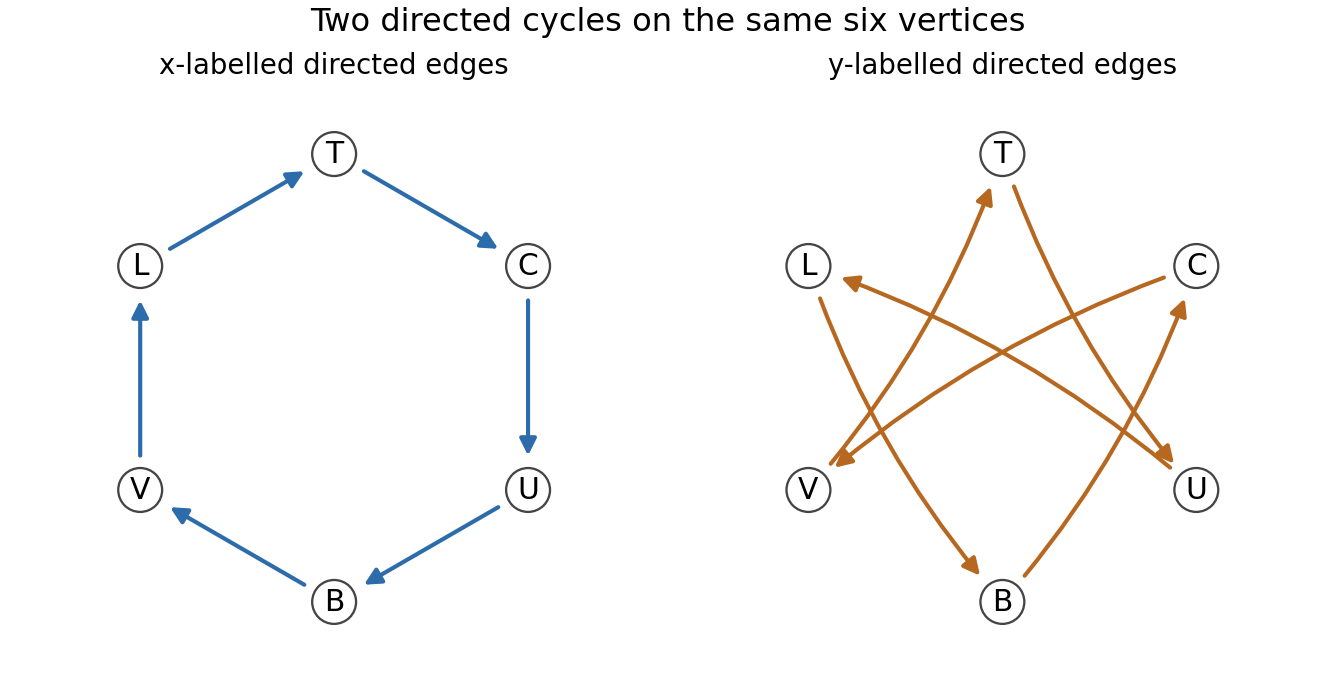
The two directed cycles describing the octahedral covering
. Both panels use the same six named vertices. Their union is the covering graph; following x or y gives the monodromy table. Details.
Choose the spanning tree consisting of the first five edges from to . The tree paths to have labels . For every directed non-tree edge , the path from along the tree to , then along the edge, then back along the tree from , has label . Collapsing a spanning tree turns a connected graph into a wedge of circles, so these paths form a free basis of its fundamental group. There are seven non-tree edges, since . Their projected labels give the explicit generating setThe covering map induces an injection on fundamental groups, so these seven generators are also a free basis for the image subgroup. The first comes from the remaining edge ; the other six come from the outgoing edge at each vertex in the table.
Now the word lifts at around the triangleso . Starting at , however, its lift iswhich is not closed. A deck transformation sending to would take the first closed path to a closed lift of the same word at , contradicting uniqueness of lifts and the displayed nonclosed path. No such deck transformation exists. This is also the closed-lift obstruction expressed by the deck transformation group as a monodromy centralizer.
For a connected covering of a connected, locally path-connected, semilocally simply connected space, the classification of connected covering spaces says that the image subgroup is normal if and only if the covering is regular. The two-circle wedge and this connected finite graph satisfy those hypotheses. Since regularity fails, is not normal in the base group . All normality comparisons here are in that base group.
Articles by others on the same topic
There are currently no matching articles.