A function is periodic with period whenThe period need not be the smallest positive one; for example, every positive integer multiple of a period is also a period.
Use the period-two Fourier series conventionAway from its jumps this square wave is an odd function, so . Its Fourier sine coefficients areOnly odd Fourier harmonics remain. ThereforeThe Fourier series equals away from the jumps; at a jump it gives the midpoint of the one-sided limits by Dirichlet's theorem on Fourier series. The printed definition leaves the values at the integers unspecified. Choosing finite values there consistent with period two changes neither the Fourier coefficients nor these limiting values.
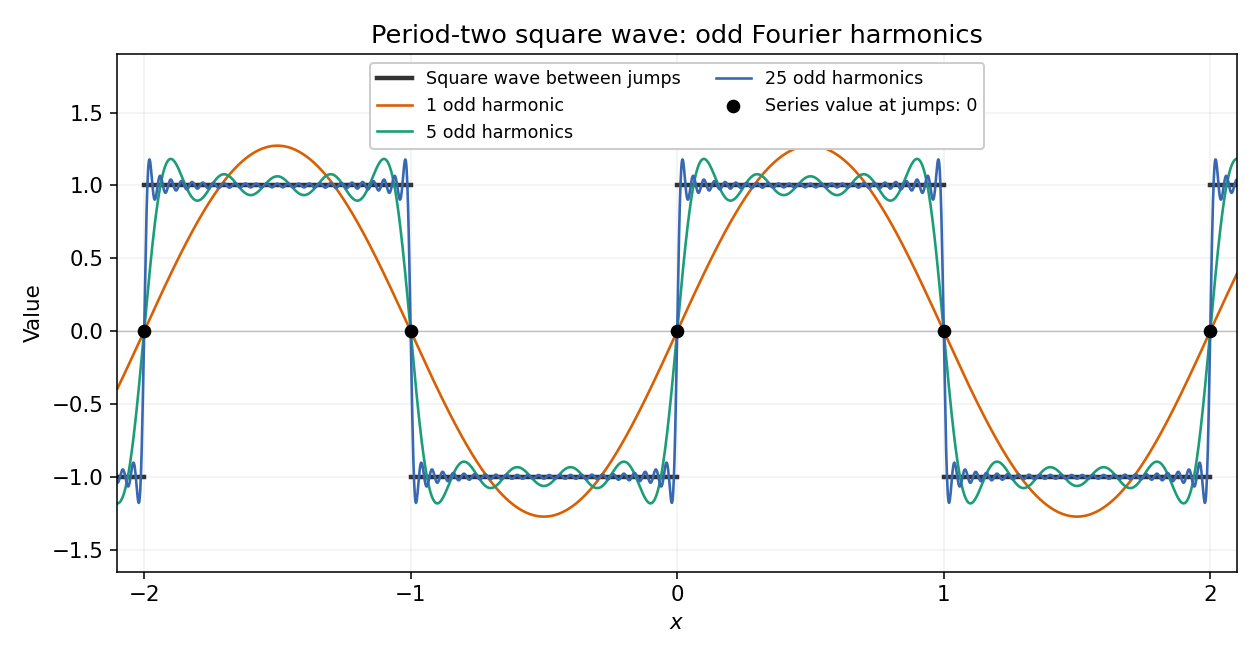

The left and right limits at zero are and . By Dirichlet's theorem on Fourier series, the Fourier series converges toIndeed every term is zero at .
At , the left limit is . The right limit is because of the period-two extension. Therefore Dirichlet's theorem on Fourier series gives the Fourier series limitEvery Fourier partial sum is also exactly zero there because .
Articles by others on the same topic
There are currently no matching articles.