The original cover identifies the examination as 9 September 2015.[ref]
Discrete mathematics, continuous mathematics, and probability resit examination by the University of Oxford (2015). Cover, formal code A10100W1, Long Vacation 2015
The image of a function isThe function is surjective, or onto, exactly when every equals for at least one , equivalently . It is injective, or one-to-one, exactly whenThus surjectivity concerns whether the entire codomain is reached; injectivity concerns whether distinct inputs have distinct outputs.
Since , the image of a function is contained in . Both endpoints occur, at and . By continuity and the intermediate value theorem applied on , every intermediate value occurs too. HenceIt is not surjective onto because, for example, is not attained. It is not injective because although .
If , then and , so . Thus the function is strictly increasing on its domain and is injective. Its values are nonnegative, so it is not surjective onto :If means its image of a function is ; if it includes zero its image of a function is . Indeed, for any , set and ; then . This convention does not change the classification.
With the convention , the even inputs map to for , while the odd inputs map to for . These two images of a function are disjoint and together equal . Within either class there are no repeated outputs. More explicitly the inverse function isConsequently is both injective and surjective, hence a bijection. If instead , the input zero is absent: remains injective but its image of a function is , so it is not onto. The printed paper does not specify this convention; the zero-based convention gives the apparent intended bijection.
Take every complement of a set relative to . By set difference, De Morgan's laws, and distribution of set intersection over set union,Here the middle term is the empty set, since a set and its complement of a set are disjoint.
The commutativity and associativity of set intersection giveEquivalently, part (ii) reduces both sides to removal of the same set union .
For every set , the definition of a power set givesEquality by identical membership therefore provesThe essential observation is that being a subset of a set intersection means being a subset of both factors.
First suppose the sets are finite, with cardinalities and . The power set and Cartesian product counting rules giveSince , the desired inequality follows.
The power-set product cardinality inequality also has an injection proof that does not assume finiteness. Choose distinct and distinct . For and , define the subset of These three encoding regions are disjoint. The row with second coordinate recovers ; the column with first coordinate and second coordinate different from recovers ; the extra position records whether . Thus is injective, proving for arbitrary setsEncoding by alone would fail: all pairs with either factor empty would have the same output.
Let be the number of objects in box . The arrangements correspond exactly to nonnegative integer solutions of . By stars and bars, place stars and separating bars in a row. The number of stars between consecutive bars records the occupancy of each distinguishable box, with adjacent bars allowing an empty box. Choosing the bar positions gives
Put one object into each box first. The remaining objects can be distributed without restrictions, so stars and bars givesEquivalently, the substitution gives a bijection between positive integer solutions of and nonnegative integer solutions of .
Use mathematical induction. For , the left side is . If the identity holds at , thenThe base case and induction step establish the geometric series identity
For the base case , , since multiplying by reduces this to . Suppose the claimed inequality holds for some . The identitythen givesThus mathematical induction proves
The initial values of the two sequences agree: and . For , use the first-order recurrence relation at and :Therefore satisfies exactly the same derangement recurrence as . By strong induction, equality of the preceding two terms implies equality of the next term. ConsequentlyThe first-order recurrence relation therefore also counts derangements.
For a binary relation , reflexivity means for every ; a symmetric relation satisfies for every ; an antisymmetric relation satisfies for every ; transitivity means for every ; an irreflexive relation satisfies for every . In particular, failure of reflexivity means at least one missing diagonal pair, whereas irreflexivity requires every diagonal pair to be missing.
There are possible ordered pairs and hence binary relations. A reflexive relation must contain the diagonal pairs, while its remaining pairs are unrestricted. Subtracting the reflexive relations givesbinary relations that are not reflexive.
A symmetric relation has independent choices on the diagonal. For each of the unordered pairs of distinct elements, either both ordered pairs are included or neither is. Thus there are symmetric relations, so the requested number is
For each unordered pair with , antisymmetry allows three choices: neither direction, only , or only . This contributes . The diagonal is unrestricted by antisymmetry, but being not irreflexive requires a nonempty subset of the diagonal pairs. There are such choices. HenceThis allows some diagonal pairs to be absent; “not irreflexive” does not require a reflexive relation.
We prove the stronger bound for every by strong induction. The initial case is . For , put . Then , so the induction hypothesis and the defining recurrence relation giveThusThe recurrence relation must be read as applying for ; applying it at would invoke outside the printed domain. No value of is needed.
Using with integers ,The quantity in parentheses is an integer, so the divisibility criterion for modular arithmetic gives
By Euclidean division, write and , with integers and . The hypothesis is . Apply the addition rule from part (b)(i) with to obtainTherefore . But , and the only multiple of in that interval is zero. Henceso the two remainders agree.
The decimal expansion is . Since , repeated use of the multiplication rule in part (b)(ii) gives for every . Repeated use of the addition rule in part (b)(i) now givesIf , the left side is congruent to zero, whenceThis is the decimal digit-sum divisibility test for three, derived directly from modular arithmetic.
Set . The definition of the floor function gives . Adding the integer yieldsSince is an integer, it is exactly the floor of . Thus
Put . Because , is a nonnegative integer, andThe function is strictly increasing for , so . Both powers are integers. Taking the floor function therefore givesTaking nonnegative th roots now gives . ConsequentlyThe argument also covers , when both outer floors are zero.
For the composite trapezoidal rule, the mesh width is and the nodes are . The endpoint weights are halves and the interior weights are ones, soThis formula is an approximation to the definite integral, not an exact equality with it for finite .
Let . The expression in part (ii) givesBecause is continuous on , the composite trapezoidal rule converges to its definite integral, which is by part (i). In fact its standard composite trapezoidal error bound is , since . Therefore
Taking the partial derivatives of the parabolic coordinates transformation, holding the other coordinate fixed each time, givesThus its Jacobian matrix is .
The determinant of the Jacobian matrix is . Wherever , the inverse function theorem permits a local inverse of the parabolic coordinates transformation, andReading off its entries givesThese are local formulas on a chosen branch: and have the same image, and at the origin the Jacobian matrix is singular, so this inverse-derivative formula does not apply there.
Apply the multivariable chain rule to a differentiable function on the chosen local branch of the parabolic coordinates:Substituting part (ii) gives
For , the derivatives are and . Its endpoint values are and , so it satisfies both the ordinary differential equation and the boundary conditions. Moreover any solution of has the form ; the boundary conditions force and . Thus the unique solution of the boundary value problem is
The endpoint boundary conditions areThe finite difference equation can be written . Set . Then , so . Summing from to givesUsing and yields , hence . ThereforeThis also covers , where there are no interior equations. Uniqueness follows because the difference of two solutions has zero second finite difference, hence is linear in , and vanishes at both endpoints. This is an exact finite difference solution for constant second derivative: the method is exact at the nodes here because the centered second finite difference differentiates this quadratic polynomial exactly.
The characteristic equation of the constant-coefficient linear ordinary differential equation iswhose roots of a polynomial are . Taking real and imaginary parts of the corresponding exponential functions gives the real general solution
For a particular solution, try . Substitution givesMatching coefficients requires and , so and . Adding the homogeneous solution from part (i), the general solution is
Put . Substituting and into part (ii), using , givesThus and . Solving these two linear equations givesConsequently the solution of the boundary value problem isThe two independent boundary conditions determine uniquely.
Since , divide by to obtain the first-order linear ordinary differential equationAn integrating factor is . Multiplication by this factor givesAfter integration, , so
Let and . Subtracting the two constraint equations gives , hence and . The feasible set is therefore a circle.
For Lagrange multipliers , the stationarity equation becomesAt , the first equation gives . The second ensures and , so the third gives . The constraints then force . Both points do satisfy the multiplier equations, taking .
There are no missing singular constraint points: on the feasible circle, the two constraint gradients and are linearly independent, since . Thus the complete list of constrained critical points and critical values isThe bound on the feasible circle shows that the positive value is the global maximum and the negative value is the global minimum.
A function is periodic with period whenThe period need not be the smallest positive one; for example, every positive integer multiple of a period is also a period.
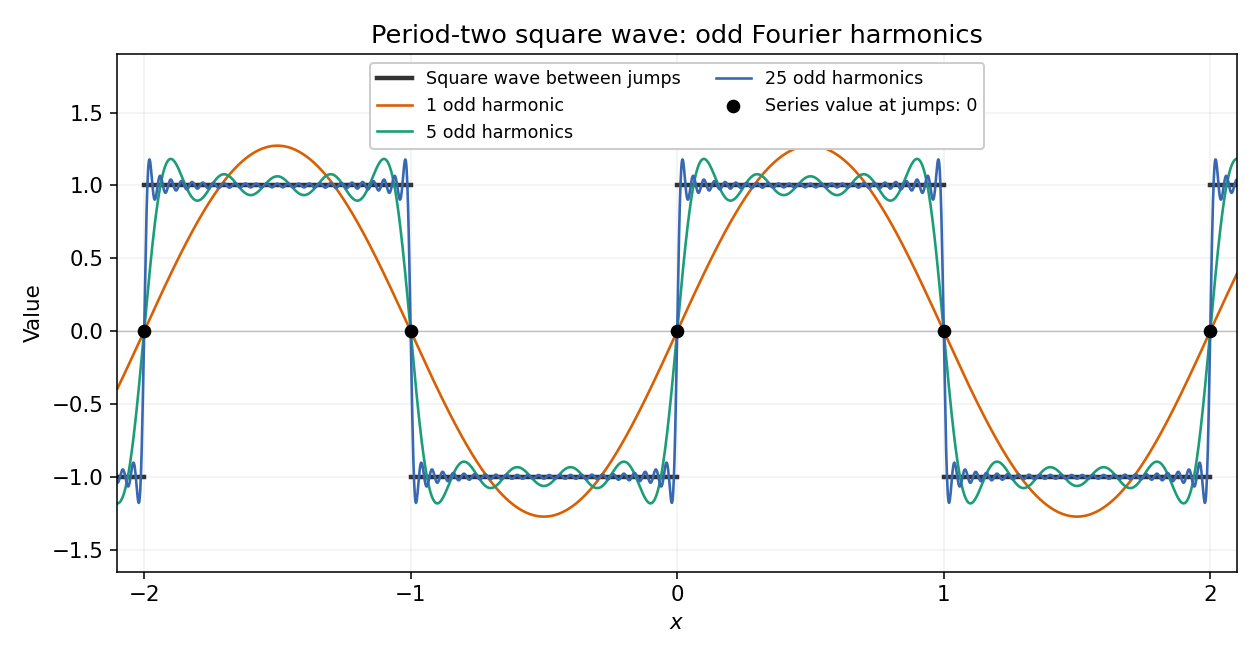
Use the period-two Fourier series conventionAway from its jumps this square wave is an odd function, so . Its Fourier sine coefficients areOnly odd Fourier harmonics remain. ThereforeThe Fourier series equals away from the jumps; at a jump it gives the midpoint of the one-sided limits by Dirichlet's theorem on Fourier series. The printed definition leaves the values at the integers unspecified. Choosing finite values there consistent with period two changes neither the Fourier coefficients nor these limiting values.

Articles were limited to the first 100 out of 158 total.
Articles by others on the same topic
There are currently no matching articles.