A function is periodic with period whenThe period need not be the smallest positive one; for example, every positive integer multiple of a period is also a period.
Use the period-two Fourier series conventionAway from its jumps this square wave is an odd function, so . Its Fourier sine coefficients areOnly odd Fourier harmonics remain. ThereforeThe Fourier series equals away from the jumps; at a jump it gives the midpoint of the one-sided limits by Dirichlet's theorem on Fourier series. The printed definition leaves the values at the integers unspecified. Choosing finite values there consistent with period two changes neither the Fourier coefficients nor these limiting values.
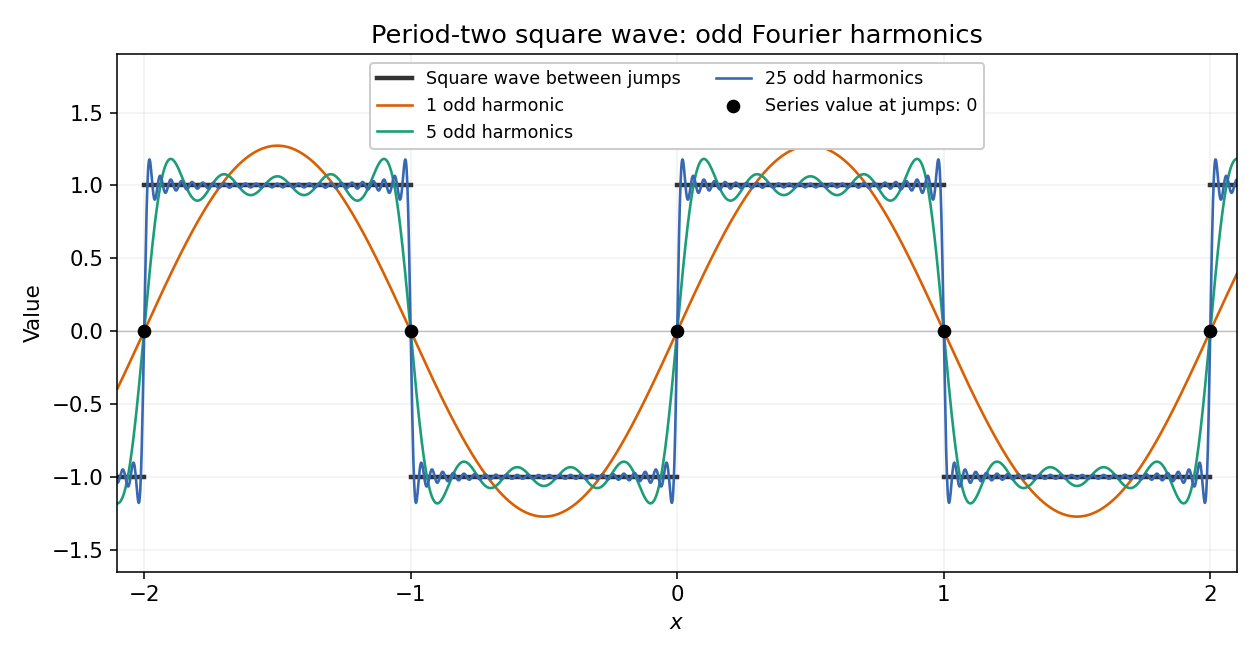

The left and right limits at zero are and . By Dirichlet's theorem on Fourier series, the Fourier series converges toIndeed every term is zero at .
At , the left limit is . The right limit is because of the period-two extension. Therefore Dirichlet's theorem on Fourier series gives the Fourier series limitEvery Fourier partial sum is also exactly zero there because .
The derivative factors asThe polynomial is differentiable everywhere, so its critical points occur precisely where this derivative vanishes. HenceTheir values are and .
The relevant derivatives at areThus the cubic Taylor polynomial isIn fact the exact expansion is , so the omitted term has order in big O notation.
At , , so the second-derivative test gives a strict local minimum. In fact is negative for and positive for except at , so is the global minimum as well.
At , the second-derivative test is inconclusive because . But changes from negative to positive across , while . Hence this is a stationary inflection point. Equivalently, the leading nonconstant term in the Taylor polynomial changes sign across . The paper explicitly uses “saddle point” to mean an inflection point, so in its terminology the classification isHere the “saddle point” is a one-dimensional stationary inflection point, rather than the usual multivariable use of saddle point of a scalar function.[ref]
Discrete mathematics, continuous mathematics, and probability resit examination by the University of Oxford (2015). Page 8, Question 6(b)(iii), explicit definition of “saddle point”
Articles by others on the same topic
There are currently no matching articles.