Solving the linear ordinary differential equation and imposing the initial condition givesAs , the requested limit is
Let , , and let approximate . The forward Euler method gives the difference equationThis geometric sequence has solutionFor fixed , the limit as is , as required by the exact solution.
The amplification factor is . To reproduce decay, the forward Euler method requires , equivalentlyAt , and the approximations alternate with constant magnitude ; for , and the magnitude grows. This is the condition of absolute stability for this decaying differential equation.
Stability is only a minimum requirement. Values just inside the bound can still give a poor endpoint approximation; resolving the decay accurately generally requires a smaller step size. If positivity at every step is desired, the stronger condition ensures . The figure shows the difference between decay of the exact solution and numerical oscillation.
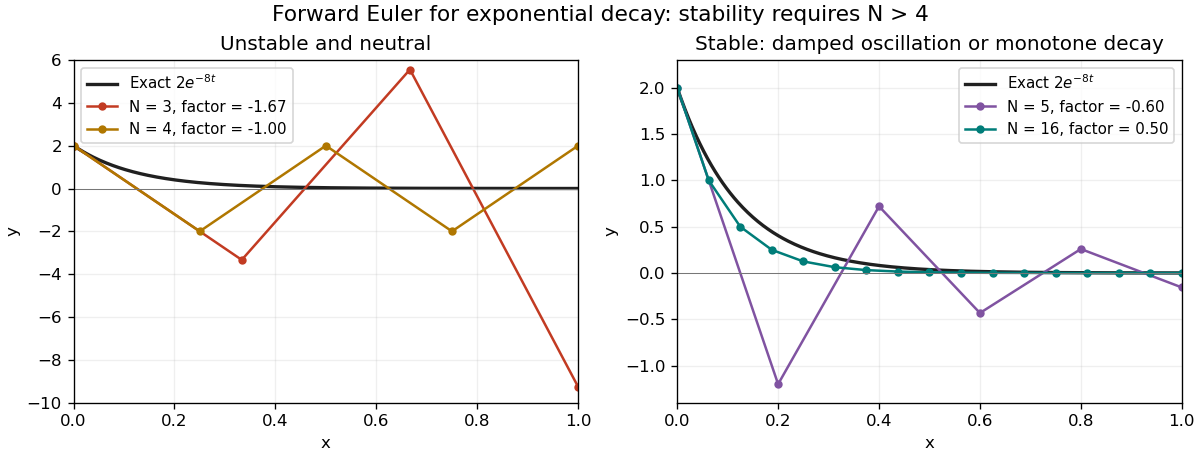
Forward Euler approximation to exponential decay: instability, neutral oscillation, and stable decay
. Details. 
Articles by others on the same topic
There are currently no matching articles.