The set difference consists of elements belonging to the first set but not the second:The symmetric difference consists of elements belonging to exactly one of the two sets:In particular, the two sets in this union are disjoint sets.
Every complement of a set is taken in the same universal set . Apply De Morgan's laws for propositional logic to the membership propositions. For every ,Equality of membership for every element proves the set identities
Using set difference as an intersection with a complement of a set, and using double negation, givesInterchanging the two sets simply interchanges the two terms of this union, whose commutativity gives
We use a double inclusion proof. First, let . If , then , since otherwise . Hence in this case . If , then , since otherwise . Hence in this case . This proves the first set inclusion.
Conversely, an element of belongs to neither nor . An element of also belongs to neither set difference. Thus every element of lies outside , proving the reverse set inclusion. Therefore
The identity function fixes every element, and function composition means applying the inner function first:
If , applying the function gives . Since , this implies , proving injectivity. Also every is the image of , because , proving surjectivity.
Take the functionThen for every real number , while . Thus it is an involution different from the identity function.
Seek an affine function . Its function composition with itself isEquating coefficients requires and . Because and , either choice or has . Thus two valid functions areSubstitution into verifies each answer. These provide the requested maps; no assumption that every possible solution is affine function is needed.
Try a linear function . The functional equation becomes for all , so must be a root of a polynomial . Its two roots of a polynomial giveFor either choice, proves the required equality directly. The positive coefficient is the golden ratio.
There are ordered selections without replacement. Each unordered -element subset occurs in exactly orders, so the binomial coefficient isOne precise specification of its domain, codomain, and map isHere , and includes the single empty selection. The actual values on are positive, so is also a valid codomain. For fixed , one can instead use the function with .
Apply the factorial formula for the binomial coefficients:For or , the same equality holds with the conventional zero value when the lower index exceeds the upper index.
For , the adjacent binomial coefficients obeySince and , the sign is determined by the numerator:The printed codomain is inconsistent with the displayed map: , and when is odd, . With the usual extension for , is a function , and for ; the positive range above remains unchanged. Without that extension, the natural domain is .[ref]
In the intended range , division by the positive binomial coefficient givesConsequently the intended remainder isThere is a necessary qualification to the printed unrestricted domain. If binomial coefficients outside are extended by zero, then every satisfies , regardless of . For example, satisfies the literal equality but has . Thus the literal extended-domain premise alone does not determine a remainder; the boxed conclusion requires , or equivalently here .
For adjacent binomial coefficients, the ratiois greater than when , equal to at , and less than afterwards. For odd , the row is therefore increasing up to its two equal central entries and decreasing after them. The maximum is attained exactly atThey are distinct, including when , so is not unique. This is the unimodality of binomial coefficients.
We prove Cassini's identity by mathematical induction. At ,Suppose . The Fibonacci recurrence gives and henceThe induction proves
For a nonzero geometric sequence, substitute into the linear recurrence and cancel :The characteristic equation of a linear recurrence therefore has rootsThe zero sequence is a degenerate solution for any for which the displayed expression is defined. A nonzero sequence with cannot satisfy the recurrence at , since it would require .
The linearity of the Fibonacci recurrence allows a linear combinationThe initial conditions give and . Since , we obtain and . Thus Binet's formula is
If it holds at and , then the Fibonacci recurrence givesThe identities and turn the numerator into . Thus
For functions , big O notation meansUsing the natural logarithm and exponential function, . Since , for every we have . The witnesses therefore prove
Suppose the definition of big O notation held with constants . Choose an odd integer . At this input, and , so the required inequality would be , a contradiction. ThusThe infinitely many even inputs, where , cannot repair the failure on odd inputs because the bound must hold for every sufficiently large input.
A direct mathematical induction proves . The base cases and hold. If the bound holds at and , then the Fibonacci recurrence givesThus the definition of big O notation holds with , proving
The Euclidean division gives with and . Writing givesSince is an integer, this proves the divisibilityincluding .
The greatest common divisor is the largest positive integer dividing both inputs:This maximum exists because belongs to the set and all its elements are at most .
Write using the Euclidean division. If and , then . Conversely, if and , then . Therefore and have exactly the same positive common divisors, provingFor , this agrees with .
Set . At each iteration with , compute the remainder , then setStop at the first index with and return . The positive second coordinates strictly decrease, so algorithm termination follows from the well-ordering principle. The equality of greatest common divisors established in (ii) is a loop invariant, and at termination it gives
Consider one iteration with and . If , then . If , the quotient is , so . In either case , whenceRepeated application, or mathematical induction, provesThis also holds for the final iteration, whose left side is zero. For zero iterations the correct relation is equality , rather than a strict inequality.
Count the final division producing zero as an iteration, and let the total be . The terminal product alone gives no useful bound. Instead apply (i) to each nonterminal product, which is a positive integer and hence at least .
If , the penultimate product satisfiesAs is an integer, this impliesFor , the same bound holds since implies . In particular the Euclidean algorithm uses divisions, in big O notation. The convention that includes the final zero-producing division explains the one-step offset in the argument.
The second coordinate after two iterations satisfieswhenever those two divisions are needed, by the same remainder bound, now applied to . Let . If the Euclidean algorithm has not already stopped after iterations, then its positive second coordinate is at most : for ,For the original is already . A second coordinate of requires just one more division. ConsequentlyThis removes dependence on the potentially much larger input . It improves the scale to one involving only the smaller input; the rounded numerical bound need not be smaller for every pair. One may always take the minimum of the bounds in (ii) and (iii).
Assume the homogeneous function is differentiable. Applying the multivariable chain rule to gives, for near ,Setting proves Euler theorem for homogeneous functions:Only positive near are needed, so the derivation remains valid even when a noninteger makes the printed phrase “all real ” require qualification.
The linear ordinary differential equation has differential operator . Put and use the product rule twice:Substitution cancels the and terms, leaving . Two integrations give . Hence the general solution isThe two arbitrary constants account for the order of the differential equation; the factor in the particular term reflects the repeated root of the characteristic polynomial.
On an interval with , set . The product rule gives , and substitution givesThis is a separable differential equation. Since for real , separation loses no real constant solution:Thus the general solution on any interval avoiding zero and the poles of the tangent function isAt the original differential equation forces , but no real solution from this family extends over a whole interval through zero: encounters infinitely many poles as .
For , write the linear ordinary differential equation asAn integrating factor on each interval avoiding is ; multiplication by a nonzero constant, including a sign, is immaterial. ThereforeThe partial fraction decomposition isIntegrating gives the general solutionThe constant is independent on each connected interval of definition. At the singular points the undivided differential equation forces and . The displayed family tends to these values, but its derivative has a logarithmic divergence there, so no member extends as a differentiable function through either singular point.
The chain rule givesThe exponential function never vanishes, so all critical points areIn particular .
Use the Taylor series with . Since begins at cubic order and begins at sixth order, through cubic terms the Taylor series isThe linear and quadratic coefficients are zero. The stronger remainder , in big O notation, follows because the fourth-order term is also zero; the next term is .
Near zero, has the sign of , so just to the left and just to the right. Thus the critical point is neither a local minimum nor a local maximum. Moreover the Taylor series gives , which changes sign at zero. ThereforeThis is the point called a “saddle point” in the question; stationary inflection point specifies the one-variable meaning.
Solving the linear ordinary differential equation and imposing the initial condition givesAs , the requested limit is
Let , , and let approximate . The forward Euler method gives the difference equationThis geometric sequence has solutionFor fixed , the limit as is , as required by the exact solution.
The amplification factor is . To reproduce decay, the forward Euler method requires , equivalentlyAt , and the approximations alternate with constant magnitude ; for , and the magnitude grows. This is the condition of absolute stability for this decaying differential equation.
Stability is only a minimum requirement. Values just inside the bound can still give a poor endpoint approximation; resolving the decay accurately generally requires a smaller step size. If positivity at every step is desired, the stronger condition ensures . The figure shows the difference between decay of the exact solution and numerical oscillation.
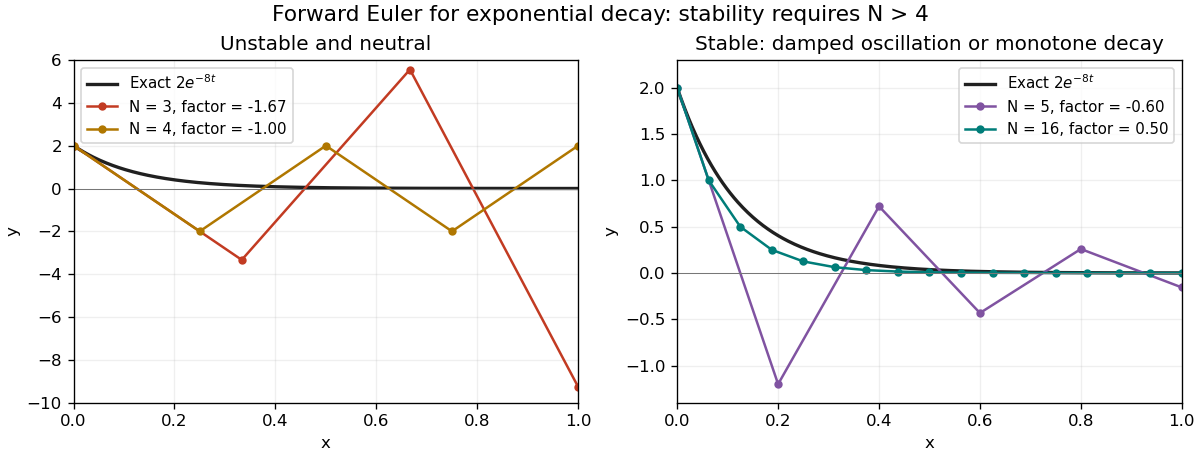
Forward Euler approximation to exponential decay: instability, neutral oscillation, and stable decay
. Details. 
For positive edge lengths the volume is and the surface area constraint is . Introduce a Lagrange multiplier :The stationary point equations areMultiplying these by , respectively, and equating their left sides gives and . Because all edge lengths are positive, the equations imply ; hence . The constraint gives .
To establish a global maximum, rather than only a stationary point, apply the arithmetic-geometric mean inequality to :Equality holds exactly when , or . Therefore
Articles were limited to the first 100 out of 166 total.
Articles by others on the same topic
There are currently no matching articles.