False. Take two vertices with both directed edges, and start depth-first search at . The timestamps are , , , . There is an edge, hence a directed path, from to , but . Reaching a gray ancestor does not make the ancestor finish first.
False. Use only the directed edge , but choose first in the outer loop of depth-first search. It finishes before a second discovery tree starts at : , , , . The edge supplies the required directed path and , yet . A path to an already black vertex need not put the two vertices into one discovery tree.
False. Let the directed edges be , , and . Start depth-first search at and explore its neighbor before . ThenThe directed path exists and , but and are siblings in the discovery tree. An existing path may leave the current recursive branch via a gray ancestor and only later enter a different branch. The usual white-path condition would need all vertices of a suitable path to be white when is discovered; that condition is absent here.
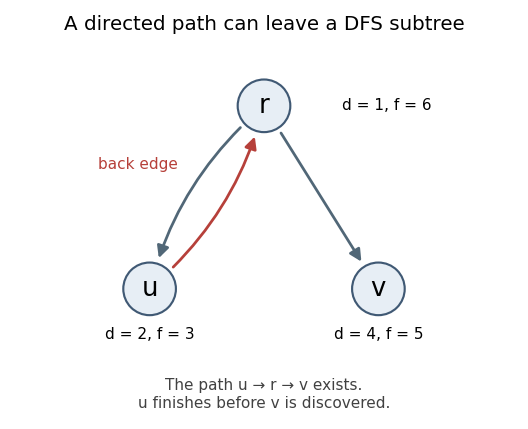
A directed path crosses from an earlier DFS branch to a later branch through the root; node labels give discovery and finishing times
. Details. 
False for directed distance. Take four vertices . Put both directed edges between every distinct pair in , and add and . Every vertex has out-degree two, satisfying , and there are no self-loops. Nevertheless no directed path leads from any of to , so the claimed finite upper bound on graph distance fails.
If “connected” means weakly connected, that portion does follow: a weak component of size gives each of its vertices out-degree at most , so each component would have size at least , making two components impossible. It does not imply a strongly connected directed graph. Thus either the strong-connectivity interpretation fails outright or the weak interpretation leaves the distance assertion false; the complete claim is false in either case.
Articles by others on the same topic
There are currently no matching articles.