Source release: Oxford examination archive, member
a10101w1.pdf. The held cover identifies the regular 14 June 2018 examination. Every printed option is treated below.Use a Moore machine whose state records the longest suffix of the received stream that is also a prefix of the target word. The transitions areThe last row preserves overlap: after recognition, one more one leaves suffix , giving . Initialize to and update the state on each active clock edge; the output after that edge reports whether the word has just ended. This is a prefix-suffix sequence recognizer.
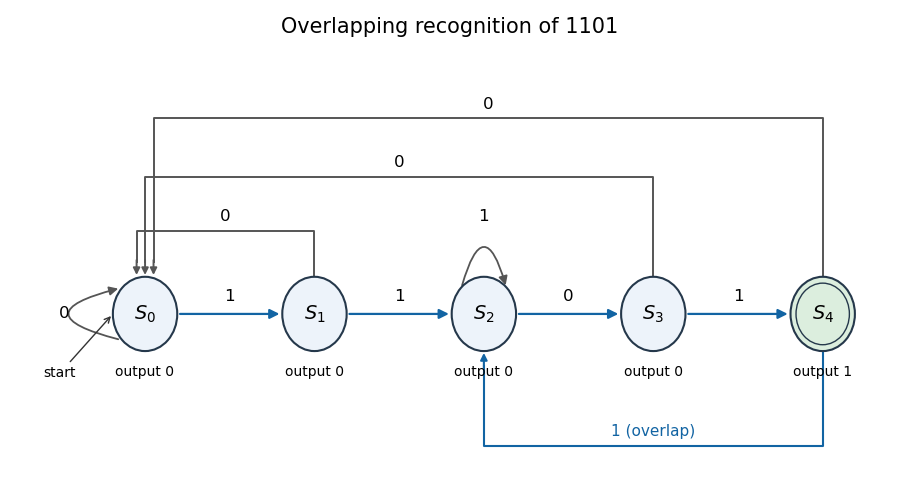
State transitions of the overlapping Moore machine recognizer
. Edge labels are input bits. Only the shaded, double-ring state produces output one. Details.
Five distinct states require three D flip-flops, since . Choose the state encoding equal to the three-bit binary expansion of . Write the present bits as , in decreasing significance. The state transition table isThe dashes are don't-care conditions for minimizing the logic. They do not prescribe what the actual circuit will do in those unused states; part (e) determines that from the chosen equations.
With the encoding in part (b), is a valid Moore machine output equation. Among reachable states, exactly at . This uses unused output-table entries as don't-care conditions. If one instead wants the output to be zero in every unused state, use ; that extra requirement does not change any output from a valid state.
Use four-variable Karnaugh maps with rows and columns , both in Gray code order. A dash denotes an unused present state. The maps for the three next-state bits areFor , join its sole one with the dash directly below it. For , use the four-cell groups and , and the two-cell group ; the last group wraps between the top and bottom rows. For , join the one at row , column to the dash below it; the one at row , column is isolated. These prime implicants giveHere products mean Boolean conjunction and sums mean Boolean disjunction. The inputs are the desired next-state bits of the three D flip-flops. The equations are independent of the unused values except for the explicitly chosen Karnaugh map groups.
Evaluate the implemented equations from part (d), rather than the don't-care entries of the original table:States and enter a valid state after one edge. State does so after one edge for zero, or moves to and enters a valid state on the following edge for either next input. Thus every unused state recovers within at most two clock edges, independently of the incoming bits. The machine cannot become trapped there. This self-starting finite-state machine property does not guarantee meaningful recognizer output during recovery; initialization to still establishes the intended stream history.
The internal Boolean functions are , , , and . Put the falling edge of at . Since throughout, throughout. The remaining transitions, including every stated propagation delay, areThe inverter delays the rise of by ten nanoseconds, and the AND gate adds another ten. Consequently and are simultaneously zero for ten nanoseconds. This gap propagates through the two OR gates. The output has a static-one logic hazard: a low glitch on ns, despite its equal initial and final logical values.
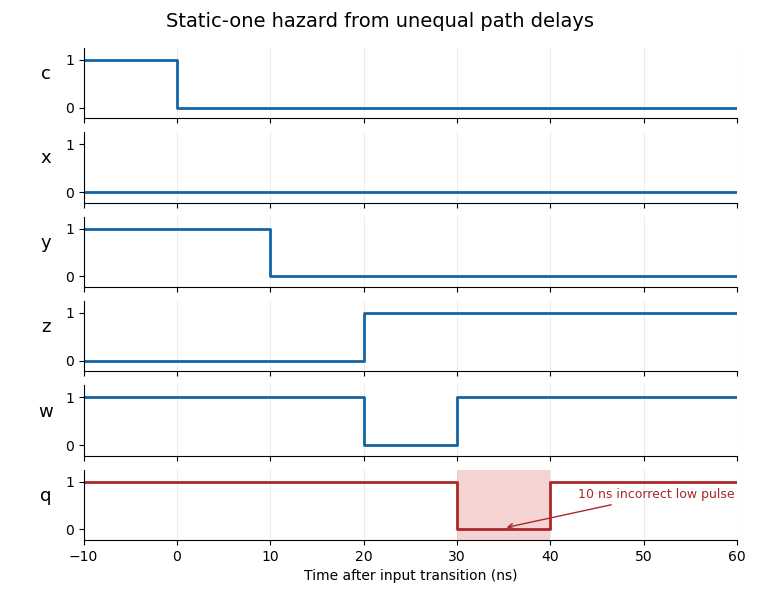
Delayed transitions produce a ten-nanosecond static-one logic hazard
. The shaded interval marks the incorrect output pulse. Exact ten-nanosecond gate delays are used, including propagation of the pulse. Details.
The steady-state output is . Its Karnaugh map, with rows and columns in Gray code order, isThe existing prime implicants cover adjacent ones except for some transitions in . The consensus theorem supplies the two missing bridging implicants and , givingBoth are needed in a hazard-free sum of products retaining the original terms. At , the two values of require a common implicant, necessarily covered by ; at , the corresponding transition requires . Neither bridge covers the other's critical edge. All other adjacent-one pairs already share a term. Thus two is the least number of additional prime implicants. This addresses single-input static hazards; simultaneous input changes require separate analysis.
To implement the two additional prime implicants explicitly, add two 2-input AND gates and two 2-input OR gates. Reuse from the existing inverter. An OR-tree arrangement that keeps the maximum propagation delay at 40 ns isThe five product gates feed four OR gates; the original circuit already supplied three of the product gates and two OR gates. From the primary inputs, and settle by 10 ns, so settles by 20 ns. The two products in and the product settle by 20 ns, so and settle by 30 ns, and by 40 ns. In particular, no increase in worst-case delay is necessary. Merely appending two OR gates to the old output would unnecessarily lengthen some paths.
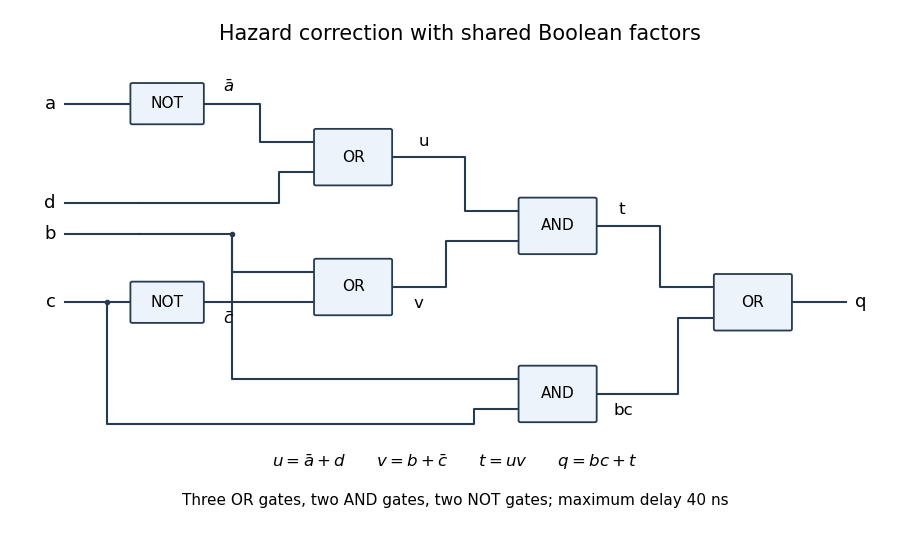
If arbitrary rewiring and factoring are allowed, an even smaller added-hardware implementation isExpanding this expression gives all five terms from part (b). It needs three OR gates, two AND gates and the existing two inverters: add one OR gate, reuse two existing AND gates and leave the third unused. Both and settle by 20 ns, by 30 ns and by 40 ns. During a potentially hazardous change of , the bridging condition holds regardless of ; zero-to-zero cases keep either both zero or all relevant products steadily zero. The factored circuit therefore retains single-input hazard protection. The four-gate count above is the minimum when the two extra product implicants are required as separate AND outputs; factoring changes that implementation constraint.

Removing logic hazards prevents transient false control pulses, incorrect triggering of asynchronous state changes and avoidable switching activity. It also makes behavior less sensitive to unequal propagation delays. These benefits matter especially when an output directly controls another circuit rather than being sampled only after settling.
The usual costs are redundant logic gates, larger area and capacitance, more wiring and possibly a longer critical path. Power can rise from extra hardware even when glitch power falls. A synchronous design may instead sample after a sufficiently long clock period, trading settling time against additional hazard-correction logic. A circuit proved free of single-input static hazards need not be safe under arbitrary simultaneous input changes; metastability at an asynchronous input is a different problem.
Fetch the MIPS instruction at the program counter, and compute . The opcode selects an MIPS R-type instruction; register-file read addresses and select the two operands. The function field selects ALU addition. The result returns through write-back multiplexer input zero to destination , and the next program counter is .
Using the diagram's actual selector encodings, the control signals areHere means decode the function field; means add and means subtract. The source's is a two-bit control: the branch-taken output is . With , is immaterial; zero is a convenient concrete setting. No data-memory access occurs.
Fetch and decode the MIPS I-type instruction, read and , and subtract their values in the arithmetic logic unit. The zero flag is one exactly when they are equal. The branch target isThe branch selector chooses that target when and make the diagram's condition equal to . Otherwise it chooses . Neither registers nor data memory are written. The control signals areDashes are don't-care conditions because register write enable is zero. The immediate goes to the branch-target adder, while the main ALU's second input remains the value in .
For the semantics stipulated by the question, write to register 31 and load the next from register . Read through register-file output . Select input two of the next-PC multiplexer, which is already wired from . Select destination input two, already the constant register number 31, and write-back input two, already .
Thus the printed diagram already contains the necessary three-way multiplexers and wires. Extend the controller's opcode/function decoding to generateThe displayed and settings are arbitrary safe choices for an unused result. No additional datapath hardware or control field is required beyond decoding this instruction into the existing values. This uses the question's explicitly specified link convention.
Use the stipulated MIPS I-type instruction encoding, whose unused field is zero, so register-file output supplies the hardwired zero register. With and subtraction selected, the arithmetic logic unit computes . Its zero flag detects , while bit 31 of is the sign in two's complement. Therefore the required signed test isIntroduce one new control bit , and replace the zero-flag input to the existing branch XOR byThis needs an AND gate, an OR gate and a tap of the sign bit. With , existing branch behavior is unchanged. With and , the existing branch-taken circuit gives , exactly the positive test. Its output still selects between and the usual sign-extended branch target. The complete control row isSet for each instruction in parts (a)–(c). Registers and data memory remain unchanged. The available signed
slt operation could support a different design; the sign-and-zero design above avoids adding an ALU-input swap and explicitly distinguishes zero from positive values.Over the underlying field , the row space is the linear span of the row vectors of , a vector subspace of . The column space is the linear span of its column vectors, a vector subspace of . The null space isa vector subspace of the domain. The column space is the image of a linear map represented by ; the null space is its kernel.
Gaussian elimination givesElementary row operations preserve the row space, so is a basis. The two rows are linearly independent because their first two coordinates form the standard basis of .
The pivot columns of the reduced matrix in part (i) are columns one and two. Select those columns of the original matrix, giving the column-space basisThey are independent, for example their first two entries have determinant . The remaining original column is the first plus twice the second. Taking the reduced matrix's columns instead would generally give the wrong column space.
The reduced equations are and . Thus the null space is the lineThe nonzero spanning vector gives a one-element basis, so the nullity is one.
Reducing the augmented matrix givesThere is no contradictory row. Hence the system is consistent, with affine solution spaceThe three planes intersect in this common line. Their normals span a two-dimensional row space, leaving a one-dimensional common direction, the null space. More explicitly, five times the first equation minus eleven times the second plus twice the third is the zero equation, including the right-hand side; the third plane therefore contains the intersection of the first two.
The rank of is the dimension of its column space, equivalently the dimension of its row space or the number of pivot columns in a row-echelon form. For an matrix it lies between zero and .
Each elementary matrix is obtained by applying one invertible elementary row operation to the identity matrix. Its inverse is the elementary matrix for the reverse operation. A product of elementary matrices is therefore invertible and has full rank .
Conversely, if , Gaussian elimination has a pivot in every column and reduces to the identity. Writing the successive row operations as left multiplication gives . Hence , a product of elementary matrices. This proves both directions of the elementary-matrix factorization theorem.
False. In the real vector space , both and are bases: each is linearly independent and spans the whole space. A basis need not be a unique set. What is fixed for a finite-dimensional vector space is the number of basis elements, its dimension.
True. Existence follows because the basis spans . If , subtract to get . The basis vectors' linear independence forces every , proving uniqueness. For an infinite basis, both representations have finite support, so the same argument applies to their finite union. These coefficients are the coordinates relative to a basis.
Transpose both inverse identities, using reversal of multiplication under matrix transposition:Thus , by uniqueness of the matrix inverse.
Let column of be , so . Every diagonal entry of the invertible lower triangular matrix is nonzero, since its determinant is the product of those entries. In row one through row , the right-hand side is zero. Forward substitution first gives , then , and successively for all . These are precisely the entries above the diagonal in column of . Every column satisfies this, proving that is lower triangular. This is triangularity of an inverse matrix.
If is an invertible upper triangular matrix, is invertible and lower triangular. Part (ii) makes lower triangular, while part (i) identifies it with . Transposing gives that is upper triangular. This deduction uses both the inverse-transpose identity and the lower-triangular result.
Gaussian elimination givesThe first two original columns form an image basis:Their independence follows already from their third and first coordinates. The third column is twice the first plus the second, and the fourth is the first plus twice the second, so they span every output of .
The rank-nullity theorem states for a linear map from a finite-dimensional vector space . Here the domain has dimension four and the image has dimension two. Thus . For example, a kernel basis is , as follows from the reduced equations.
A linear map is onto, or surjective, when every equals for some ; equivalently its image is all of . Here is not onto, because its image has dimension two while its declared codomain has dimension three. Indeed every image vector satisfies , so, for example, is not attained.
A linear map is one-to-one, or injective, when equal outputs imply equal inputs. Equivalently its kernel is : subtracting inputs converts equality of outputs to a zero output. Here is not one-to-one, since its kernel has dimension two. Concretely, for distinct inputs.
For independent columns in a real inner product space, the Gram-Schmidt process recursively formsEach subtracts the orthogonal projections onto earlier normalized vectors. Their independence ensures . The resulting are orthonormal and preserve the span of every initial column set. Putting and for , with zeros below the diagonal, gives a QR decomposition with . Dependent input columns require omitting a zero residual or treating rank deficiency separately.
The first column has norm two, giving . Its inner products with the second and third columns are both one. Subtracting from the second column leaves , of norm three, so . The inner product of with the third column is one. Subtracting from that column leaves , of norm two. Thus the Gram-Schmidt process givesThe columns of have unit norm and pairwise zero inner products, so . Direct multiplication verifies .
A unit vector along the line is . Reflection fixes its component parallel to and negates its perpendicular component, so the reflection matrix isIndeed , and . These characterize the orthogonal reflection in that line.
The line passes through and has the same direction as in part (i). Translate by , reflect by , then translate back. In homogeneous coordinates the affine reflection isAct on column , reading the product from right to left. Every point with is fixed. The translation column is , as for any reflection in an affine hyperplane.
At , the linear-system residual is . Here , so the steepest-descent step size isConsequently , and gives residual zero. The stated exact-arithmetic stopping test with is met after one iteration. Stop there rather than trying to evaluate the next, undefined step. This is the special case where the initial residual is an eigenvector.
No, except when started at the exact solution. Merely failing the usual symmetric positive-definite matrix hypothesis would not by itself prove divergence. For this particular matrix one can prove that every defined nonzero-residual step increases the linear-system residual norm.
Write , put and . For , direct substitution into the stated iteration givesFor , bothare strictly positive; completing squares gives and . Hence and the residual norm strictly increases at every defined step. If before the residual vanishes, the algorithm is instead undefined. Neither behavior converges to residual zero. The matrix is invertible, so this also rules out convergence of the iterates to its unique solution.
For example, from the zero starting guess the first two step sizes are and , giving and . This demonstrates the failure without treating a sufficient convergence theorem as a necessary one. The general calculation is residual growth in an indefinite steepest-descent iteration.
The reductio ad absurdum rule discharges an assumption from a derivation of contradiction and concludes . It is derivable using negation introduction followed by double-negation elimination:Conversely, if RAA is supplied, double-negation elimination follows from this natural deduction derivation:Thus replacing double-negation elimination by RAA leaves these classical deductions available. RAA is not being assumed as an intuitionistic rule.
1. ¬¬φ                  premise
2.   ¬φ                 assumption [i]
3.   ⊥                  ¬E, 1, 2
4. φ RAA, 2–3, discharging [i]Use disjunction introduction, negation introduction and conjunction introduction in the following natural deduction proof. Indentation marks the assumptions discharged at their closing lines.The two separate temporary assumptions establish the two required negations; neither is retained in the conclusion.
1. ¬(φ ∨ ψ)             premise
2.   φ                  assumption [i]
3.   φ ∨ ψ              ∨I-left, 2
4.   ⊥                  ¬E, 1, 3
5. ¬φ                   ¬I, 2–4, discharging [i]
6.   ψ                  assumption [j]
7.   φ ∨ ψ              ∨I-right, 6
8.   ⊥                  ¬E, 1, 7
9. ¬ψ                   ¬I, 6–8, discharging [j]
10. ¬φ ∧ ¬ψ ∧I, 5, 9This instance of Peirce's law uses the supplied classical double-negation elimination rule. First derive while assuming , using explosion inside a further temporary assumption.This is a formal natural deduction proof from exactly the given premise; no unproved excluded-middle lemma is needed.
1. (P → Q) → P          premise
2.   ¬P                 assumption [i]
3.     P                assumption [j]
4.     ⊥                ¬E, 2, 3
5.     Q                ⊥E, 4
6.   P → Q              →I, 3–5, discharging [j]
7.   P                  →E, 1, 6
8.   ⊥                  ¬E, 2, 7
9. ¬¬P                  ¬I, 2–8, discharging [i]
10. P ¬¬E, 9Write the new exclusive or connective as . Give it the two introduction rulesand the elimination ruleIn elimination, discharge the two pairs of case assumptions; retain the assumptions needed for the major premise and the shared context . These are natural deduction rules for exactly one of , not merely at least one.
For a syntactic check, derive from by : in the first case introduce and then the left disjunct; in the second case introduce and then the right disjunct. Conversely, from that disjunction use disjunction elimination; conjunction elimination extracts in the first branch and in the second, so the respective introduction rule yields in both. This proves equivalence to the ordinary truth-functional specification and explains both the introduction and elimination rules.
Use the exclusive-or natural deduction rules defined in part (i). The only extra lemma needed is double-negation introduction, derived from the given rules by assuming under , obtaining contradiction, and discharging that assumption. The full proof incorporates that derivation:In the first case the second introduction rule is instantiated with right operand . In the second case the first introduction rule requires , which is exactly the derived line 10.
1. ¬P ⊕ Q               premise
2.   ¬P                 first ⊕E case assumption [i]
3.   ¬Q                 first ⊕E case assumption [j]
4.   P ⊕ ¬Q             ⊕I₂, 2, 3
5.   ¬¬P                second ⊕E case assumption [k]
6.   Q                  second ⊕E case assumption [l]
7.   P                  ¬¬E, 5
8.     ¬Q               assumption [m]
9.     ⊥                ¬E, 6, 8
10.  ¬¬Q                ¬I, 8–9, discharging [m]
11.  P ⊕ ¬Q             ⊕I₁, 7, 10
12. P ⊕ ¬Q              ⊕E, 1, 2–4, 5–11,
discharging [i], [j], [k], [l]A fresh variable is an arbitrary eigenvariable whose value is not constrained by the undischarged assumptions. For universal introduction, it must not occur free in those assumptions; otherwise a fact about one constrained object could be incorrectly generalized to all objects. For existential elimination, its temporary witness must additionally not occur free in the conclusion or in other undischarged assumptions outside the witness subproof. Choosing a completely unused variable is a sufficient convention. These are the eigenvariable conditions, and concern free occurrences rather than harmless reuse of bound names.
Articles were limited to the first 100 out of 458 total.
Articles by others on the same topic
There are currently no matching articles.