At low northern latitude, a simple induced total-field magnetic anomaly is generally asymmetric and bipolar, not a symmetric central positive peak. A compact body more magnetic than its surroundings, magnetized parallel to a northward, downward ambient field, gives its principal positive lobe on the southern side and a negative lobe toward the north. At exactly zero magnetic inclination its central anomaly reverses relative to the pole; latitude and survey orientation must therefore be included.[ref]
Magnetic line profiles by UBC Geophysical Inversion Facility. Line-profile examples 1–5: latitude, profile orientation and remanence effects
For an original explicit sketch, put a dipole at depth and let increase northward. In a north–south vertical section with inducing inclination , an induced magnetization parallel to the ambient field givesA geocentric-dipole approximation at latitude gives , only an illustrative field direction, not a measured local value.
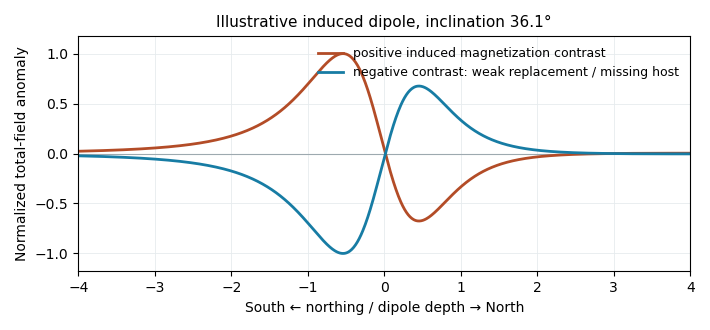
Original induced-dipole profiles: a positive magnetic body and an excavated or weakly magnetized replacement give opposite signs at the same field inclination
. Details. 
For the actual crater, breccia, water and sediment may replace more magnetic basalt, giving negative magnetization contrast. In that case reverse the simple positive-body sketch: a dominant southern low and a northern high are possible even with purely induced contrasts. The magnetic sign cannot be inferred from density or from the word “crater” alone.
Articles by others on the same topic
There are currently no matching articles.