Section C: Geophysical Methods.
A gravity anomaly is measured gravity minus a specified reference gravity after the stated reductions. A Bouguer gravity anomaly aims to remove the predictable effects of latitude, observation elevation and surrounding topographic mass, so residual variations can be related to subsurface geophysical density contrasts.
Measure relative gravity with a calibrated gravimeter at stations across and beyond the crater, and survey station positions and elevations accurately, preferably with GNSS tied to a reference datum. Repeat a base station through the day to estimate instrument drift and tie the traverse to a gravity datum. Record station times, because tidal and drift corrections are time dependent.
Apply instrument scale and drift corrections, solid-Earth and relevant ocean-loading tidal corrections, latitude/reference-ellipsoid gravity subtraction, the free-air correction, the Bouguer slab correction for material between station and datum, and a terrain correction for departures from a flat slab. The crater’s strong relief makes the last correction important. A local regional-field/background estimate is also needed if the target is the crater’s residual anomaly. State the reduction density; it is not the inferred breccia density.[ref]
Geophysical Data Grids for the Conterminous United States by United States Geological Survey. Gravity-anomaly discussion: latitude, free-air, simple Bouguer and terrain reductions
For a fixed land traverse there is no moving-platform Eötvös correction to add.Treat the quoted anomaly as the response of a slab of thickness replacing host rock. The Bouguer slab formula applies to the geophysical density contrast, not the absolute density:With , m and ,Thus in the slab approximation. The negative anomaly requires less dense infill. A finite bowl has a different geometric response, and water, post-impact sediment and the regional baseline can matter; the stated calculation is the requested slab estimate. The plotted minimum appears closer to mGal, but the numerical instruction explicitly supplies mGal and controls this calculation.
Collect a magnetic survey along the traverse with a calibrated total-field magnetometer, recording time, accurately surveyed position and sensor height. Extend observations beyond the crater to establish the background, repeat stations or tie lines to test consistency, and use a stationary base-station magnetometer to monitor temporal field changes. Keep the instrument away from vehicles, fences and magnetic equipment; map unavoidable cultural sources rather than treating them as geological signals.
Correct instrument offsets and heading effects where applicable, remove measured diurnal variation, reject or separately treat magnetic-storm intervals, and subtract the appropriate large-scale geomagnetic field at the survey epoch. Level overlapping traverses and state whether a local regional trend has also been removed. Unlike gravity, there is no universal rock-independent Bouguer correction for magnetic topography: a magnetic topographic effect needs a model of terrain and magnetization.
Measure representative magnetic susceptibility and remanent magnetization on oriented rock samples to interpret the profile. Total field alone does not tell whether a contrast comes from induced or remanent magnetization, crater excavation, or strongly magnetic material in the infill.
At low northern latitude, a simple induced total-field magnetic anomaly is generally asymmetric and bipolar, not a symmetric central positive peak. A compact body more magnetic than its surroundings, magnetized parallel to a northward, downward ambient field, gives its principal positive lobe on the southern side and a negative lobe toward the north. At exactly zero magnetic inclination its central anomaly reverses relative to the pole; latitude and survey orientation must therefore be included.[ref]
Magnetic line profiles by UBC Geophysical Inversion Facility. Line-profile examples 1–5: latitude, profile orientation and remanence effects
For an original explicit sketch, put a dipole at depth and let increase northward. In a north–south vertical section with inducing inclination , an induced magnetization parallel to the ambient field givesA geocentric-dipole approximation at latitude gives , only an illustrative field direction, not a measured local value.
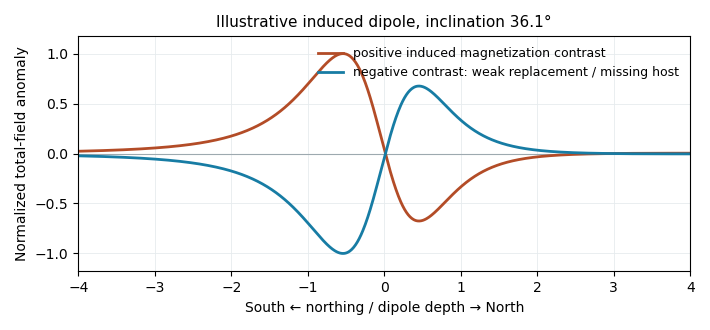
Original induced-dipole profiles: a positive magnetic body and an excavated or weakly magnetized replacement give opposite signs at the same field inclination
. Details. 
For the actual crater, breccia, water and sediment may replace more magnetic basalt, giving negative magnetization contrast. In that case reverse the simple positive-body sketch: a dominant southern low and a northern high are possible even with purely induced contrasts. The magnetic sign cannot be inferred from density or from the word “crater” alone.
The supplied south–north profile has a large southern/interior negative trough and a sharp positive peak toward the northern rim. That is opposite to the simplest positive, presently induced magnetic body in question 5(d). It therefore does not justify interpreting the crater as a concentration of strongly magnetic meteorite material.
A negative magnetization contrast from replacing magnetic basalt already reverses the simple induced-body response. In addition, the target Deccan Traps can retain strong remanent magnetization whose direction differs from the present geomagnetic field; crater excavation and rim geometry then produce a strong magnetic topographic effect. Rock-magnetic measurements and forward modelling distinguish these contributions. A primary study of this crater attributes most of its anomaly to magnetized target basalts and topography, with a comparatively small contribution from the breccia and post-impact sediment.[ref]
The curve alone is not a unique diagnosis of reversed polarity, impact-induced magnetization or a buried iron mass. The physical conclusion supported by the comparison is that a positive induced-body model is inadequate; inherited target-rock magnetization, its removal and geometry must be modelled.
Articles by others on the same topic
There are currently no matching articles.