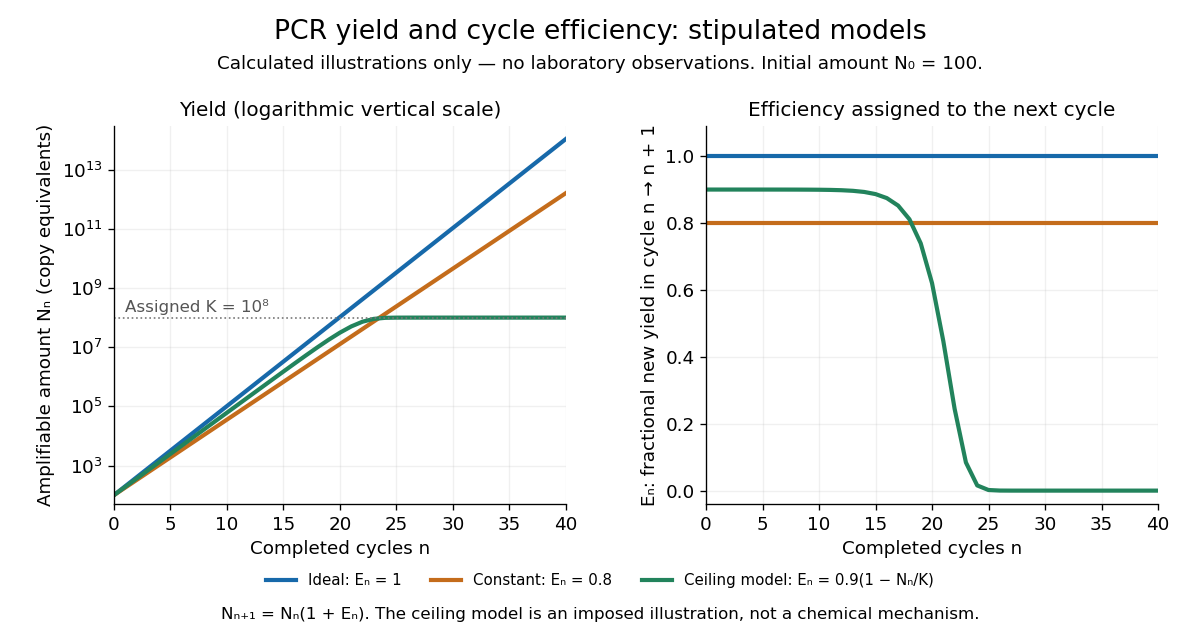
For a stipulated population of amplifiable copies, let be the amount after cycle and define PCR efficiency by the fractional new yieldHere means one additional copy per existing copy, hence ideal doubling. If every cycle has the same PCR efficiency , the exponential growth model gives . Starting with copies, twenty ideal cycles give copies; the stipulated value gives about . An efficiency of 80 percent therefore means multiplication by 1.8 each cycle, not retention of 80 percent of the final ideal yield.

In the ideal strand-counting example, all duplex-equivalent material doubles, but exact-length amplicons lag initially. Starting from one longer duplex and retaining its two original strands, cycle contains exact-length strands out of total strands. Thus their fraction is : zero after cycle 1, one quarter after cycle 2 and one half after cycle 3. This counts strands rather than assuming every strand immediately finds an exact-length partner. The generic yield model above ignores this early distinction.
Articles by others on the same topic
There are currently no matching articles.