A plasmid is a DNA element capable of replication separately from the main chromosomes of its host. Engineered plasmids can carry genes for genetic transformation and functional complementation.
Genetic transformation introduces DNA into recipient biological cells. It can change their genotype and sometimes their phenotype; the yeast cross-species complementation experiment separates detecting introduction of a plasmid from detecting its functional effect.
Replica plating transfers samples from corresponding biological colonies or patches to several growth conditions while preserving their spatial arrangement. A master plate makes it possible to relate growth or failure at one location to the same source population on another plate.
A genome is the complete set of genetic information under discussion. For a cellular organism it is encoded in DNA, including genes and other sequences. Specify whether a comparison concerns a nuclear genome, a mitochondrion's genome or all cellular genetic material: the cell nucleus does not contain every DNA sequence in a typical eukaryote. See NHGRI: genome.
DNA sequencing determines the order of nucleotide bases in DNA. Sequence data can test molecular rearrangements, as in the functional plastid-to-nucleus gene transfer experiment, or support phylogenetics after a suitable sequence alignment.
A sequence alignment places nucleotide sequences or protein sequences in correspondence for comparison. The choice of corresponding positions affects evolutionary inference; matching a short stretch alone does not establish common descent of entire organisms.
The polymerase chain reaction amplifies a selected DNA region using repeated copying steps. Amplified material can be examined by DNA sequencing; appropriate template controls help distinguish a new rearrangement from material already present in the starting preparation.
The essential trick is to choose two PCR primers on opposite DNA strands with their extendible ends facing into the same interval. A DNA polymerase extends each PCR primer ; the resulting DNA can itself become a template. The amplicon is therefore selected by two opposed PCR primers, rather than by the DNA polymerase recognizing a named gene. This makes PCR amplification useful for inspecting one interval within a much larger genome. Here PCR means polymerase chain reaction; the statistical abbreviation PCR means principal component regression.[ref]
Polymerase Chain Reaction (PCR) by Addgene. Background Information: two primers, template-directed copying and product verification
For a deliberately tiny nucleotide sequence example, display the upper strand as . The left PCR primer is and binds the lower strand. The right PCR primer, written in its own -to- direction, is : the reverse complement of CAGC. It binds the upper strand and extends leftward in the drawing. With flanks outside this interval, the bounded amplicon contains base pairs, including both PCR primer sequences. These four-nucleotide PCR primers illustrate direction and counting only; they are not a proposed experimental design.
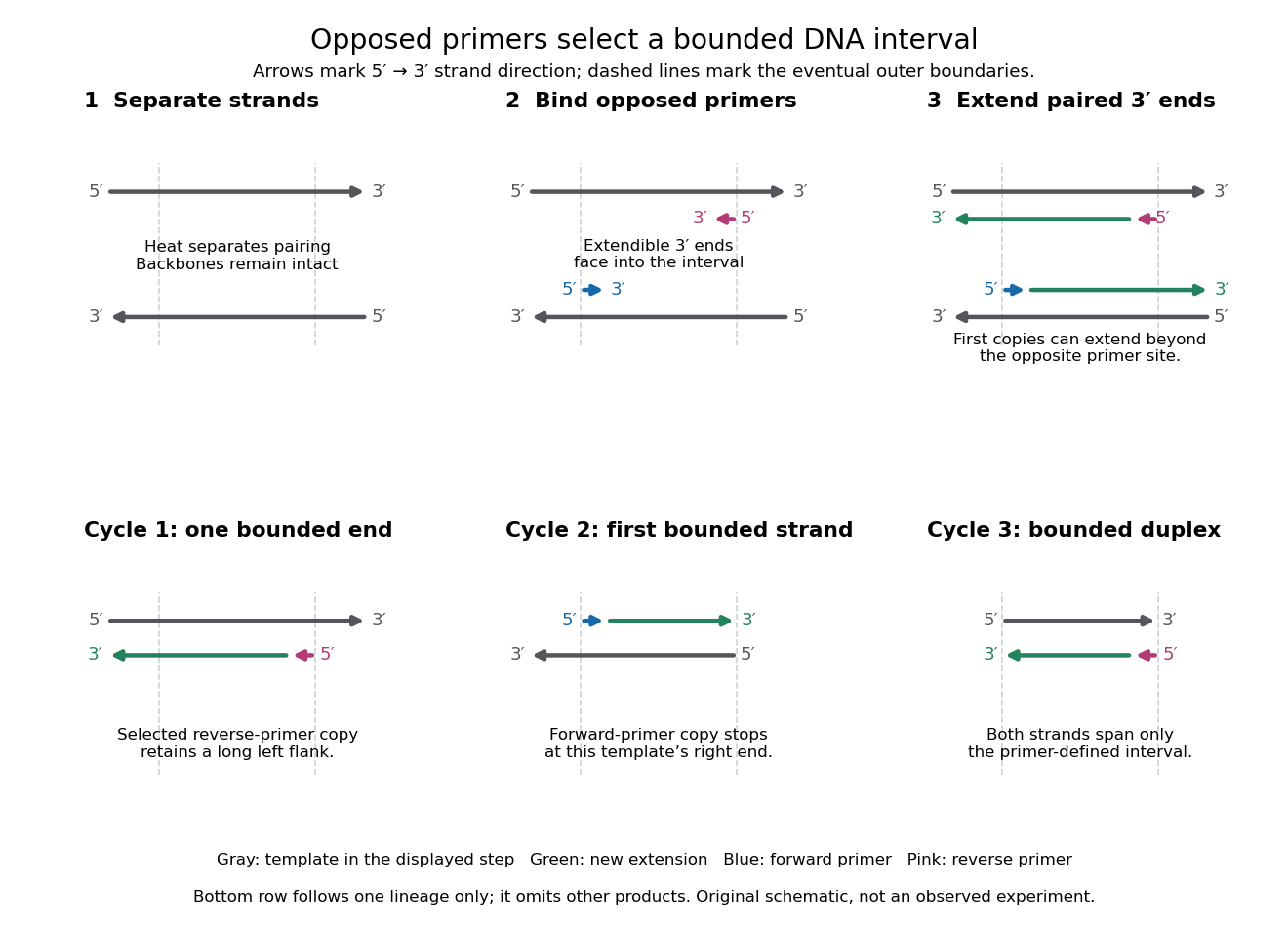
A PCR primer is a short DNA strand that supplies a paired end for a DNA polymerase. Its nucleotide sequence determines where base pairing can initiate copying. Matching a PCR primer at one site is insufficient: both PCR primers must support opposed extension across a copyable interval for sustained selective PCR amplification.
An amplicon is a nucleic acid product of amplification. In ordinary PCR amplification without added primer tails, its boundaries eventually correspond to the outer ends of the two PCR primer binding sites. First-cycle extensions on long starting templates can run beyond the opposite site; exact-length single strands appear in cycle 2 and exact-length duplex products in cycle 3 under complete extension. This explains why the bounded product becomes dominant even though the initial extensions need not have its length.
A PCR thermal cycle separates three jobs. During PCR denaturation, heating separates the paired DNA strands without intentionally cutting their phosphodiester bonds. During PCR annealing, cooling permits base pairing between PCR primers and templates. During PCR extension, the chosen interval supports DNA polymerase synthesis from the paired ends. Each new nucleotide is supplied as a deoxynucleoside triphosphate; its incorporation lengthens the strand. The DNA polymerase is a catalyst, while these nucleotides are consumed substrates.[ref]
Principles of PCR by Thermo Fisher Scientific. Principles of PCR, accompanying description: denaturation, annealing, primer-dependent extension and dNTP incorporation
Taq polymerase withstands repeated high-temperature strand separation better than a heat-sensitive DNA polymerase. Its extension activity still depends on temperature, buffer solution and magnesium ions. Heat resistance does not mean constant activity at every stage: the separation temperature serves the DNA, whereas the extension temperature serves the copying enzyme. As one institutional example, Addgene's Basic PCR Program specifies separation, primer binding and extension. These are example settings, not universal properties of all PCR primers or DNA polymerases.[ref]
Polymerase Chain Reaction (PCR) by Addgene. Basic PCR Program, steps 1–6; Materials List: Taq buffer with magnesium chloride
A thermal cycler changes the temperature of reaction tubes through a programmed sequence. A heated lid can reduce evaporation and condensation above the reaction. Instrument timing, sample temperature and nominal block temperature need not be identical.
For a stipulated population of amplifiable copies, let be the amount after cycle and define PCR efficiency by the fractional new yieldHere means one additional copy per existing copy, hence ideal doubling. If every cycle has the same PCR efficiency , the exponential growth model gives . Starting with copies, twenty ideal cycles give copies; the stipulated value gives about . An efficiency of 80 percent therefore means multiplication by 1.8 each cycle, not retention of 80 percent of the final ideal yield.
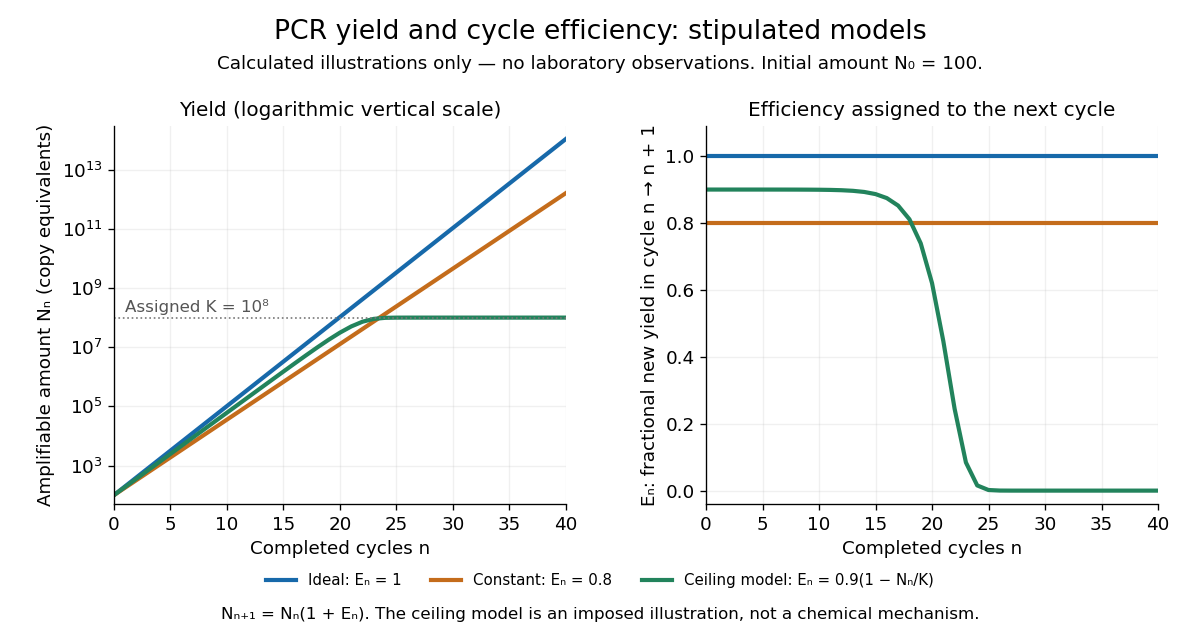
In the ideal strand-counting example, all duplex-equivalent material doubles, but exact-length amplicons lag initially. Starting from one longer duplex and retaining its two original strands, cycle contains exact-length strands out of total strands. Thus their fraction is : zero after cycle 1, one quarter after cycle 2 and one half after cycle 3. This counts strands rather than assuming every strand immediately finds an exact-length partner. The generic yield model above ignores this early distinction.
A PCR plateau is the late phase in which further cycles add little product. Depletion of substrates and accumulation of reaction by-products can reduce PCR efficiency. Consequently, similar final amplicon amounts need not mean similar initial template amounts. In the stipulated green model, implies , and growth approaches the imposed ceiling. That illustrates loss of starting-amount information without claiming to identify the limiting chemical process in an actual tube.[ref]
PCR Cycling Parameters—Six Key Considerations for Success by Thermo Fisher Scientific. PCR cycle number determination and Figure 7: lowered efficiency and plateau from reaction-component depletion and by-products
PCR specificity concerns whether the accumulated amplicon comes from the intended interval. Binding temperature, PCR primer nucleotide sequences and their possible alternative binding sites matter. Too permissive binding can support competing products; excessively restrictive binding can prevent the intended product. A band of the expected length is useful evidence, but unrelated nucleotide sequences can have the same length. DNA sequencing tests identity more directly, subject to mixtures and copying errors.[ref]
How to Design a Primer by Addgene. Primer Design for PCR: specificity, paired melting temperatures and complementary primer sequences
A primer dimer is an amplification artifact in which PCR primers provide extendible partners for one another. Its accumulation consumes substrates and may produce a signal even without the intended template. It is not evidence that the intended amplicon was present.[ref]
Why do I see amplification curves in my NTC samples? by New England Biolabs. FAQ: primer structures as DNA-polymerase substrates, and carryover PCR-product contamination
PCR controls are scientific controls that separate different explanations for a readout. A no-template reaction contains the PCR primers and copying reagents but replaces the added template with water or sample buffer. Amplification there can indicate carried-over DNA or a primer dimer; a clean result does not exclude contamination confined to one sample.[ref]
How can I distinguish non-template amplification (NTC) from real products? by New England Biolabs. FAQ: target-free control reactions and differing product sizes or melt profiles
Different comparisons answer different questions. A known amplifiable template tests whether the PCR primers, DNA polymerase and thermal cycler can produce the expected amplicon. An extraction blank follows sample preparation without adding the sampled material. A separate amplifiable interval in the sample can test whether recovered DNA supports copying, although success there does not guarantee success at the target. A length standard calibrates gel electrophoresis; it is not a control for the copying reaction. These comparisons are an analytical design extension to the teaching example below, not a claim that its student protocol includes every comparison.
The DNA Learning Center's Detection of an Alu Insertion Polymorphism by PCR by DNA Learning Center, Cold Spring Harbor Laboratory supplies a concrete length-based example. It collects mouthwash biological cells, concentrates them with a microcentrifuge, heats them by Chelex extraction and transfers the DNA-containing supernatant. Its reaction combines of that preparation with primer mix and a reagent bead in a thermal cycler. Thirty cycles use , and , each for thirty seconds. An electrophoresis chamber separates products by agarose gel electrophoresis in a 2 percent gel; a UV transilluminator reveals stained DNA.[ref]
Detection of an Alu Insertion Polymorphism by PCR by DNA Learning Center, Cold Spring Harbor Laboratory. pp. 2–3, Procedures I–III: extraction, 25 microlitre reaction, cycle profile, gel and UV readout
Its PCR primers flank an insertion site at the PV92 locus. The student protocol predicts a 715-base pair product with the Alu element and a 415-base pair product without it. Two bands support a heterozygous genotype; one corresponding band supports a homozygous genotype only if amplification and detection of both alleles were adequate. These are the protocol's expected readouts, not newly collected observations.[ref]
Detection of an Alu Insertion Polymorphism by PCR by DNA Learning Center, Cold Spring Harbor Laboratory. p. 1, Introduction: primer-flanked insertion and stated 715/415 bp genotype patterns
The instructor manual describes extra bands from nonspecific priming and a small diffuse primer dimer band. A missing target band therefore cannot on its own distinguish failed extraction, inhibited copying, poor binding or lack of the target. Nor does detection of the Alu element at this one genetic locus establish a complete genome, a unique personal identity or a clinical conclusion. The PCR controls help separate these possibilities; DNA sequencing can add sequence evidence to the size comparison.[ref]
Using an Alu Insertion Polymorphism to Study Human Populations by Dolan DNA Learning Center, Cold Spring Harbor Laboratory. printed pp. 18 and 29, Results and Discussion and Amplify DNA by PCR: primer dimer and nonspecific priming
RT-PCR combines reverse transcription with PCR amplification. The RT names the RNA-to-DNA step, not real-time observation. RT-PCR can have an endpoint readout. A matched preparation omitting reverse transcriptase tests whether contaminating DNA could account for amplification; it answers a different question from a no-template reaction.[ref]
Basic Principles of RT-qPCR by Thermo Fisher Scientific. One-step vs. Two-step RT-qPCR and Controls for RT-qPCR: minus-reverse-transcription control
Real-time polymerase chain reaction monitors fluorescence during cycling. With validated specificity, calibration and PCR efficiency, that record supports estimating initial template amount; this quantitative use is called qPCR. Ordinary endpoint PCR amplification examines accumulated product afterwards. qPCR need not start from RNA, and RT-PCR need not monitor fluorescence. Combining both operations gives RT-qPCR.[ref]
Real-Time PCR (qPCR) Basics by Thermo Fisher Scientific. Real-Time PCR Basics: amplification monitoring and quantification
RT-qPCR applies qPCR after reverse transcription. Differences in RNA recovery and conversion into Complementary DNA can affect its inferred starting amount as well as differences in PCR efficiency.
The 1993 Nobel chemistry announcement credits Kary Mullis with inventing the polymerase chain reaction method and states that the technique was first presented in 1985. The reusable-product principle explains its power: each successfully copied interval can help specify the next generation. The award attribution is a historical claim; it does not imply that every improvement in DNA polymerases, thermal cyclers or PCR controls came from one person.[ref]
Press release: The 1993 Nobel Prize in Chemistry by Royal Swedish Academy of Sciences. 13 October 1993 announcement, award citation and introductory account of PCR first presented in 1985
The PV92 locus is a genetic locus on human chromosome 16 used in the PV92 teaching experiment to compare the presence and absence of an Alu element.
An Alu element is a repeated DNA element; the PV92 teaching experiment examines one particular insertion site rather than amplifying every copy across the genome.
Chelex extraction releases DNA from heated biological cells in the presence of a resin that binds metal ions. The PV92 teaching experiment transfers the supernatant, leaving resin and debris behind.
Reverse transcription makes DNA from an RNA template using a reverse transcriptase. It reverses the template/product relationship of ordinary transcription, which makes RNA from DNA. The resulting Complementary DNA can supply a template for PCR amplification.[ref]
Basic Principles of RT-qPCR by Thermo Fisher Scientific. RNA as the Starting Material and Reverse Transcriptase Enzymes
Complementary DNA is DNA made from an RNA template by reverse transcription. When its template is mature messenger RNA, its sequence reflects the processed transcript rather than every intervening intron in the corresponding gene.
A Northern blot separates RNA by size and detects selected sequences through hybridization with a probe. Detection of a messenger RNA supports transcription of a gene, but does not alone establish a functional protein or its destination.
DNA replication copies a double-stranded DNA molecule into two daughter double-stranded DNA molecules. In semiconservative replication, each daughter retains one parental strand and receives one newly synthesized complementary strand. DNA polymerases build the new strands from incoming nucleotides; they do not make RNA or proteins in this copying step. See Alberts et al., Molecular Biology of the Cell, 4th edition (2002): DNA replication mechanisms.
For a five-base pair example, separate from its partner . Base pairing specifies a new TACGG partner for the old ATGCC strand and a new ATGCC partner for the old TACGG strand. With error-free copying, both daughter DNA molecules have the original nucleotide sequence, but different physical strand histories. One initial duplex contains ten nucleotides; one complete round produces two duplexes containing twenty nucleotides, ten retained and ten newly incorporated.
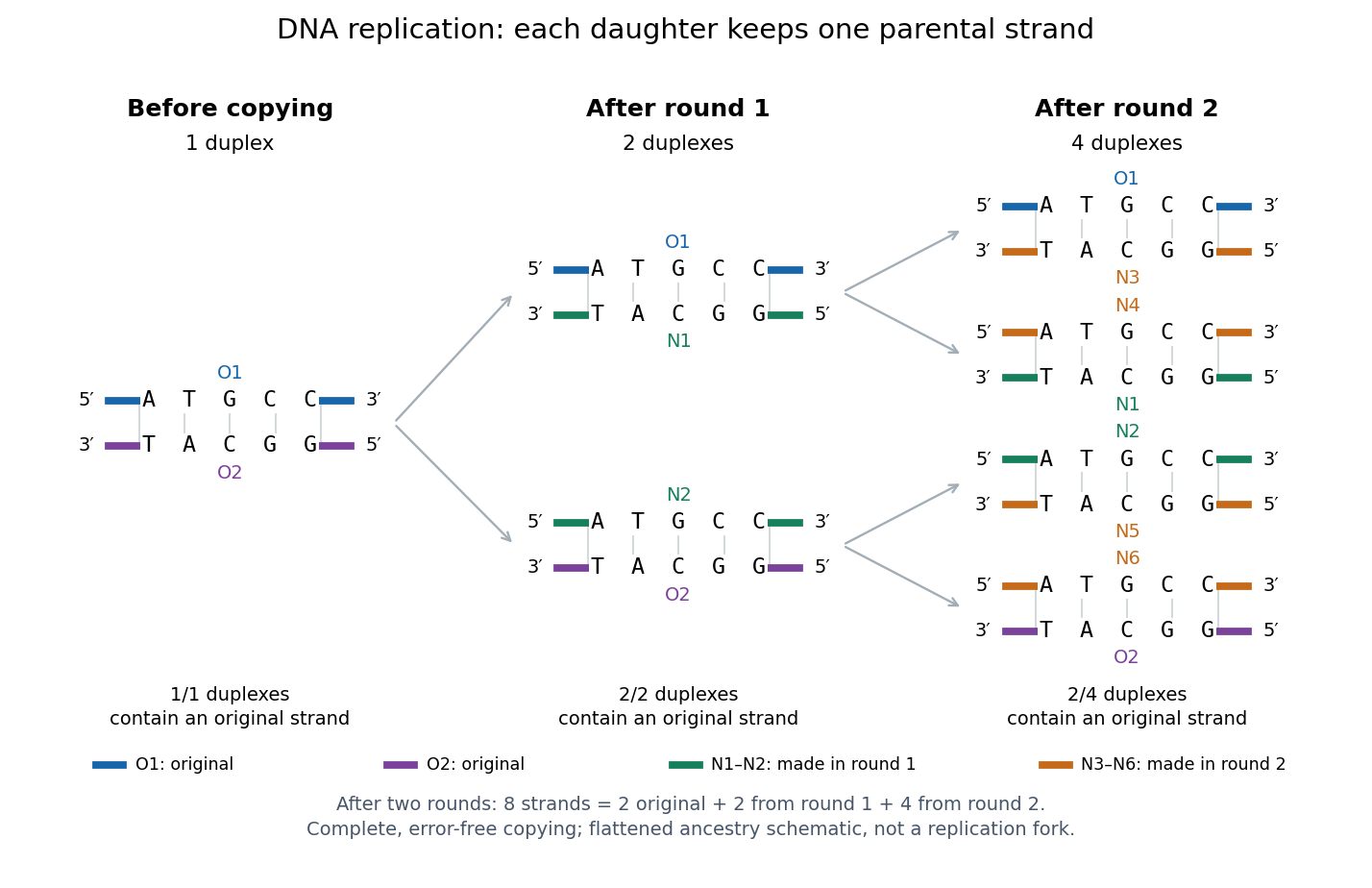
Semiconservative replication: follow two original DNA strands through two complete copying rounds
. Blue O1 and purple O2 are the original strands; green strands were made in round 1 and orange strands in round 2. Each arrow connects a parent duplex to its daughters. After round 2, two of four duplexes retain an original strand, and the other two retain a round-1 strand. All eight strands have the appropriate complementary nucleotide sequences; colors identify strand age, not different nucleobases. The flattened duplexes show ancestry and orientation, not a replication fork or molecular shape. Details.This is useful for inheritance: both daughter biological cells can receive a copy of the DNA record. The elegant feature is that base pairing lets each strand specify its missing partner. Direction matters too: a replicating DNA polymerase reads its template and extends the new strand at its end, so synthesis proceeds . These are opposite directions on antiparallel nucleic acid strands, not two alternative directions of synthesis. The enzyme needs a pre-existing paired strand end to extend; the diagram omits the machinery that starts and coordinates copying. See Alberts et al.: template-directed synthesis and the requirement for a primer.
The strand accounting predicts observable differences between copying mechanisms. In 1958, Meselson and Stahl grew Escherichia coli with the heavier nitrogen isotope , then supplied and measured extracted DNA by density-gradient centrifugation. After one generation their samples contained intermediate-density DNA; after two, intermediate-density and light DNA occurred in equal amounts. This supported semiconservative replication in the tested Escherichia coli culture. It was an isotope assay of sampled DNA, not simultaneous testing of every kind of DNA or direct colored-strand photography. See The replication of DNA in Escherichia coli by Matthew Meselson and Franklin W. Stahl.
In semiconservative replication, each daughter duplex retains one strand of its immediate parent. Under complete copying without strand loss or exchange, one starting duplex gives duplexes after rounds, but still only two original strands. For , the fraction of duplexes containing an original strand is : all after one round, half after two, a quarter after three. The fraction of all strands that are original is instead . A strand made in round 1 is parental when round 2 begins.
A replicating DNA polymerase is an enzyme that extends a paired strand end with nucleotides selected against a DNA template. New DNA grows while the template is read . Base pairing specifies the partner; the DNA polymerase catalyzes its incorporation. See Alberts et al.: DNA polymerase.
Taq polymerase is a heat-resistant DNA polymerase used in PCR amplification. It requires a paired strand end and nucleotide substrates; heat resistance does not confer target recognition.
A deoxynucleoside triphosphate is a nucleotide containing deoxyribose and three phosphate groups. DNA polymerases use these substrates to extend DNA; the four standard substrate types carry adenine, cytosine, guanine or thymine.
A DNA replication inhibitor interferes with DNA replication; the observed effect depends on exposure and assay conditions.
DNA repair addresses damage to DNA. Incorporation of a labeled precursor during DNA repair need not indicate duplication of the whole genome in S phase.
Gene expression uses a gene's information to produce functional RNA or a protein. Transcription makes RNA from a DNA template; for a protein-coding gene, biological translation then uses messenger RNA to specify an amino acid chain. Many genes instead produce functional RNA, including transfer RNA and ribosomal RNA, without a translated protein product. See Alberts et al., Molecular Biology of the Cell, 4th edition (2002): from DNA to RNA.
Follow the chosen coding strand : transcription of its complementary template gives in messenger RNA. In the stated reading frame, its three codons are AUG, GCU and UAA: methionine, alanine and a stop codon. Thus nine nucleotides specify two amino acid residues followed by termination, not three residues. This is an illustrative coding segment embedded in suitable expression and initiation context, not a claim that an isolated nine-nucleotide RNA is sufficient to initiate biological translation.
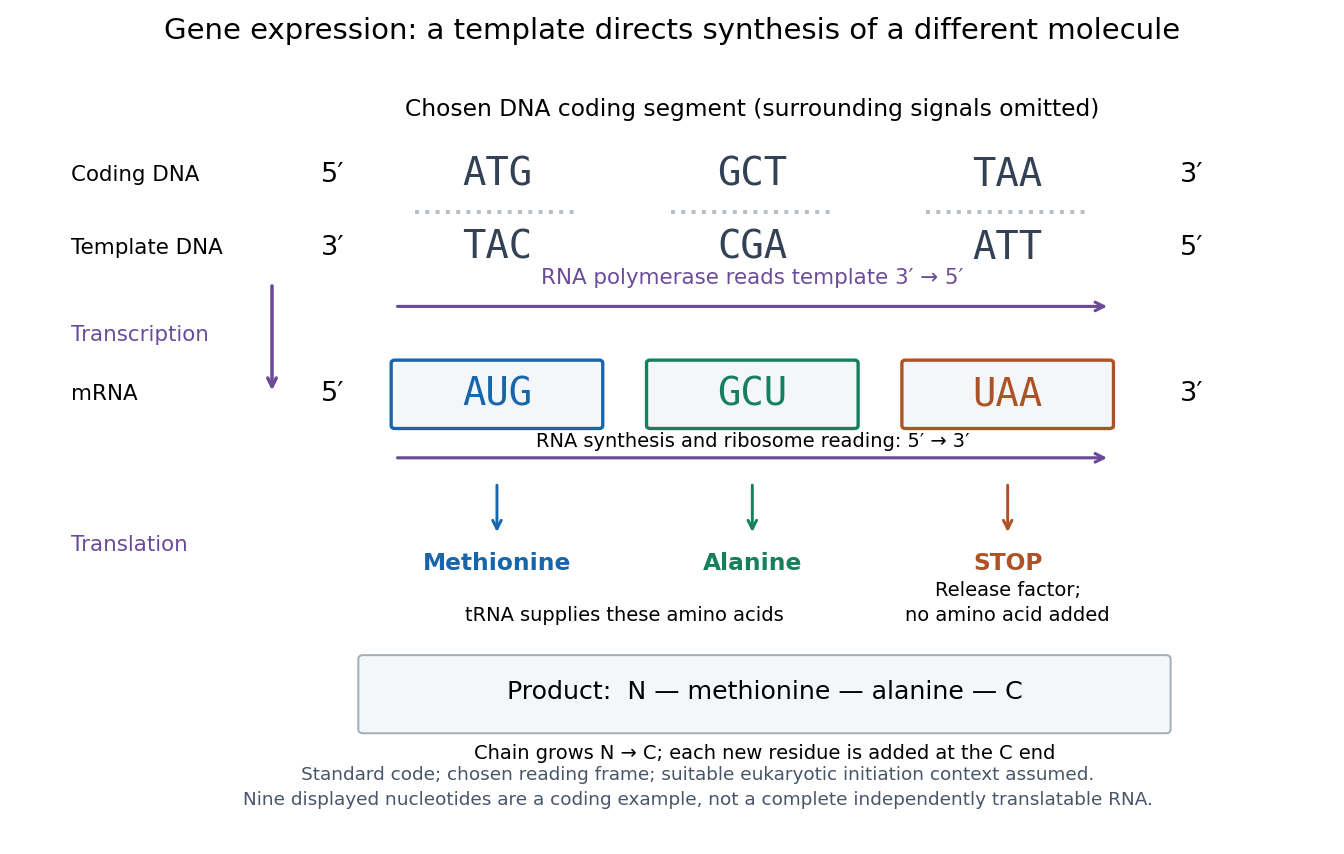
The distinction between copying and use explains how biological cells can preserve the same DNA yet produce different products. DNA replication duplicates the record; gene expression selects and uses parts of it. Transcription does not use all DNA at once, and gene expression can be controlled at several steps, including transcription, RNA processing and biological translation. See Clark, Douglas and Choi, Biology 2e: regulation of gene expression. The arrows describe template-directed synthesis: the DNA does not physically turn into a protein, and the messenger RNA does not supply the amino acids from which that protein is assembled.
In the GAL1 gene promoter system used in the yeast cross-species complementation experiment, the inducing sugar galactose promotes gene expression from the engineered construct, whereas glucose provides a noninducing comparison. The comparison concerns an imposed regulatory system, not the donor species’ native regulation. [ref]
Pathways Over Time Plasmids Engage Students in Functional Genomics Research by Clare O’Connor. O’Connor (2018), Plasmid features enable multiple student experiments and Complementation reveals conservation of function: GAL1 promoter
A gene promoter is a DNA region involved in initiating transcription. Moving a coding sequence into a nuclear genome does not guarantee that its original gene promoter can drive nuclear gene expression.
A transcription factor is a protein that regulates transcription. Combinations of transcription factors help select gene expression patterns during cell differentiation. [ref]
Anatomy and Physiology 2e by J. Gordon Betts and others. Anatomy and Physiology 2e, §3.6, Differentiation and Figure 3.35: transcription factors
Transcription is synthesis of RNA using one DNA strand as a template by an RNA polymerase. During elongation the RNA polymerase reads that template while extending RNA . Only the selected region is transcribed; other regions need not be active, and the template strand can differ between genes. See Alberts et al.: RNA polymerase and selection of transcribed DNA regions.
For the displayed example, align these three nucleotide sequences in the same left-to-right positions:The first template triplet TAC selects AUG: T pairs with A, A with U, and C with G. The next CGA selects GCU, and ATT selects UAA. The coding strand therefore matches the RNA lettering except for T versus U, whereas the template is complementary. Reading that template in its own direction gives ; orientation cannot be discarded. The gene expression diagram keeps all three rows aligned. See Clark, Douglas and Choi, Biology 2e: template and coding strands in transcription.
This correspondence makes nucleotide sequences interpretable, but replacing T by U is valid only after identifying the coding strand. Moreover, RNA may be processed after transcription, so the initial product and mature messenger RNA need not have identical uninterrupted nucleotide sequences. Transcription also makes functional RNA that will not undergo biological translation. See Alberts et al.: RNA processing and RNA as the final gene product.
An RNA polymerase used in transcription is an enzyme that synthesizes RNA from a DNA template. Unlike a replicating DNA polymerase, it can start a new strand without a pre-existing paired strand end; initiation still requires the appropriate DNA signals and associated machinery. See Alberts et al.: RNA polymerase and transcription initiation.
For a specified transcription unit, the coding strand is the DNA strand matching the initial RNA product in the direction, with T in place of U. The opposite DNA strand is the template. The name does not imply that every transcribed gene encodes a protein. See Clark, Douglas and Choi: coding and template strands.
Biological translation uses a ribosome to read messenger RNA codons and assemble the corresponding amino acid chain. Transfer RNA adaptors match codons through base pairing and carry the amino acids; the genetic code supplies the correspondence. The chain grows from the N-terminus toward the C-terminus, by adding each new residue at the C-terminus. See Clark, Douglas and Choi, Biology 2e: ribosomes, transfer RNA and protein synthesis.
In the gene expression diagram, read in the chosen reading frame. Under the standard genetic code, AUG specifies methionine and GCU specifies alanine; UAA is a stop codon. The result before any subsequent processing is the two-residue chain N–methionine–alanine–C, followed by termination. The stop codon contributes zero amino acids. See Clark, Douglas and Choi, Biology 2e: the standard genetic code. This example assumes appropriate initiation at the displayed AUG in a suitable context in a eukaryote; the diagram displays the coding segment, not a complete independently translatable messenger RNA.
Initiation establishes the starting position and reading frame, using a ribosome, an initiating transfer RNA and additional factors. At a standard stop codon, a release factor promotes release of the chain rather than delivery of another amino acid by transfer RNA. See Clark, Douglas and Choi: initiation and termination of translation. A short two-residue example illustrates decoding, not the size or folding of a typical functional protein.
The useful connection is between two different alphabets: nucleotides specify the order of amino acids through the genetic code. Base pairing helps select transfer RNA, while the ribosome catalyzes joining the delivered amino acids. The messenger RNA remains a template rather than being consumed as the chain's building material. Separating template, adaptor and product makes clear why transcription and biological translation are distinct mechanisms.
The genetic code assigns RNA codons to amino acids or termination signals. Four possible nucleobases at each of three positions give codons. In the standard genetic code, 61 specify amino acids and three are stop codons; several codons can specify the same amino acid. Variants exist, so state which genetic code is being used. See Clark, Douglas and Choi: genetic code assignments and variants.
A codon is a three-nucleotide unit read in a specified reading frame during biological translation. For example, GCU specifies alanine in the standard genetic code. Its letters are read .
In the standard genetic code, UAA, UAG and UGA are stop codons: they signal termination of biological translation rather than an amino acid assignment. See Clark, Douglas and Choi: stop codons.
A reading frame specifies how consecutive nucleotides are grouped into codons. Starting at position 1 of AUGGCUUAA gives AUG / GCU / UAA; starting at position 2 gives UGG / CUU with AA left over. The letters are unchanged but the groups differ. A possible grouping alone does not establish an actual biological translation initiation site.
Articles by others on the same topic



Molecular genetics is a branch of genetics that focuses on the molecular structure and function of genes. It combines principles from molecular biology, biochemistry, and genetics to study the role of genes in heredity, variation, and the mechanisms of genetic expression and regulation. Key areas of molecular genetics include: 1. **Gene Structure and Function**: Understanding how genes are organized, including their sequence, regulation, and the production of RNA and proteins.