The apparatus and motivating measurement are described in permanganate-iron titration; the following is an original account of its possible errors. Assume correct titrant standardization, the acidic permanganate-iron balance, quantitative conversion of the sampled , and additive contributions expressed as equivalent titrant volumes. WriteHere is the sample titre, the titration blank, background reagent consumption, and signed offsets of the observed titration endpoints from the respective stoichiometry conditions after background consumption. The subscripts distinguish sample and blank. is additional sample-specific permanganate demand, absent from the blank; is apparent delivery used to fill an initially air-containing burette tip rather than enter the flask. Assume the blank's tip is already filled; the sample should also have after proper preparation. These terms are a diagnostic model, not measured components of the stipulated blank.
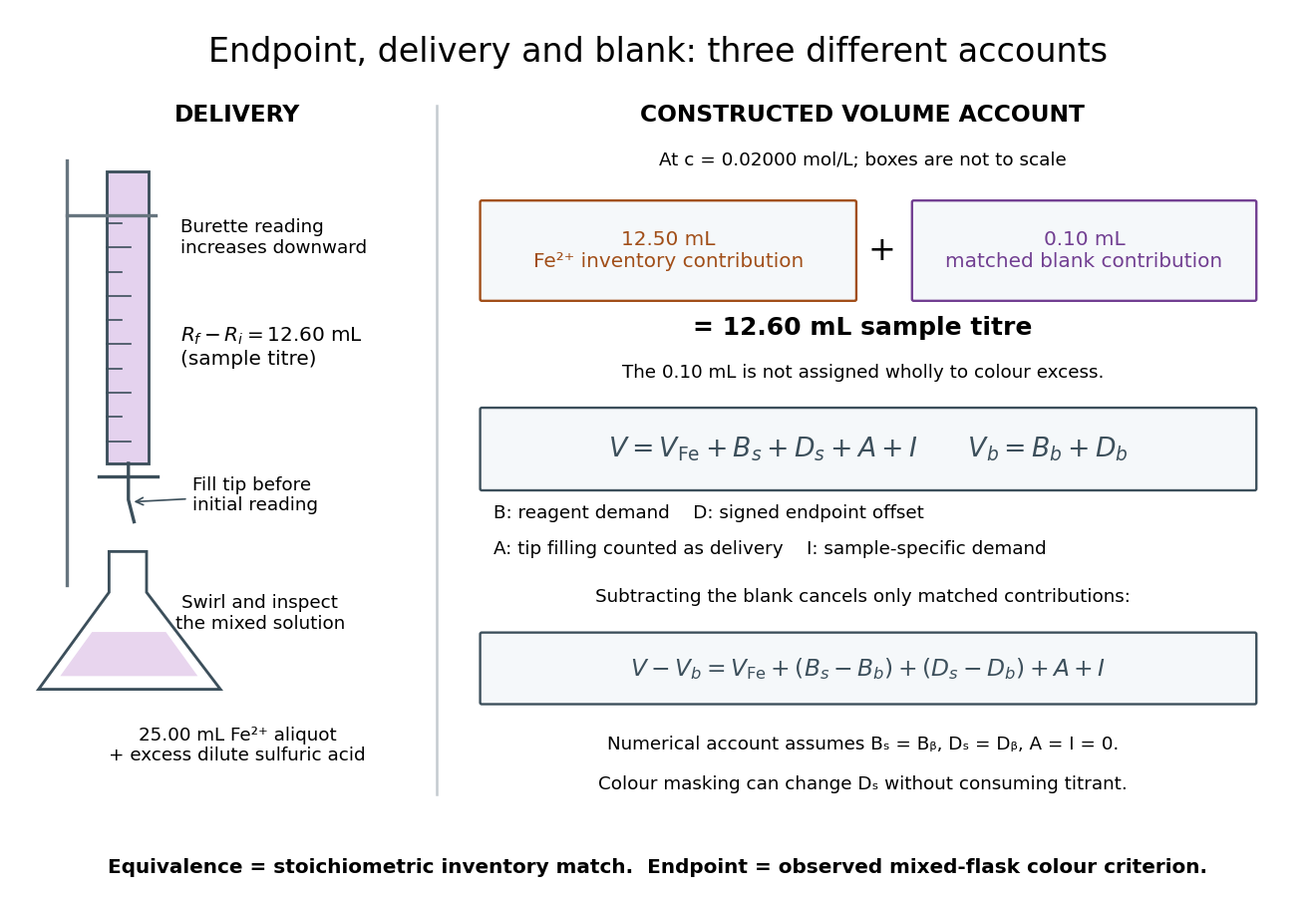

Subtracting the two accounts proves the error relationThe simple inference is valid when this residual is negligible. Matching water and sulfuric acid tests the background terms, but does not by itself establish : flask composition and viewing conditions can differ. A coloured sample can mask residual permanganate, changing the assigned titration endpoint without a corresponding redox consumption. A sample-specific reducing agent instead contributes positive by consuming permanganate. A reagent titration blank cannot measure either effect just by omitting the sample.
A transient purple streak before mixing is not the mixed-flask titration endpoint. Conversely, the equivalence point is the five-to-one inventory match, without a promised visible flag. In the ideal selective model, a persistent excess colour requires some permanganate beyond that match. No particular drop size, waiting time or endpoint offset is stipulated here; the same stated colour criterion must be applied to sample and blank, and its transferability checked.
The model also predicts error direction. If a tip bubble disappears during sample delivery, makes the inferred amount of substance too high because final minus initial burette reading includes liquid that stayed in the tip. Conditioning the tip before the first reading prevents this particular discrepancy; subtracting a separate titration blank is not an instrument repair. Repeated aliquots test scatter, a known added inventory tests the five-to-one response, and an independent titrant standardization tests . These are the proposed controls from permanganate-iron titration, with distinct diagnostic roles; none alone proves absence of all sample interference.
Articles by others on the same topic
There are currently no matching articles.