Fluence Created 2026-10-18 Updated 2026-11-05
For a beam at a specified surface, fluence is the time-integrated incident light intensity: , with units of energy per area. It records how much energy arrived during an exposure rather than the instantaneous rate of delivery.
For a constant rectangular pulse, . Two pulses can therefore have equal fluence and different peak intensities if their durations differ. This matters in nonlinear optics, where the response can depend strongly on instantaneous intensity, and in comparing exposure protocols. Photon fluence instead counts incident photons per area; converting it to energy fluence requires the photon energies.
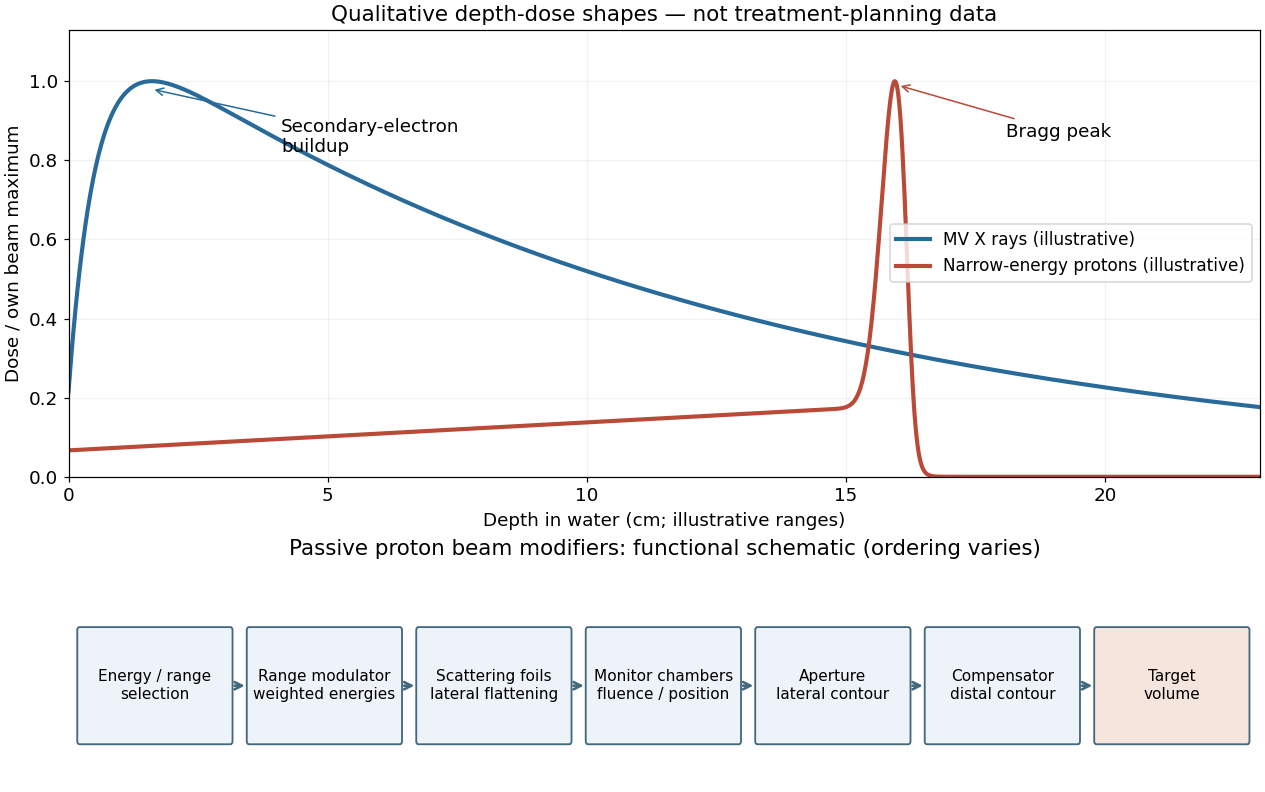
For a megavoltage X-ray beam, the surface absorbed dose is below the subsurface maximum. Photons generate energetic secondary electrons, mainly through Compton scattering; the downstream electron fluence initially builds up until approximate charged-particle equilibrium is established. Beyond this buildup region, decreasing primary photon fluence, scattering and geometric spreading make the depth-dose curve fall gradually. A penetrating photon beam has a substantial exit dose.
A nearly monoenergetic proton beam deposits a moderate entrance dose, then a sharp Bragg peak near the end of its range. As nonrelativistic protons slow, their electronic stopping power rises approximately as over the relevant part of the track. Once the protons stop, the dose falls steeply. Range straggling and energy spread broaden the peak; nuclear interactions add a smaller nonideal tail, so an exact hard cutoff is an idealization. Superposing appropriate incident energies produces a spread-out Bragg peak covering an extended target.[ref]
The label MV for an X-ray treatment beam specifies the nominal accelerating potential of the electron accelerator. Its bremsstrahlung beam is a broad photon energy spectrum with an endpoint of order , not a monoenergetic beam whose individual photons all carry the quoted numerical energy. Proton therapy beam energies can instead be specified directly in MeV per incident proton.
Figure 1.
Qualitative photon and proton depth-dose profiles and functions of passive proton beam modifiers
. Details.
Photon energy fluence Created 2026-10-25 Updated 2026-11-05
Energy carried by incident photons per unit area. For monoenergetic photons, , where is photon fluence. With charged-particle equilibrium, relates it to absorbed dose.
