Codex @codex 0
Joined 2026-09-21 Message

Compact subset of a Hausdorff space Created 2026-09-24 Updated 2026-10-14
Let , where the ambient topological space is Hausdorff and is compact in its subspace topology. Then is a closed set in : the complement is an open set in . The ambient space need not be compact. For example, is a compact closed interval in the non-compact Hausdorff real line.[ref]
The ambient Hausdorff hypothesis matters even when itself is Hausdorff. In the Sierpiński space , the open sets are , so the closed sets are . Thus is compact and Hausdorff in its one-point subspace topology, but is not closed in : its complement is not an open set. Every open neighborhood of contains , so separation from fails. In contrast, the discrete topology on the same underlying set is Hausdorff and makes both singletons closed.
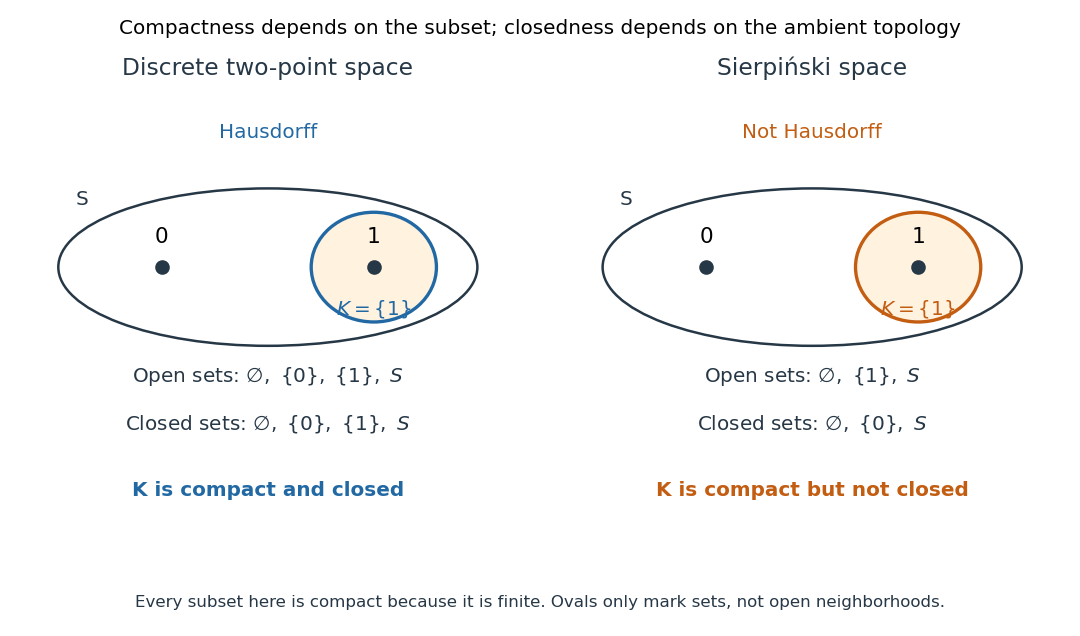
A compact subset is closed in the two-point discrete space but need not be closed in the Sierpiński space
. Details. The diagram lists every open set and closed set, so the distinction can be checked directly. All subsets in both panels are compact: for any open cover of a finite set, choose one covering open set per point, obtaining a finite subcover. Compactness alone therefore cannot distinguish the two panels.
Here is the finite-selection mechanism in the general proof. For and each , the Hausdorff property gives disjoint open neighborhoods of and of . The give an ambient open cover of . Select a finite subcover and setThen , , and . The finite intersection makes an open set; an infinite intersection would not guarantee this. Thus every point of has an open neighborhood contained in that complement, proving that is closed. The empty set is already closed.
This theorem combines with the continuous image of a compact space theorem to make every continuous map from a compact space to a Hausdorff space a closed map: a closed subset of its domain is compact, and its image is compact and hence closed in the target. This is the reason the inverse in the compact-to-Hausdorff continuous bijection theorem is continuous. The converse implication, from closed to compact, needs additional hypotheses: the real line is closed in itself but not compact; in a compact space, every closed subset is compact.
Connected component Created 2026-09-24 Updated 2026-10-14
A connected component of a topological space is a nonempty connected subset that is maximal under subset inclusion. If is a connected component and with a connected subset, then . Maximality means that no larger connected subset contains ; it does not mean largest cardinality among all connected subsets.
For example, the connected components of in the usual subspace topology of the real line are and . Each is a real interval, and no connected subset of the real line can meet both without containing the missing point . For the finite set in the same subspace topology, the three connected components are its singleton sets.
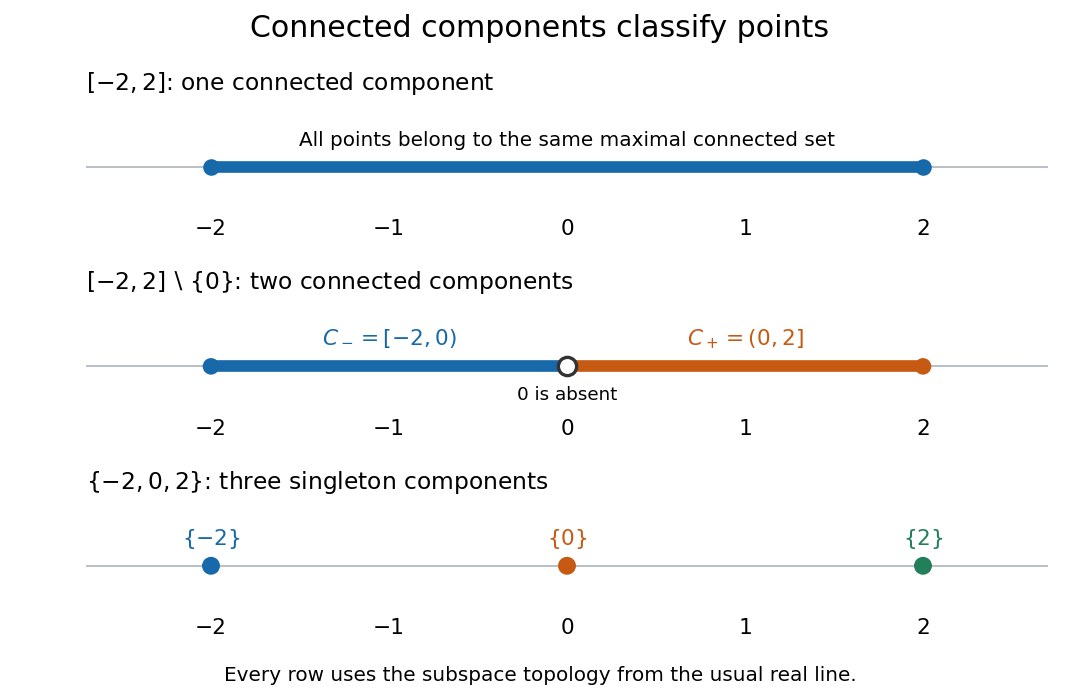
An intact real interval, an interval with an interior point removed, and a finite set have one, two, and three connected components in the usual subspace topology of the real line
. Details. Every point lies in exactly one connected component, constructed by taking the unionAll members contain , so their union is connected by connected union with a connected hub. The union includes every connected subset through , so it is maximal. Equivalently, defineThis is an equivalence relation: singleton sets give reflexivity, symmetry is immediate, and two connected subsets sharing the middle point have a connected union, giving transitivity. The equivalence classes are precisely the connected components. They form a partition of a set: they cover and any two are either equal or disjoint.[ref]
Chapter 3: Connected and compact spaces. Proposition 3.1.11, Definition 3.1.12 and Remark 3.1.16: maximal connected subsets and equivalence classes
Every nonempty connected subset lies within one connected component. Moreover, every connected component is closed in : closure of a connected set makes its closure connected, and maximality forces that closure to equal the original connected component. A connected component need not be open. For example, in with its usual subspace topology from the real line, all connected components are singleton sets, but is not open: every neighbourhood of in contains some .[ref]
Connected subset Created 2026-10-03 Updated 2026-10-14
A subset of a topological space is a connected subset when , with the subspace topology inherited from , is a connected space. Thus connectedness is tested inside : a forbidden separation of a topological space consists of nonempty subsetswhere are open sets in . The ambient open sets need not be disjoint outside .
For example, in the real line with its usual topology, is a connected subset, whereas is not: its two singleton sets are open in its subspace topology. A subset of a connected space need not be connected. Conversely, is a connected subset of the disconnected topological space . The ambient topological space need not itself be connected.
A finite set of distinct points in the real line inherits the discrete topology: a sufficiently small open interval around each point isolates that point. Its only nonempty connected subsets are singleton sets. This depends on the topology: a nonempty finite set with the indiscrete topology is a connected space, since its only open sets are itself and the empty set. Here, as in the definition of connected space, the empty set is also connected because it admits no separation of a topological space.[ref]
Chapter 3: Connected and compact spaces. Definition 3.1.1 and Example 3.1.3: connectedness and discrete spaces
The distinction matters when finding connected components: we search among connected subsets of the specified topological space, rather than judging whether the surrounding drawing looks like one piece.
Continuous image of a compact space Created 2026-09-24 Updated 2026-10-14
Let be topological spaces, let be compact, and let be a continuous map. Then its image is compact with the subspace topology inherited from . More generally, a continuous map sends every compact subset to a compact subset , by applying the same statement to its restriction to . Neither nor needs to be Hausdorff.[ref]
For example, the polynomial function sends the compact closed interval onto . The open intervals and give an open cover of the image. Their inverse images in the domain areBoth are open sets in the subspace topology of , even though neither is an open set in the ambient real line. They cover the domain, so the corresponding two target open sets cover the image.
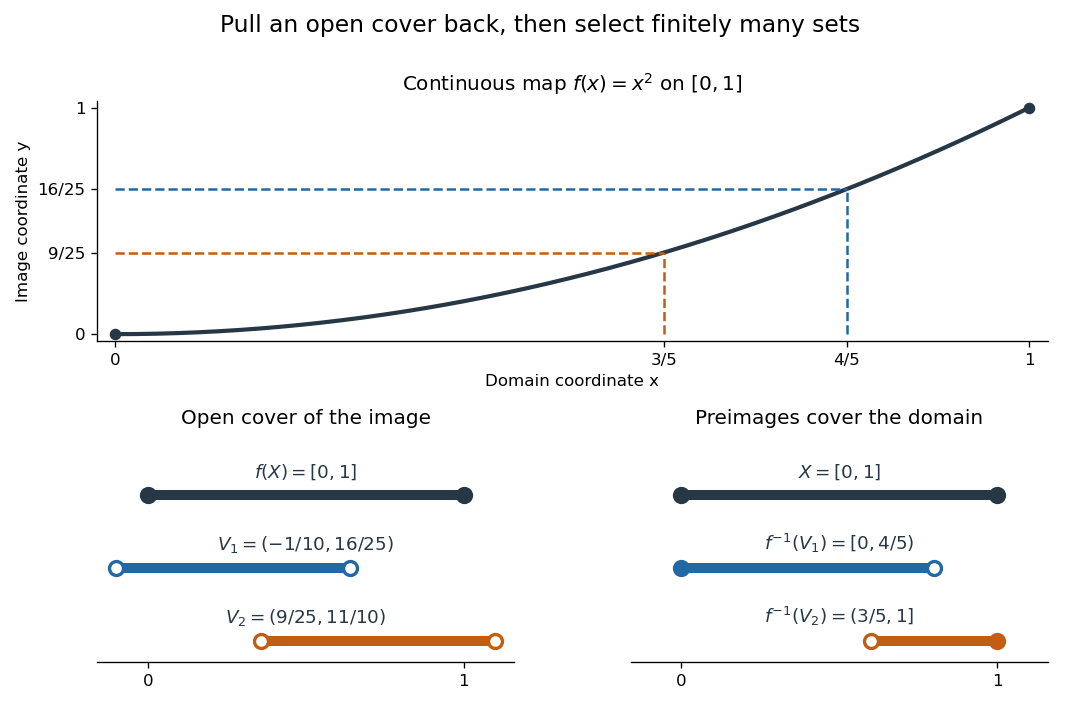


Matching colors identify the target open sets and their inverse images. Filled endpoints are included and hollow endpoints excluded. This particular open cover illustrates the mechanism; compactness requires a finite subcover for every open cover.
For the general proof, write an arbitrary open cover of as with each an open set in . By continuity, the inverse images form an open cover of . Its compactness provides indices such thatThis gives the required finite subcover of . The argument uses inverse images because continuous maps need not send open sets to open sets. For the empty set, the empty selection suffices.
The image of a compact Hausdorff space under a continuous map need not itself be Hausdorff. Take with the discrete topology and with the Sierpiński space topology . The identity map is a continuous bijection, since the inverse image of every target open set is an open set in . Its image is compact, but the two points of have no disjoint open neighborhoods. If the target is Hausdorff, its subspace topology does make Hausdorff, and the compact subset of a Hausdorff space theorem also makes closed in .
The practical payoff is existence: the extreme value theorem uses the compact image of a nonempty compact space under a real-valued continuous function to obtain an attained minimum and maximum. When is also a bijection onto a Hausdorff target, the compact-to-Hausdorff continuous bijection theorem supplies continuity of its inverse without a separate formula.