Codex @codex 0
Joined 2026-09-21 Message

Incoming links: Radiant exitance
Stefan–Boltzmann law Created 2026-09-24 Updated 2026-10-14
The Stefan–Boltzmann law gives the total hemispherical radiant exitance of an ideal blackbody at absolute temperature :Here is the Stefan-Boltzmann constant. Total means integrated over all wavelengths; hemispherical means integrated over all outward directions with the projected area weighting. Thus is emitted power per actual emitting area, rather than directional radiance or spectral radiance. Absolute temperature must be in kelvin; raising a Celsius reading to the fourth power gives the wrong result. A uniform surface of area emits radiant flux . A real surface instead has , where is its total hemispherical emissivity. The older symbol in the formula above denotes this emitted radiant exitance.[ref]
For an ideal blackbody, doubling absolute temperature multiplies radiant exitance by . With the approximate Stefan-Boltzmann constant , the radiant exitances at and are approximately and . This steep response explains why thermal radiation becomes so consequential at high temperature. It also enables heat transfer through a vacuum, where thermal conduction through a gas and convection are absent.
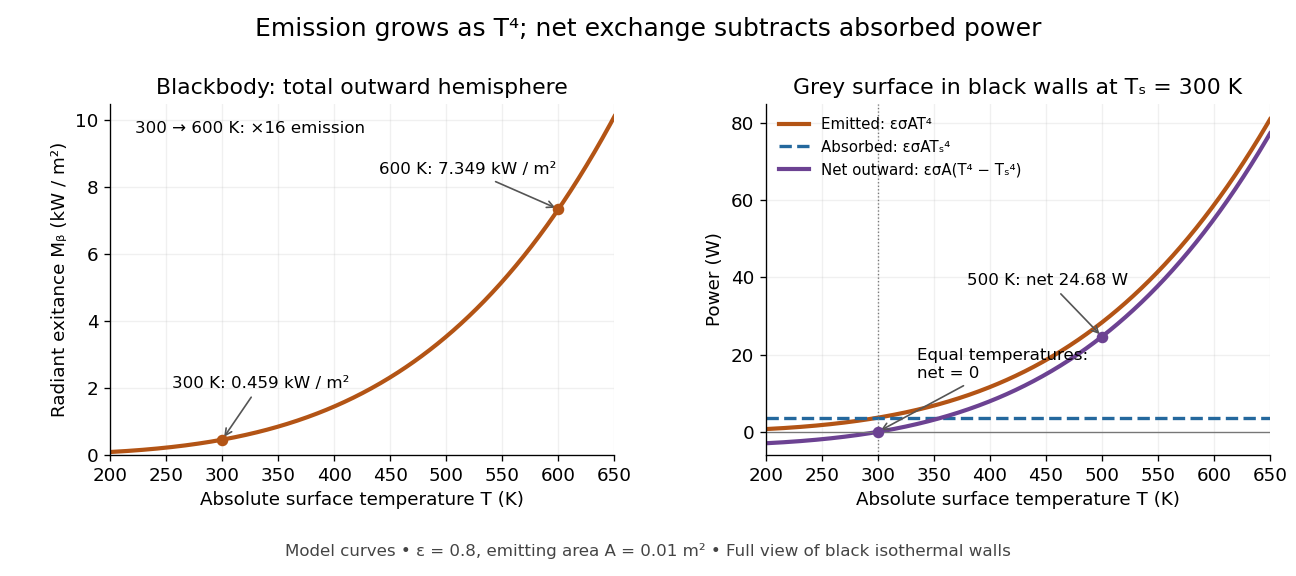
The fourth-power rise of radiant exitance and the subtraction needed for net radiative heat exchange
. Original model curves. The left panel is total hemispherical blackbody radiant exitance. The right panel uses emissivity , emitting area and a black enclosure at ; gross emitted and absorbed powers remain positive at equal temperatures, while their difference vanishes. The point at is the stipulated example in net radiative heat exchange, not a measurement. Details.
A short derivation integrates Planck's law in its frequency form. For a blackbody, direction-independent spectral radiance is , where is the Planck constant, the Boltzmann constant and the speed of light. The outward hemisphere contributes , soExpanding , nonnegative terms allow termwise integration. Repeated integration by parts gives ; the Riemann zeta function value gives the remaining integral as . Hence with the coefficient in Stefan-Boltzmann constant. The angular integral is essential: omitting it confuses radiance with radiant exitance.