For a small, uniform surface at temperature , enclosed by much larger black walls all at temperature , the outward net heat transfer by thermal radiation isAssume an opaque grey body that is a diffuse thermal emitter, with the same emissivity and radiometric absorptance at the surface's current temperature. Its emitting area sees only the enclosure: the view factor to the walls is one, with no self-viewing surface, opening or intervening obstruction. The intervening medium must neither absorb nor emit appreciable thermal radiation; a vacuum supplies a useful idealization. The enclosure is maintained at uniform . The small-body assumption makes that reservoir description physically reasonable; genuinely black isothermal walls supply the incoming irradiance even without an infinite area ratio. Positive means net loss by the surface; negative means net gain. This expression counts thermal radiation alone, not all heat transfer.[ref]
Thermodynamics and Propulsion. §19.1, cavity irradiance; §19.2, grey-body absorptance/emittance; §19.4, enclosed-body view factor one
The reasoning is a two-way energy balance. Black walls supply irradiance , so the surface absorbs and emits . Subtract these to obtain . For an opaque surface the remaining fraction of incoming radiant flux is reflected; counting emitted plus reflected outgoing radiant flux minus total incoming radiant flux gives the same result. Kirchhoff's law of thermal radiation justifies equal spectral absorption and emission factors; the grey body assumption lets one factor be taken outside both spectral integrals.
Choose , , and . These are stipulated model inputs, not measured material properties. Using givesThe incoming irradiance is , corresponding to incident on the surface; only is absorbed. At , emitted and absorbed powers are both , so radiative equilibrium has zero net exchange despite continuing emission. Changing only emissivity to reduces both one-way powers and the net loss by a factor of four, giving net. A low-emissivity coating therefore suppresses both radiative cooling to colder walls and radiative heating from hotter walls.
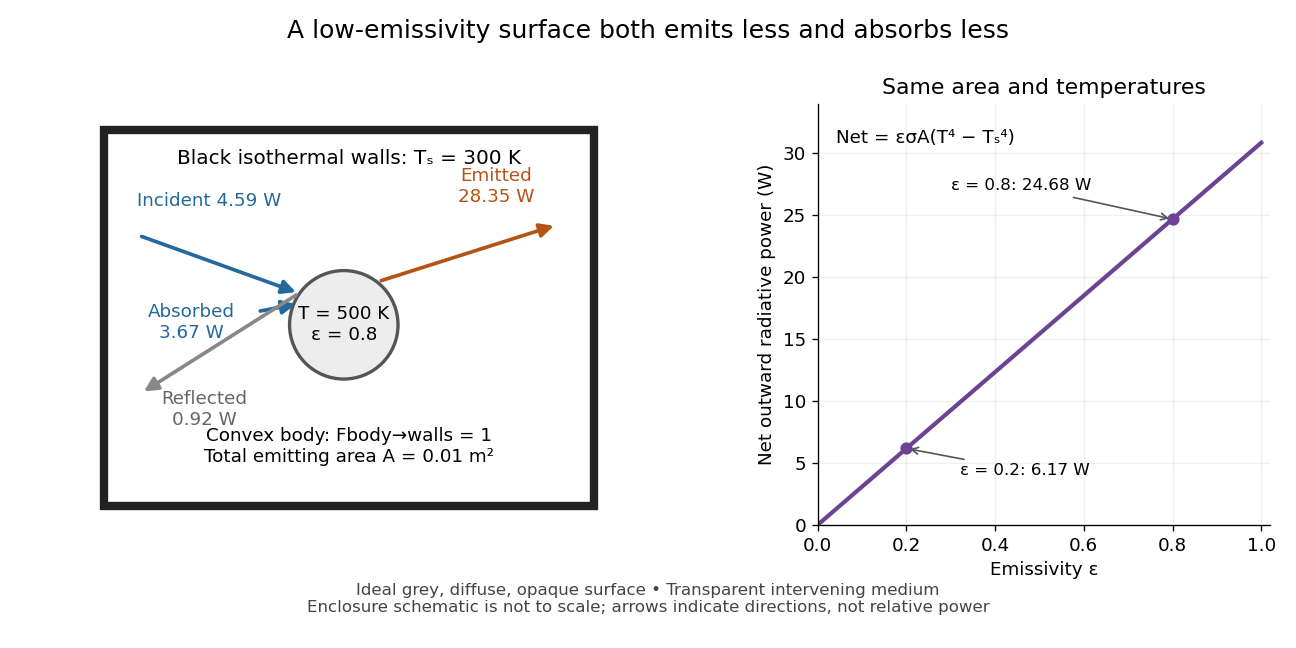
Two-way exchange in a black enclosure and the effect of emissivity
. Original schematic, not an experimental apparatus. The central convex body has total emitting area , temperature and view factor one to black walls at . Arrows show gross emission, absorbed enclosure radiation and reflected enclosure radiation for emissivity ; widths are illustrative. The graph compares stipulated emissivities under the same geometry and temperatures. Details.
Near equal temperatures, write . Taylor's theorem givesFor constant emissivity, the radiative heat transfer coefficient is approximately at and . This local linear approximation is useful for small temperature differences; the difference in the worked example needs the full fourth-power expression.
A cooling experiment requires a wider first law of thermodynamics balance. In a uniform-temperature model without a heater,where is the sample's heat capacity and the last two terms are signed outward convection and thermal conduction losses. A vacuum suppresses convection but does not eliminate thermal conduction through supports or sensor leads. A cooling slope therefore cannot establish emissivity unless these paths and heat capacity are independently constrained. Multiple wall temperatures, incomplete view factors, wavelength-selective materials or appreciable intervening absorption require a more complete radiative transfer calculation.
The view factor is the fraction of uniformly distributed, diffuse outgoing radiant flux from surface that directly reaches surface . It depends on geometry, including obstruction, rather than on temperature or emissivity. All destinations in a closed enclosure have fractions summing to one. For a convex body fully enclosed by walls, ; the reverse view factor is generally smaller. Reciprocity gives . Two unobstructed spheres with outer radius ten times the inner radius have and . Do not multiply both directions by an assumed identical view factor.[ref]
Thermodynamics and Propulsion. §19.4, equations 19.4 and following reciprocity relation; §19.4.1, concentric spheres
Articles by others on the same topic
There are currently no matching articles.