For , put probability mass at zero and at each of and . This symmetric probability distribution has mean zero. Its second and fourth moments are both , because the nonzero outcomes have square and fourth power equal to one:For the kurtosis is ; for it is . In the latter case of the probability mass is at zero, yet all of the fourth central moment comes from the remaining . The standard score takes values and , with variance one. Each nonzero outcome contributesto kurtosis. At , the two rare outcomes are ten standard deviations from the mean, and their contributions are .
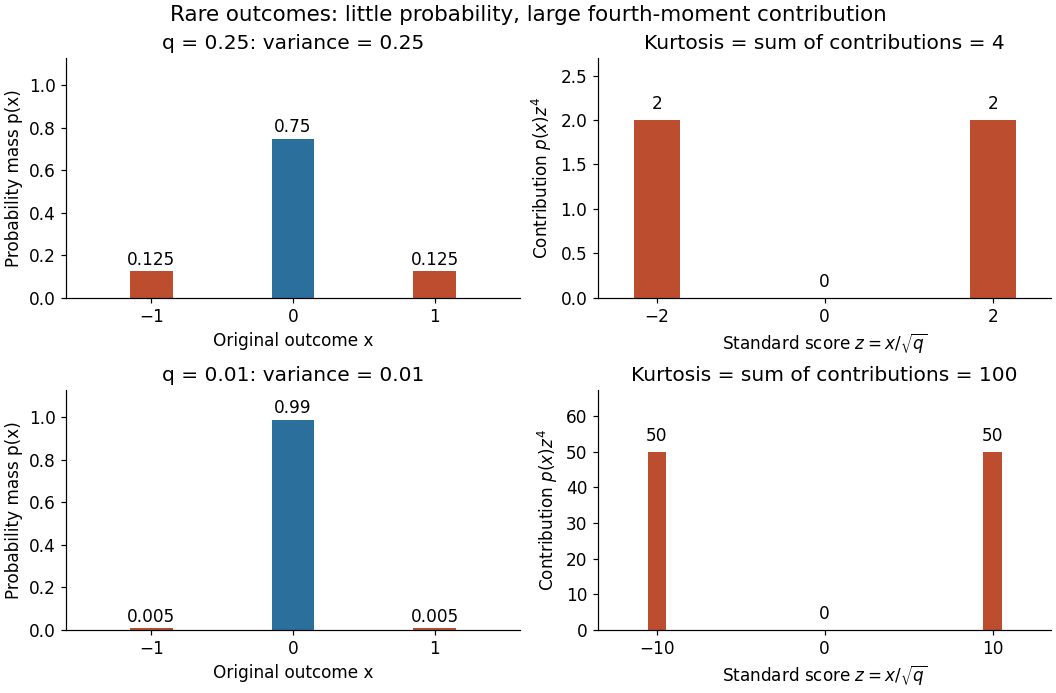

Every member has finite support of a probability distribution, so all its moments are finite. Nevertheless, kurtosis becomes arbitrarily large as approaches zero: high kurtosis does not require an unbounded support of a probability distribution or a heavy-tailed distribution. At the variance vanishes and kurtosis is undefined. At this discrete probability distribution even has the normal distribution value and excess kurtosis zero, so those values do not establish a normal distribution.
Articles by others on the same topic
There are currently no matching articles.