Excess kurtosis subtracts from kurtosis, making the normal distribution baseline zero. The non-excess convention is sometimes called raw kurtosis; this still uses a fourth central moment, not the uncentered fourth moment . Software may report either kurtosis or excess kurtosis, so the convention must be stated.[ref]
1.3.5.11. Measures of Skewness and Kurtosis. §1.3.5.11, Alternative Definition of Kurtosis, normal baseline and software convention warning
For a standard normal distribution, the moment-generating function of a standard normal variable gives , hence excess kurtosis zero. For a continuous uniform distribution on , the mean is zero, the variance is one, and direct integration givesThe rare-outlier three-point distribution can instead have kurtosis and excess kurtosis with mean zero and variance one. These are calculated properties of specified probability distributions, rather than a measured statistic.
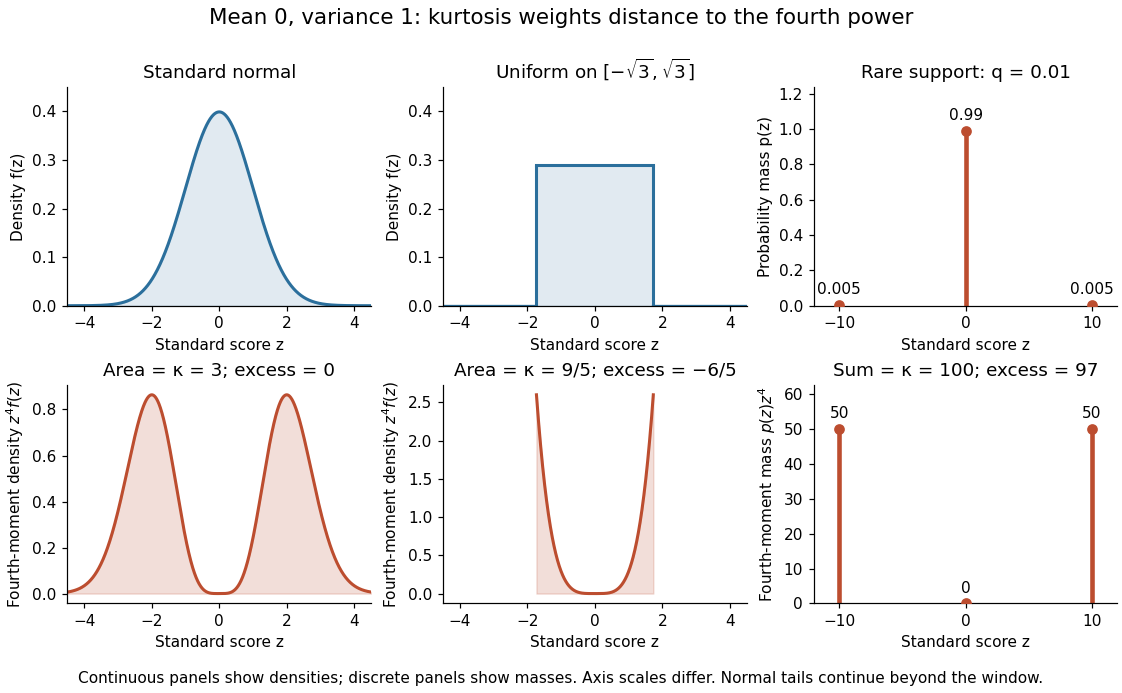
Kurtosis comparison for a standard normal distribution, a continuous uniform distribution, and a rare-outlier three-point distribution
. The upper panels show probability density functions or a probability mass function; the lower panels show their contributions to the fourth central moment. All three probability distributions have mean zero and variance one. Areas in the continuous panels and sums in the discrete panels give kurtosis. The standard normal distribution continues beyond the displayed window; density and mass heights have different meanings. Details.
Articles by others on the same topic
There are currently no matching articles.