Core hydrogen fusion supports the main sequence. Hydrogen-shell fusion around an inert helium core then produces the subgiant and red giant phases. Core helium fusion gives the red clump, followed by hydrogen- and helium-shell burning on the Asymptotic giant branch. Envelope loss can expose a hot planetary nebula nucleus before a carbon-oxygen white dwarf cools. This sequence concerns a roughly solar-mass star; initial mass, composition and mass loss affect detailed tracks and timescales.
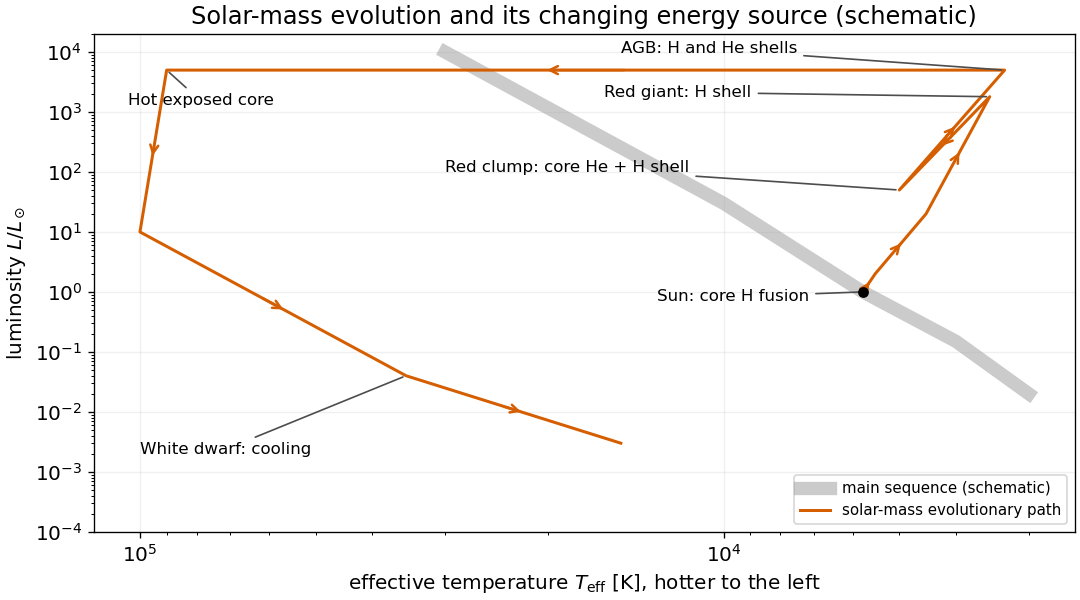
A Hertzsprung-Russell diagram plots stellar luminosity upward and effective temperature increasing toward the left. The main sequence runs from hot luminous stars at upper left to cool faint stars at lower right, with the Sun near , .
In the evolution of a solar-mass star, core hydrogen fusion initially supplies the luminosity. As core hydrogen is exhausted, hydrogen-shell fusion around a contracting helium core carries the star through the subgiant and red giant phases toward higher luminosity and lower surface temperature. Helium ignition is followed by core helium fusion with a hydrogen-burning shell, placing a solar-mass star in the red clump. The later Asymptotic giant branch has hydrogen- and helium-burning shells around a carbon-oxygen core. Envelope ejection exposes a hot central star of a planetary nebula; residual shell burning ends and the resulting white dwarf radiates stored thermal energy as it cools.
Figure 1.
Schematic solar-mass evolution on an H-R diagram, with the dominant energy sources labelled
. Details.
Core-helium-burning stars populate the horizontal branch and red clump; hot subdwarf B stars provide examples with a helium-burning core of roughly half a solar mass and a very small remaining hydrogen envelope. Their high luminosity relative to mass, hot spectra and locations away from an ordinary hydrogen-burning main sequence are observational evidence for such evolved configurations.
A plausible history starts with a hydrogen-burning star. After central hydrogen exhaustion, hydrogen-shell burning builds a compact helium core and the envelope expands on the red giant branch. Sufficient core temperature ignites helium, often by a helium flash for a low-mass degenerate core. Strong mass loss or binary interaction can strip most of the hydrogen envelope, exposing a hot helium-burning remnant; retaining a substantial envelope instead gives an ordinary horizontal-branch or red-clump star.
The simple radiative Kramers scaling estimates a luminosity contrast but does not uniquely identify one evolutionary state or predict a real subdwarf luminosity precisely. A similarly low-mass helium white dwarf would be a cooling, degenerate object rather than the sustained high-temperature helium-burning configuration assumed here.
