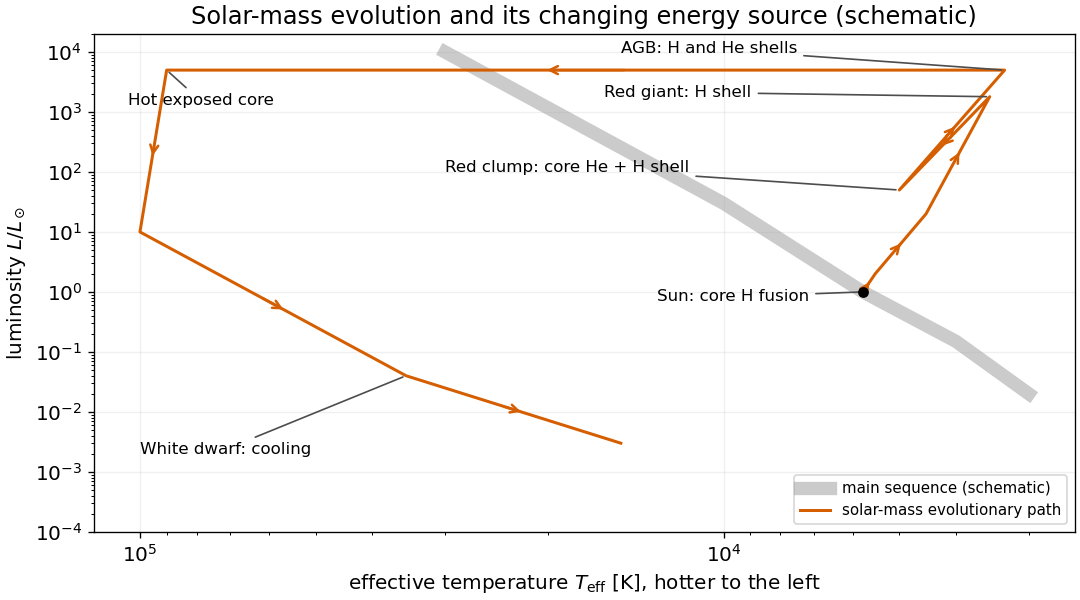
A Hertzsprung-Russell diagram plots stellar luminosity upward and effective temperature increasing toward the left. The main sequence runs from hot luminous stars at upper left to cool faint stars at lower right, with the Sun near Teff≃5800K, L=L⊙.
In the evolution of a solar-mass star, core hydrogen fusion initially supplies the luminosity. As core hydrogen is exhausted, hydrogen-shell fusion around a contracting helium core carries the star through the subgiant and red giant phases toward higher luminosity and lower surface temperature. Helium ignition is followed by core helium fusion with a hydrogen-burning shell, placing a solar-mass star in the red clump. The later Asymptotic giant branch has hydrogen- and helium-burning shells around a carbon-oxygen core. Envelope ejection exposes a hot central star of a planetary nebula; residual shell burning ends and the resulting white dwarf radiates stored thermal energy as it cools.

Ancestors (12)
- 3
- 2
- S2
- 2012
- Past exam of the short options paper shared by Prelims and Parts A and B of the physics course of the University of Oxford
- Short options paper shared by Prelims and Parts A and B of the physics course of the University of Oxford
- Physics course of the University of Oxford
- Undergraduate course of the University of Oxford
- Course of the University of Oxford
- University of Oxford
- List of universities
- Home
Discussion (0)
New discussionThere are no discussions about this article yet.
Articles by others on the same topic (0)
There are currently no matching articles.