
David C. Nicholls Created 2026-10-20 Updated 2026-11-05
David C. Nicholls led a 2012 investigation of discrepant nebular temperature measurements. The paper, with Michael A. Dopita and Ralph S. Sutherland, explores a Kappa distribution for electron energies instead of imposing a Maxwell-Boltzmann distribution.
Different spectral diagnostics weight electron energies differently. Consequently, a departure from the assumed distribution can change inferred temperatures and abundances in different ways. The study presents the nonthermal distribution as a physical explanation to test, rather than treating agreement obtained under a changed assumption as a direct measurement of the distribution itself.[ref]
Resolving the electron temperature discrepancies in H II regions and planetary nebulae: kappa-distributed electrons by David C. Nicholls and others. Abstract: alternative electron distribution and consequences for temperature and abundance diagnostics
Michael Dopita Created 2026-10-24 Updated 2026-11-05
Michael Dopita modeled the physical processes producing emission from ionized astronomical gas. With David C. Nicholls and Ralph S. Sutherland, he investigated why different spectral lines can give discrepant electron temperatures and chemical abundances in H II regions and planetary nebulae.
Their proposed explanation changed the assumed electron kinetic energy distribution from a Maxwell-Boltzmann distribution to a Kappa distribution, which has a more populated high-energy tail. Because different atomic transitions sample different electron energies, this change affects their inferred temperatures differently. The paper presented a testable interpretation of the diagnostic discrepancy.[ref]
Resolving the electron temperature discrepancies in H II regions and planetary nebulae: kappa-distributed electrons by David C. Nicholls and others. Abstract: nebular temperature discrepancies and consequences of a kappa electron distribution

Portrait of Michael Dopita
. External portrait hosted by Australian Academy of Science. Source.Weak transitions in dilute gas. A forbidden emission line is a transition absent in the electric-dipole approximation because of its selection rules, but permitted through weaker channels such as magnetic-dipole or electric-quadrupole radiation, sometimes aided by state mixing. It is not an impossible transition. Its upper atomic level is relatively long lived, so collisions can deactivate it before a photon is emitted in dense gas. Low-density astrophysical plasmas allow radiative decay to compete successfully.
In a schematic two-level statistical equilibrium,The critical density is for this simple level system; multiple radiative and collisional channels require summed rates. At each collisional excitation is likely to produce radiation, so . At high density collisional de-excitation suppresses the line relative to this low-density expectation. The rate need not decrease absolutely with increasing density; the suppression is relative to the naive excitation scaling.
A temperature-sensitive ratio. For a Maxwell-Boltzmann electron distribution,where is an effective collision strength. Lines from upper levels with different excitation energies therefore have a strongly temperature-dependent ratio. Using one ion reduces sensitivity to abundance and ionization fraction compared with comparing unrelated species.
A standard example is doubly ionized oxygen: the and angstrom lines descend from toward the ground term, while the angstrom line connects to . The higher excitation threshold makes the auroral line relatively stronger in hotter gas. In the low-density Maxwellian approximation, with slowly varying collision strengths,The numerical form is a useful approximation, not a universal exact atomic law; a multilevel atomic calculation with current collision strengths is needed for precise work.[ref]
Resolving the electron temperature discrepancies in H II regions and planetary nebulae: kappa-distributed electrons by David C. Nicholls and others. Section 4, equation 18 and the following approximation warning; arXiv:1204.3880v2, PDF pages 5–6
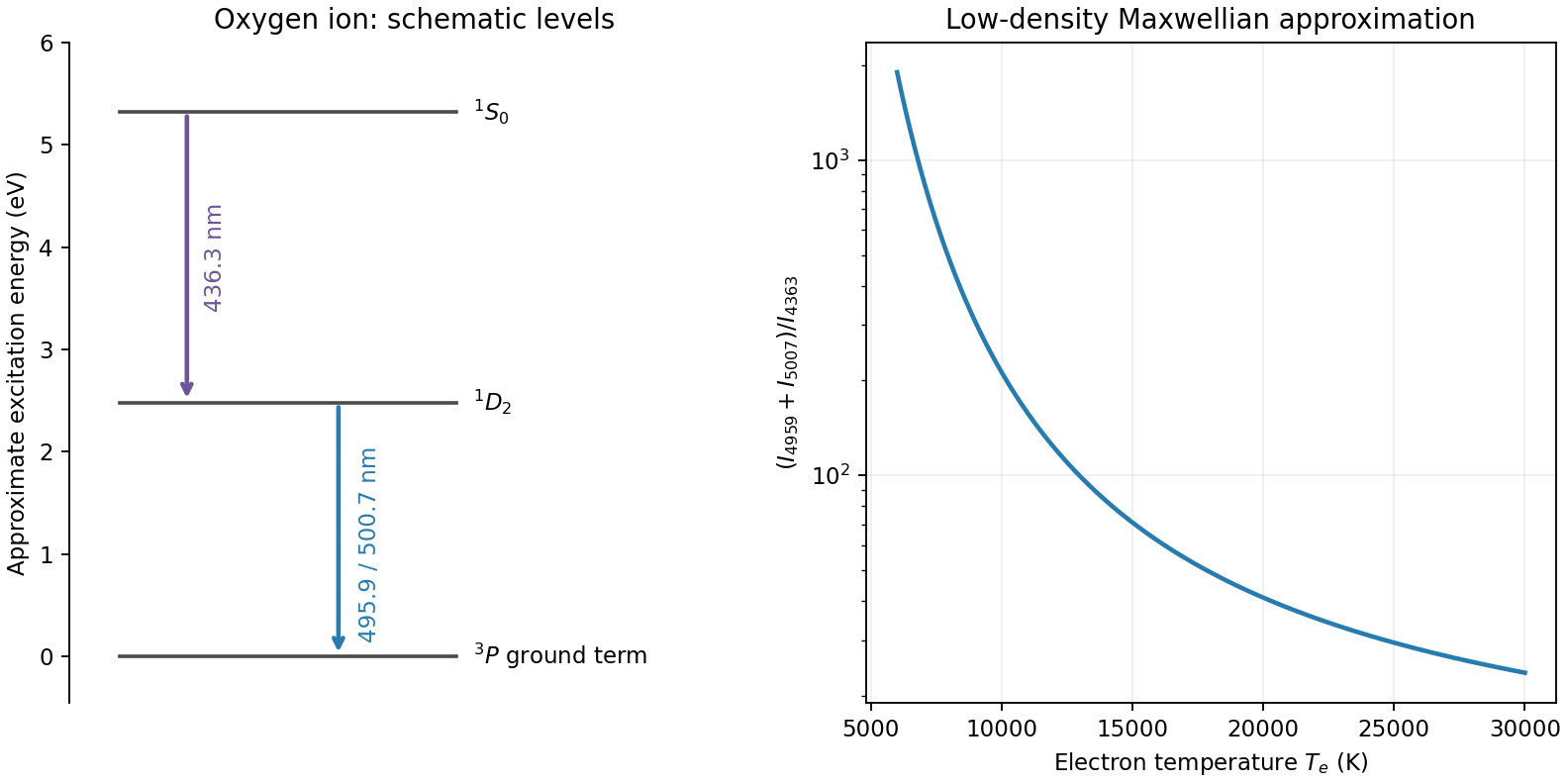
Original oxygen forbidden-line level schematic and low-density Maxwellian temperature-ratio curve; level spacings are approximate
. Details. 
In an active galactic nucleus these lines commonly diagnose the relatively dilute narrow-line gas; dense broad-line gas can collisionally quench them. Measure and deblend the fluxes, subtract continuum and stellar features, correct differential extinction, and check density independently. The ratio mainly tests radiative branching and calibration because both lines share one upper level; it is not the required temperature thermometer. Temperature gradients, multiple density components, shocks, ionization structure and departures from the Maxwellian electron distribution can bias a single inferred temperature. Without a measured ratio and density regime, no particular AGN temperature is numerically determined here.
Ralph S. Sutherland Created 2026-10-20 Updated 2026-11-05
Ralph S. Sutherland coauthored a study of probability distributions of electron kinetic energy in H II regions and planetary nebulae. With David C. Nicholls and Michael A. Dopita, he investigated whether deviations from a Maxwell-Boltzmann distribution could account for disagreements between different inferred temperatures and chemical abundances.
The authors explored a Kappa distribution with an enhanced high-energy population. The methodological point is that a temperature diagnostic depends on the assumed particle distribution; fitting different spectral lines can probe that assumption rather than merely repeat the same measurement.[ref]
Resolving the electron temperature discrepancies in H II regions and planetary nebulae: kappa-distributed electrons by David C. Nicholls and others. Abstract: discrepancies between diagnostics and the proposed kappa-distribution interpretation