For fixed statistical parameters and , Bayes' theorem gives the mixture responsibilityIt is the conditional expectation of the mixture allocation indicator. This posterior probability concerns the hidden label, with held fixed; it does not require a prior distribution over . For a continuous , use the density ratio to define this conditional distribution, rather than dividing probabilities of the zero-probability event .[ref]
Finite Mixtures. Finite Mixtures, section Recovering posterior mixture proportions: Bayes formula for label probabilities conditional on the observation, component parameters, and mixing weights
For the Two-Gaussian mixture example, the component density ratio is , so the posterior probability ratio and the mixture responsibilities areAt the two unweighted component densities are equal, so the mixture responsibilities equal the mixture weights: , . At , the second component density is twice the first and its mixture responsibility is . Equal mixture responsibilities instead occur at : the more frequent second mixture component is favored even slightly to the left of the midpoint.
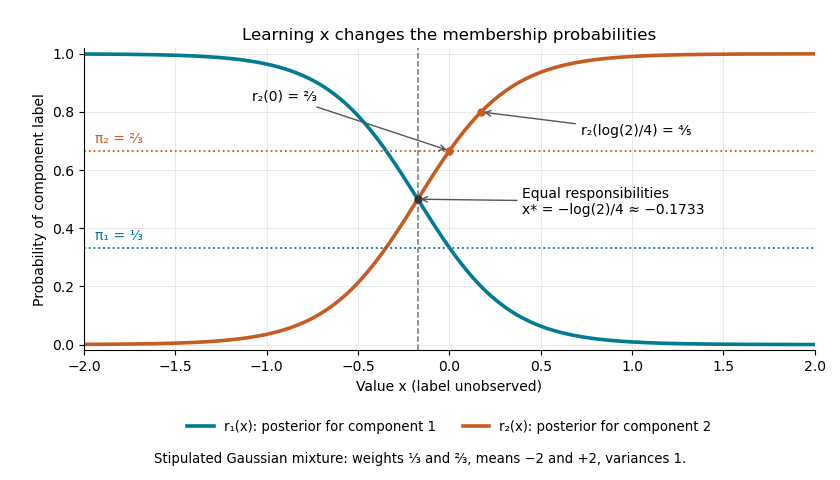

The mixture weights describe membership before learning ; mixture responsibilities describe membership after learning . The law of total expectation gives under this statistical model, although varies across individual values. In fitting by the expectation-maximization algorithm, evaluate mixture responsibilities at the current statistical parameters and recompute them after an update.
Articles by others on the same topic
There are currently no matching articles.