I would not assign the lunar mare an automatic terrestrial 100–125 km compensation level. For present-day mare basins, a local equal-column-mass model may have no physically valid compensation depth; first test whether lithospheric flexure supports the load. For ancient thermally driven subsidence that did relax, choose a common datum beneath the cooling layer in deformable lunar mantle appropriate to that epoch.
The Moon is smaller than Earth and has lost a larger fraction of its original heat. Its cold, mechanically strong outer shell can be much thicker relative to its radius than the terrestrial oceanic lithosphere. Lunar mare basalts filled pre-existing impact basins: their loading, basin excavation, mantle uplift, cooling and the evolving strength of the lithosphere all matter. A thick elastic lithosphere can support lateral stress differences, so equal column mass need not hold even after a long time. The strong gravity anomalies of lunar mascons, measured by GRAIL, are evidence that the present mare-basin system is not everywhere locally compensated.[ref]
For an explicitly assumed ancient relaxed thermal model, estimate its thermal penetration depth from thermal diffusivity and the elapsed cooling time, infer the contemporaneous mechanical lid from gravity-topography admittance or basin deformation, and place below that layer where lateral pressure anomalies relax. For example, a hypothetical several-hundred-kilometre-thick lid requires a deeper datum than that lid, not the shallow crust-mantle boundary. The paper supplies neither an epoch-specific thermal model nor a load wavelength, so a unique kilometre value is not determined. If the chosen datum is a substantial fraction of the lunar radius, spherical geometry and radial variation in gravity must replace the flat, constant-gravity column approximation.
Does the Moon have an asthenosphere? Not a demonstrated shallow, globally connected Earth-like layer underlying mobile plates; but “no weak or partially molten mantle anywhere, ever” is too strong. Apollo lunar seismology indicates a cold outer interior and more attenuating deep regions. Reanalyses support a deep low-velocity or partially molten region near the lunar core, while lunar laser ranging and tidal Love numbers constrain deep deformability and tidal dissipation. Such a deep weak region is sometimes called a lunar asthenosphere; it is not automatically the correct local compensation surface for a mare load.[ref]
The inferred melt fraction and distribution remain model dependent: Dissipation at tidal and seismic frequencies in a melt-free Moon by Francis Nimmo and others demonstrates that much of the dissipation can also be explained by hot solid-state anelasticity, although its model does not reproduce every frequency-dependent constraint. The Moon was hotter during mare emplacement and could relax loads differently then. Choose the datum from the relevant thermal and mechanical history, or use a flexural model when local isostasy fails.
Hydrostatic equilibrium means that the local pressure gradient balances gravity, with no large acceleration or strength-supported departure from that balance. In a spherical planet,
Here is the enclosed mass, not a constant total mass at every interior radius. If composition is uniform and the radial thermodynamic path is adiabatic, the relevant bulk modulus is . The chain rule then gives the Adams-Williamson relation
A phase transition or composition jump must be treated separately; its density change is not obtained by integrating one smooth homogeneous-adiabatic equation through it.
The seismic parameter is
The shear modulus measures resistance to shear deformation. Solids with transmit shear waves; an ideal fluid has zero static shear modulus, so it cannot carry a bulk S wave, while compressional P waves can still propagate through its nonzero bulk modulus.
Limitations include uncertain seismic coverage, temperature and composition tradeoffs, nonadiabatic boundary layers, phase changes, lateral heterogeneity, rotation and finite material strength. Small asteroids and comet nuclei commonly retain irregular shapes because their self-gravity is too weak to overcome strength and impact history; a few larger bodies, such as Ceres, are much closer to global hydrostatic figures. A spherical shape alone is not a complete proof of present hydrostatic equilibrium.
Two complementary remote constraints are precise spacecraft tracking, which measures gravitational harmonics and constrains mass distribution when combined with shape and rotation; and tidal or rotational measurements, such as Love numbers, librations and spin precession, which constrain deformability, moment of inertia and possible fluid layers. Magnetic induction measurements in a time-varying external field can provide an additional conductivity constraint, but are not a unique density inversion.
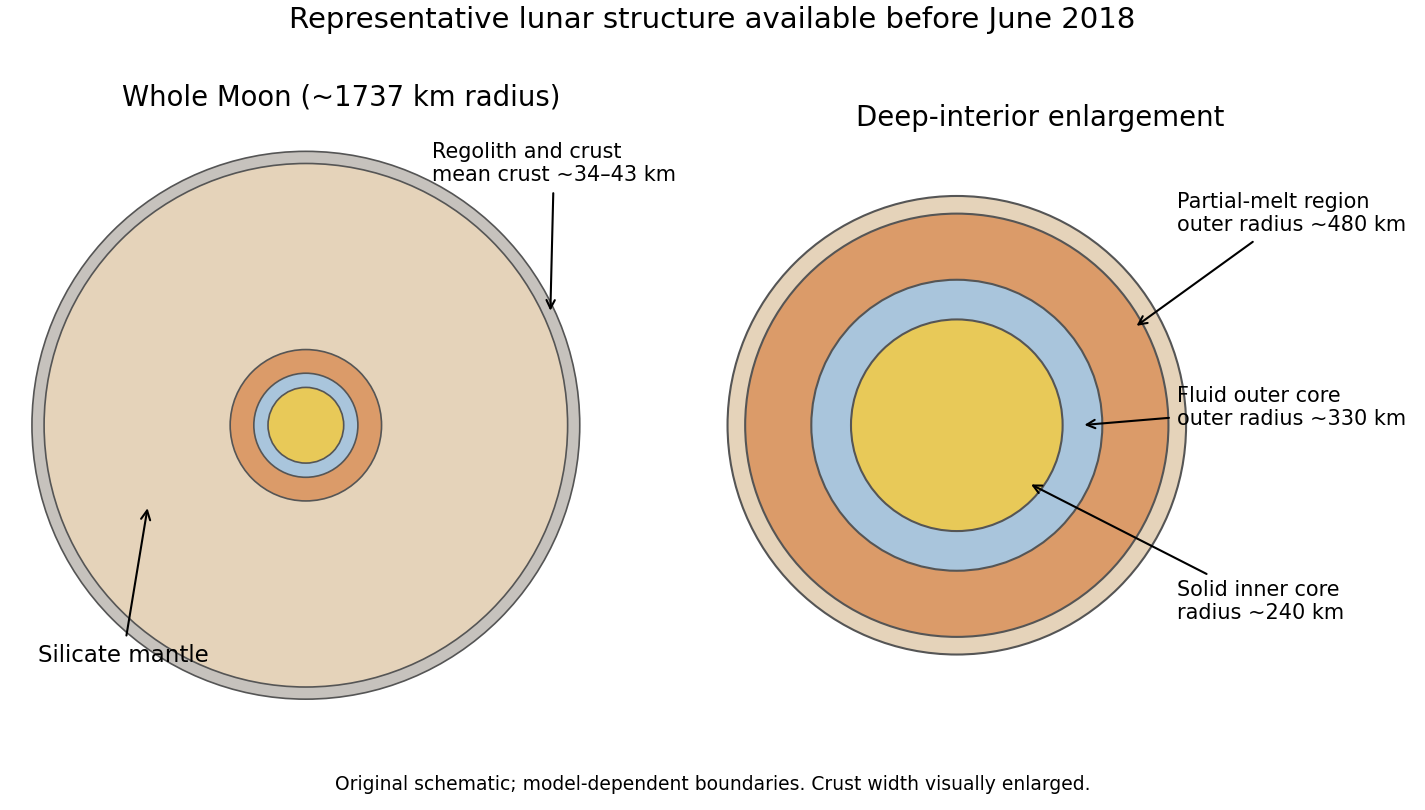
For the June 2018 lunar picture, start with a regolith and fractured crust, a largely anorthositic crust tens of kilometres thick, a silicate mantle, a deep partially molten region and a small iron-rich core. GRAIL and Apollo-based models gave a global mean crustal thickness around - km.[ref] A representative seismic model has a partial-melt boundary near radius km, a liquid outer-core boundary near km and a solid inner-core radius near km; these are model-dependent radii from the centre, not depths below the surface.[ref]
Figure 1.
A representative pre-June-2018 lunar interior model
. An original schematic cross-section labels the crust, silicate mantle, deep partial-melt region, fluid outer core and solid inner core. Approximate central layer radii are 480, 330 and 240 kilometres; the thin crust is shown with a visually enlarged width and all boundaries are model dependent. Details.
The long-running Apollo network had only four principal stations on the near side, with poor global coverage and strong scattering in the fractured near-surface material. Far-side structure and weak deep reflected phases were therefore difficult to constrain. The historical date matters: the answer does not import later Mars seismology or later lunar-core refinements into the 2018 premise.
