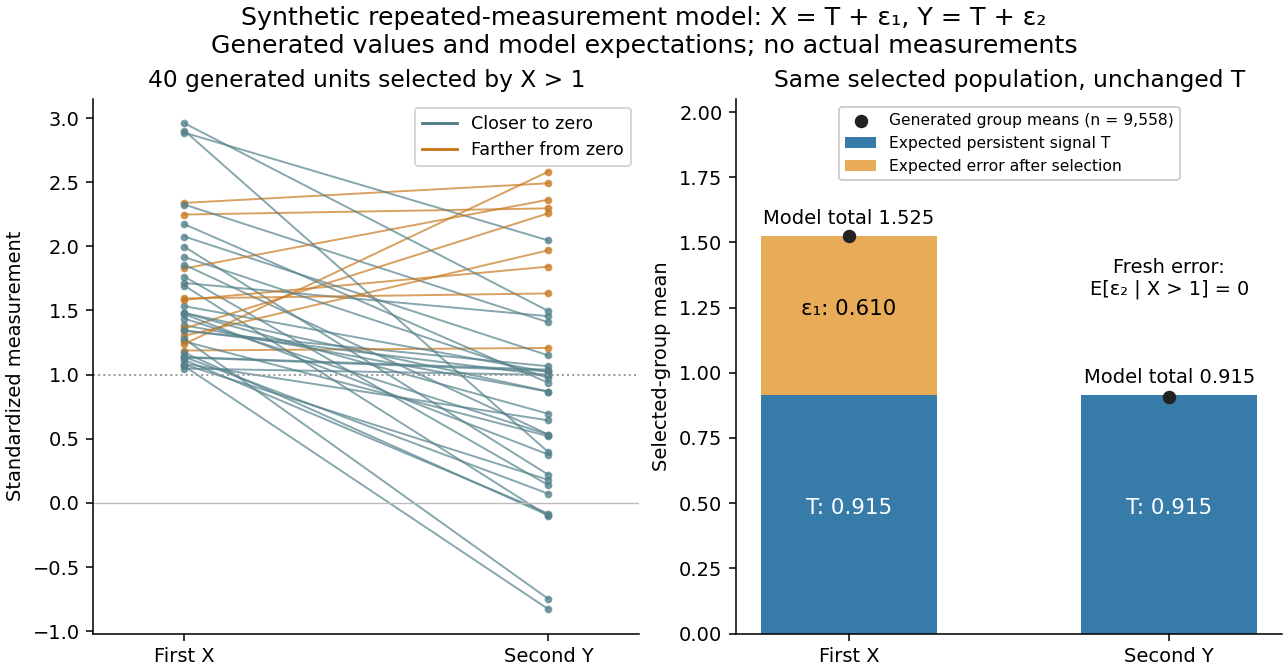
Select units with first reading , keep that membership fixed, and measure the same units again. The first reading now has a truncated normal distribution. For a general finite threshold , write for the standard normal density and for the standard normal distribution function. Since ,The tower property of conditional expectation lets us average the line over the selected group.[ref] At this givesThe average second reading is below the selection threshold even though every selected first reading exceeded it. This is a group expectation; any finite generated group's sample mean fluctuates around it. Selecting again on would define a different group and answer a different question.
The latent variable decomposition makes the apparent drop especially clear. Gaussian conditioning gives and . ThusThe first measurement error has zero unconditional mean, but positive selected mean. The second measurement error stays centered because it is independent of selection on . The persistent signal never changed.

Articles by others on the same topic
There are currently no matching articles.