In a finite volume method, orient every face numerical flux to the right. For cells 1,…,N, write the discrete total as Mn=∑j=1NhjUjn. If u is a mass per unit length, this total approximates mass; for a different conserved field, it measures that field's integral. Multiplying the update by the cell width gives an amount balance, so adjacent cells contributeThe interior face contributes −kFj+1/2n+kFj+1/2n=0. Summing all cells givesWith periodic boundary conditions, the two boundary labels denote the same physical face and must use the same numerical flux; then Mn+1=Mn. On an open interval the total changes by the boundary transfers. Unequal widths require the weighted total ∑hjUj, not the unweighted sum of cell averages.
hj(Ujn+1−Ujn)hj+1(Uj+1n+1−Uj+1n)=kFj−1/2n−kFj+1/2n,=kFj+1/2n−kFj+3/2n.
Mn+1−Mn=k(F1/2n−FN+1/2n).
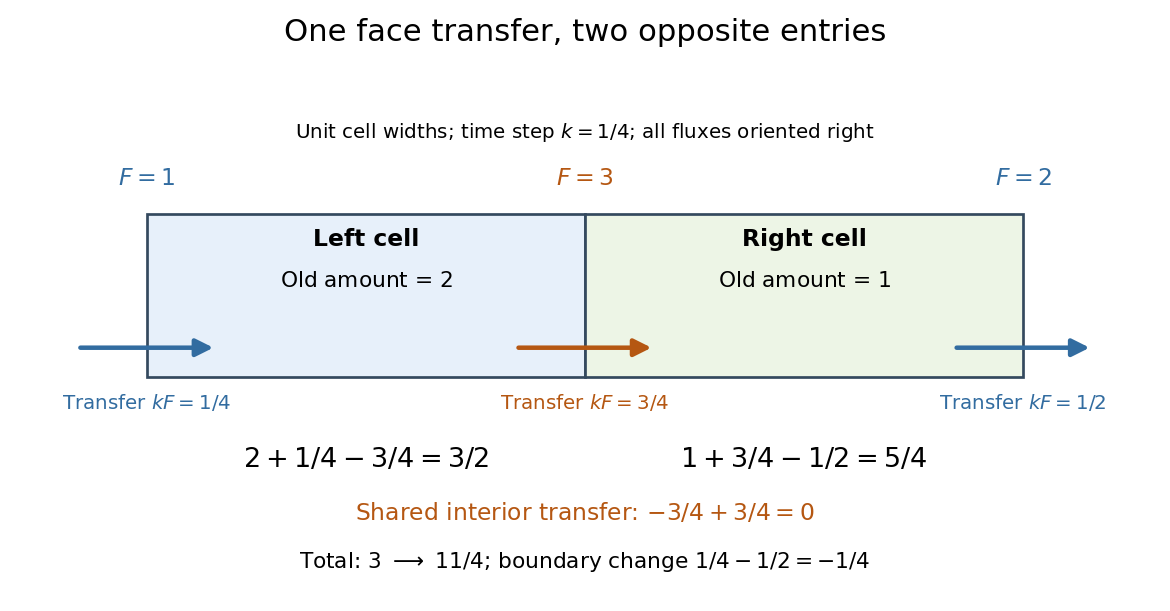

The diagram uses two unit-width cells, k=1/4, cell averages (2,1) and right-oriented numerical fluxes (1,3,2) at their three faces. The updated cell averages are (3/2,5/4): the total changes from 3 to 11/4, exactly k(1−2)=−1/4. The shared interior transfer k⋅3=3/4 cancels. If the receiving cell instead used 3+ε for that same face, the total would acquire the spurious term kε. Conservation is therefore an algebraic property of sharing the transfer, even when the numerical flux is a poor approximation. In floating-point arithmetic, independently rounded cell updates may still leave small roundoff errors in the computed total.
Articles by others on the same topic (0)
There are currently no matching articles.