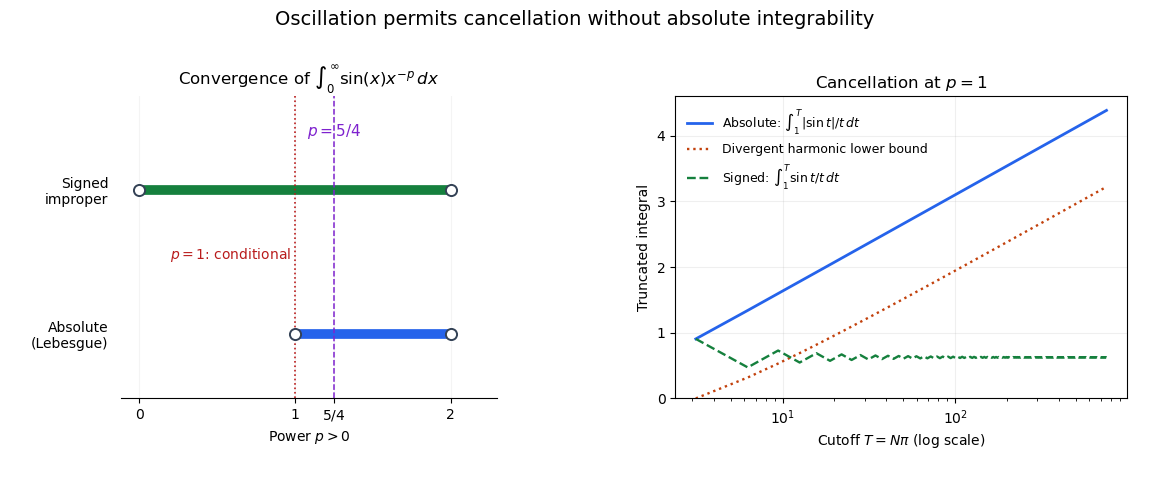
For , the function is Lebesgue integrable on exactly when . Near zero, , so absolute integrability is equivalent to that of , which requires . At infinity, gives the upper bound . For , on each interval ,and the corresponding P-series diverges.
The signed improper integral nevertheless converges for every : near zero the same local comparison applies, and at infinity the Dirichlet test for improper integrals uses the bounded antiderivative of sine and the decreasing factor . Thus gives conditional convergence, while gives absolute integrability. In particular, substituting turns into the divergent tail .

Articles by others on the same topic
There are currently no matching articles.