Speciation is the formation of distinct species through evolution. Detecting a difference between biological populations is a starting observation; its interpretation depends on the stated species concept and the evidence for lasting separation. Reproductive isolation is one important route to limiting gene flow in sexual reproduction.
Reproductive isolation consists of barriers that reduce gene flow through sexual reproduction. Distinguish premating isolation from barriers after mating. Barriers before fertilization also include incompatible gametes; barriers after fertilization can reduce offspring survival or fertility. [ref]
Biology 2e by Mary Ann Clark and others. §18.2, “Reproductive Isolation”, opening paragraphs, gametic barriers and hybrid inviability/sterility
An assay should state which step it measures. Observing fewer cross-group matings does not measure offspring fertility; observing fertilization does not demonstrate that the offspring will reproduce. These distinctions make a partial barrier informative without declaring completed speciation.
Premating isolation reduces mating between biological populations. The dietary divergence and mating isolation in Drosophila pseudoobscura assay measures this stage using observed pairings.
Postmating reproductive isolation acts after mating. Specify whether the test concerns fertilization, offspring survival, or the offspring's own reproduction; those outcomes are not interchangeable.
The 1989 experiment used eight Drosophila pseudoobscura biological populations from one Bryce Canyon population: four maintained on starch medium, four on maltose, in cages at . Testing began about a year after establishment. [ref]
Reproductive Isolation as a Consequence of Adaptive Divergence in Drosophila pseudoobscura by Diane M. B. Dodd. p. 1308, population origin, media and cage conditions
Before testing, flies spent one generation on cornmeal–molasses–agar. Virgins aged 3–6 days entered multiple-choice chambers: twelve females from each population, followed by males from both populations introduced nearly simultaneously without anesthesia. Observers scored matings for 60–90 minutes under bright indirect lighting. One group's right wing tips were clipped for identification, with clipping reversed between replicates. [ref]
Reproductive Isolation as a Consequence of Adaptive Divergence in Drosophila pseudoobscura by Diane M. B. Dodd. p. 1308, mating-preference procedure and wing-marking control
All sixteen cross-diet comparisons had positive mating assortment contrasts; eleven departed significantly from random mating. Same-diet comparisons did not show significant departures. Common-medium rearing addressed immediate diet conditioning; same-diet controls addressed separation and establishment population bottlenecks. Mate choice was not the selection target; the biological populations were maintained separately. The result supports partial premating isolation accompanying dietary divergence, not completed speciation. [ref]
Reproductive Isolation as a Consequence of Adaptive Divergence in Drosophila pseudoobscura by Diane M. B. Dodd. pp. 1309–1310, Tables 1–2 and discussion of conditioning and physical isolation
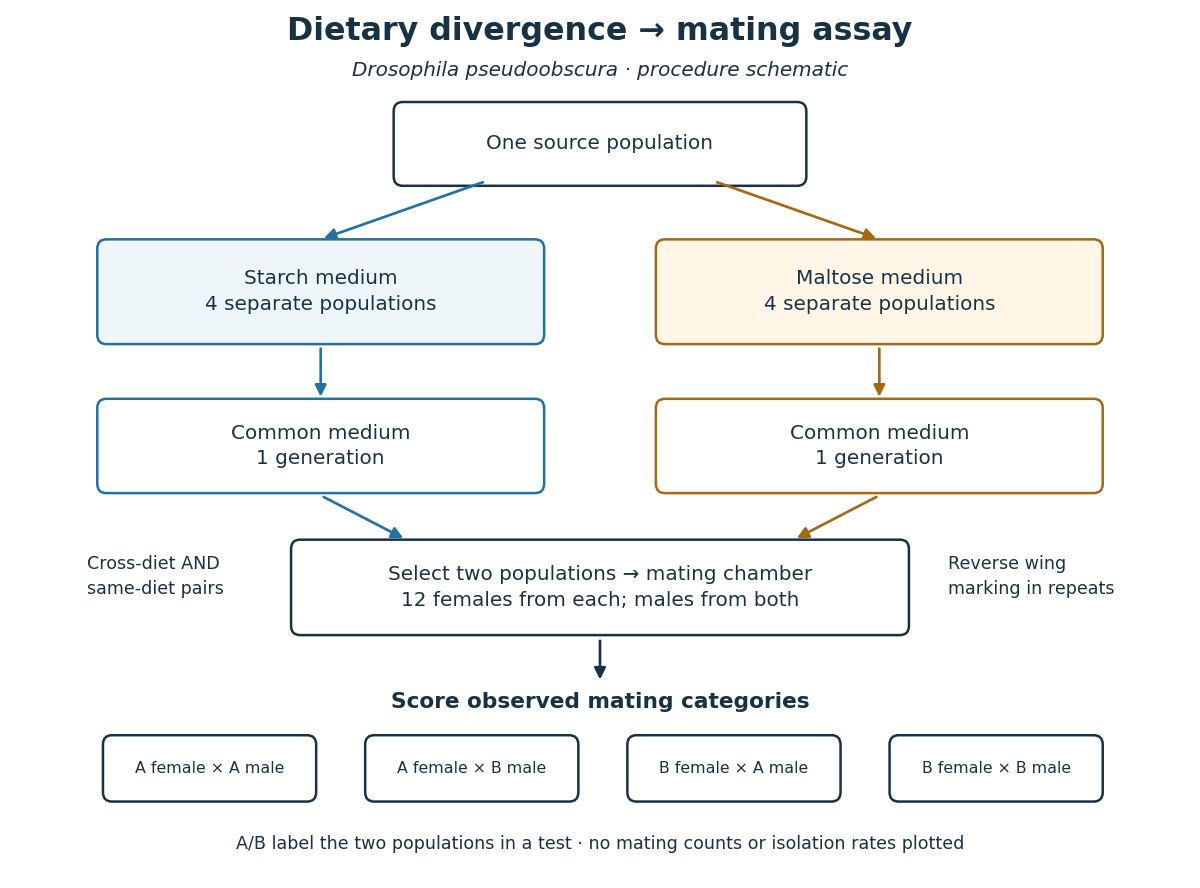
Design of the dietary divergence and mating isolation in Drosophila pseudoobscura assay
. Original design schematic. Arrows indicate procedure, not a measured reproductive isolation rate. The four mating categories are possible outcomes; no invented counts are shown. Details.
The causal inference remains limited. A negative same-diet hypothesis test does not prove zero reproductive isolation. One generation under common conditions does not exclude every persistent environmental influence. The chamber readout alone cannot identify a particular gene, establish offspring fertility, or predict gene flow after sustained contact in nature. Further experiments would need to target those questions separately.
For observed pairings between two labels , let and , where the first label denotes the female's group and the second the male's. A mating assortment contrast isIt lies between and . Positive describes an excess of same-label pairings over cross-label pairings; whether that is evidence of assortative mating depends on the null mathematical model and the assay. The four counts form a contingency table.
Here is an original scope check. Suppose independently paired females and males have probabilities of carrying label . ThenWith , the expected value is zero. With , it is , despite pairing being independent of label. This counterexample concerns unequal pool composition; it does not replace the group introductions and contingency table tests in the dietary divergence and mating isolation in Drosophila pseudoobscura experiment. Even with balanced pools, finite observed samples fluctuate: a positive alone is not a hypothesis test, much less a universal species boundary.
Articles by others on the same topic
There are currently no matching articles.