Egg laying, including choice of timing and substrate. Plant choice by an adult can determine the conditions experienced by its offspring.
Asexual reproduction produces offspring without fusion of gametes. An operational species concept for such organisms needs evidence other than interbreeding.
Budding produces a new individual from an outgrowth of its parent. In Saccharomyces cerevisiae, the daughter biological cell grows while attached to the mother and later separates; see the Burgess, Powers and Mell account cited there. Budding describes reproduction, not fermentation.
Mating between different individuals; its consequences depend on population structure and the compatibility of their alleles.
A sexual nuclear cycle involving fusion of pronuclei derived within one individual. In some Paramecium it renews the nuclear apparatus without outcrossing and produces pronounced homozygosity.
Maintenance of reproductive output when access to compatible partners or pollen is unreliable. Autonomous self-fertilization can provide it in suitable self-compatible plants, but bisexuality alone does not guarantee that outcome.
Occurrence of separate male and female reproductive structures on one individual. It does not mean that each flower is bisexual.
A reproductive or dispersal cell capable of initiating growth without fusion with another cell. In the ordinary land-plant sexual cycle, haploid spores formed by meiosis initiate gametophytes; they are distinct from fusing gametes.
Production of distinct microspores and megaspores that give rise to male and female gametophytes. Retention of developmental stages within spore walls changes protection and provisioning without itself removing the need for water-dependent sperm movement in heterosporous ferns.
The spore type developing into a male gametophyte. Its production is distinct from the later production of sperm.
Production of one principal spore type, as in many ferns. The resulting gametophytes may produce both kinds of gametes, with their actual sexual development depending on the species and conditions.
A resistant wall material in spores and pollen. It helps protect dispersal stages without eliminating the environmental requirements of later development.
Movement of spores away from their source. Resistant walls and elevated release can improve dispersal without guaranteeing germination or successful fertilization in the next generation.
Alternation between a multicellular haploid gametophyte and a multicellular diploid sporophyte. meiosis produces spores, whereas fertilization restores the diploid condition; the generations grow by mitosis.
The generation developing from a zygote and producing spores through meiosis. In the usual land-plant cycle it is diploid. Its nutritional independence and stature differ markedly between bryophytes and vascular plants.
A structure in which spores are produced. One unbranched bryophyte sporophyte bears a single sporangium; branching sporophytes can distribute several sporangia on one body.
A gamete is a reproductive biological cell that can fuse with another gamete during fertilization. In the ordinary diploid inheritance model, a haploid gamete carries one copy at each genetic locus.
Fertilization is fusion of gametes. Fusion of two haploid gametes restores the diploid state in the inheritance model used for Mendelian segregation.
In the common angiosperm arrangement, one sperm fuses with the ovum to form a diploid zygote; another fuses with the central biological cell's two polar cell nuclei, initiating endosperm with three chromosome sets. The zygote develops into a plant embryo, and the ovule develops into a seed.[ref]
For an original counting example, stipulate a plant with chromosomes and the common two-polar-nucleus arrangement. Each haploid sperm and ovum contributes . The zygote therefore has chromosomes, while the initiating endosperm cell nucleus has . The maternal seed coat remains derived from plant tissue; the whole seed has no single uniform chromosome count. This is bookkeeping for a stipulated example, not identification of a particular species. It follows by counting the chromosome sets entering each fusion, rather than assigning one count to everything enclosed by a seed coat.
The biological cell formed by fusion of gametes.
In angiosperms, pollination transfers pollen from an anther to a stigma. Fertilization is a later fusion of gametes; seed development follows. Pollination may use animals, wind or water, so an insect visit is neither required for every flower nor sufficient evidence of fertilization.[ref]
32.2 Pollination and Fertilization. Biology 2e, §32.2 opening definition, Pollination by Wind and Pollination by Water
A recognition system preventing some self or genetically incompatible pollinations from completing fertilization. Its presence and mechanism must be tested rather than inferred from bisexual floral structure.
Transfer of pollen between different individuals of the same species; compare self-pollination.[ref]
32.2 Pollination and Fertilization. Biology 2e, §32.2 opening paragraphs: self-pollination and cross-pollination
A flower can contain both reproductive groups and still receive pollen from another individual. Conversely, transfer between two flowers on one plant does not by itself imply cross-pollination. Following the donor and recipient individuals makes pollination useful for studying genetics: organ position alone cannot identify whose alleles meet at fertilization.
An angiosperm pollen grain is a small male gametophyte, not itself a seed or a single gamete. Its tube-forming biological cell supports delivery of sperm.[ref]
Observing the growth of pollen tubes (Practical Biology). Teaching notes: pollen grain and tube as male gametophyte
Use of identified pollen in sediments or other material to reconstruct vegetation and environmental change. Production, transport and preservation affect the relationship between counts and vegetation.
A growing extension from a pollen grain. In a compatible flower, the pollen tube provides a route for sperm to the angiosperm female gametophyte.[ref]
A pollen tube germination assay makes tube emergence visible outside a flower. The published Practical Biology experiment, Observing the growth of pollen tubes (Practical Biology), Technical note 3, lists florist lilies among successful materials without specifying a species. Record the actual identification; success with one sample cannot establish a universal growth rate.[ref]
Observing the growth of pollen tubes (Practical Biology). Technical note 3 and Teaching notes: material dependence and contorted versus straight tubes
Pearson's Core practical 4: Investigate the effect of sucrose concentration on pollen tube growth by Pearson Education Ltd, Teacher sheet, pp. 1–2, describes an inspectable experiment. Mix equal volumes of sucrose solution and mineral-salt medium on clean cavity slides. Dust in pollen from mature anthers with a mounted needle, record the addition time, and incubate without coverslips in covered dishes containing wet filter paper. The moist chamber reduces drying; the uncovered drops avoid oxygen limitation. Brief observations with an optical microscope at , using an eyepiece graticule calibrated against a stage micrometer, reveal tube emergence and length. Return slides to the chambers and switch off the lamp between observations to reduce heating and drying. For comparisons of sucrose concentration, use the same flower across treatments to control maturity, then repeat with other flowers.[ref]
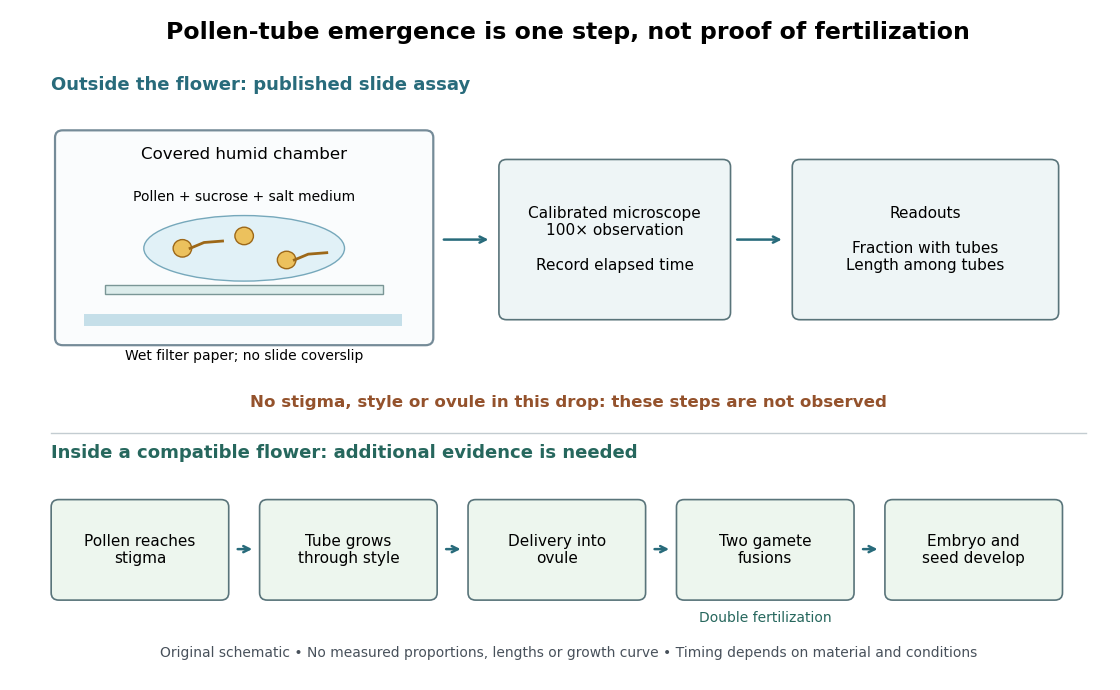
An additional proposed experimental design check is a medium-only slide: it tests whether debris is being mistaken for pollen tubes. Compare matched pollen samples at different final sucrose concentrations, keeping temperature, elapsed time and observation rules fixed. A sample known to produce pollen tubes in a previously successful medium would test whether an apparent failure comes from handling or the tested condition. These controls are questions to test, not guaranteed outcomes. A negative result cannot distinguish dead pollen from an unsuitable medium without further comparisons.
Two original calculations clarify the readout. First, take of sucrose solution and of sucrose-free medium. Assuming additive volumes, conservation of the amount of substance givesThis dilution also halves the medium's original component concentrations. Label the final molar concentration, not the starting bottle.
Second, stipulate a toy field containing pollen grains, of which have emerged pollen tubes. Its emergence fraction is . If those twelve pollen tubes have total measured length , their arithmetic mean length is . Assigning length zero to the other grains instead gives per grain. These invented numbers show why emergence fraction and mean length among emerged tubes answer different questions. Specify the denominator and the emergence criterion before counting, and avoid selecting only conspicuous long pollen tubes.
Tube emergence in a drop demonstrates growth under that medium's conditions. It observes no stigma interaction, passage through a style, delivery into an ovule, gamete fusion, or seed development. Thus a positive pollen tube germination assay does not demonstrate successful fertilization in a living flower. Its beauty is making one otherwise hidden part of sexual reproduction directly observable.[ref]
Observing the growth of pollen tubes (Practical Biology). Teaching notes: steps between pollen germination and seed formation; prepared style slides as a separate observation
Oogenesis is development of female gametes; the unequal divisions of human meiosis produce polar bodies alongside the developing ovum.
A germline-associated cell supplying macromolecules to an oocyte in systems such as Drosophila. Maternal RNA synthesis and its eventual localization are distinct processes.
A somatic cell surrounding an oocyte. In Drosophila melanogaster, ovarian follicle cells interpret oocyte signals and contribute to eggshell pattern and later embryonic positional information.
The plant life-cycle generation that produces gametes. In an angiosperm, male gametophytes are pollen grains and the female gametophyte is the embryo sac.
A name commonly used for a fern gametophyte. A small photosynthetic free-living body is a useful example, but not a description of every fern gametophyte.
An egg-bearing reproductive structure in relevant land-plant lineages. The young sporophyte can be retained on the maternal gametophyte after fertilization.

