For a nondegenerate convex minor spherical triangle, the spherical law of cosines relates two angular sides , their included interior angle , and the opposite angular side :Relabelling the vertices gives the corresponding formulas for and . As with the spherical law of sines, physical side lengths must first be divided by the sphere's radius. The spherical law of cosines determines uniquely from when the data describe such a spherical triangle. It also recovers each interior angle from three sides, for exampleUsing the cosine and the range selects a unique angle, avoiding the supplementary-angle ambiguity of an inverse sine calculation.
To derive the spherical law of cosines, let be the vertex unit vectors at , so , and . The outgoing unit tangent vectors at are and . Their dot product is both and , proving the identity. This gives a geometric explanation: spherical trigonometry compares angles in the tangent plane using vectors in the surrounding Euclidean space.
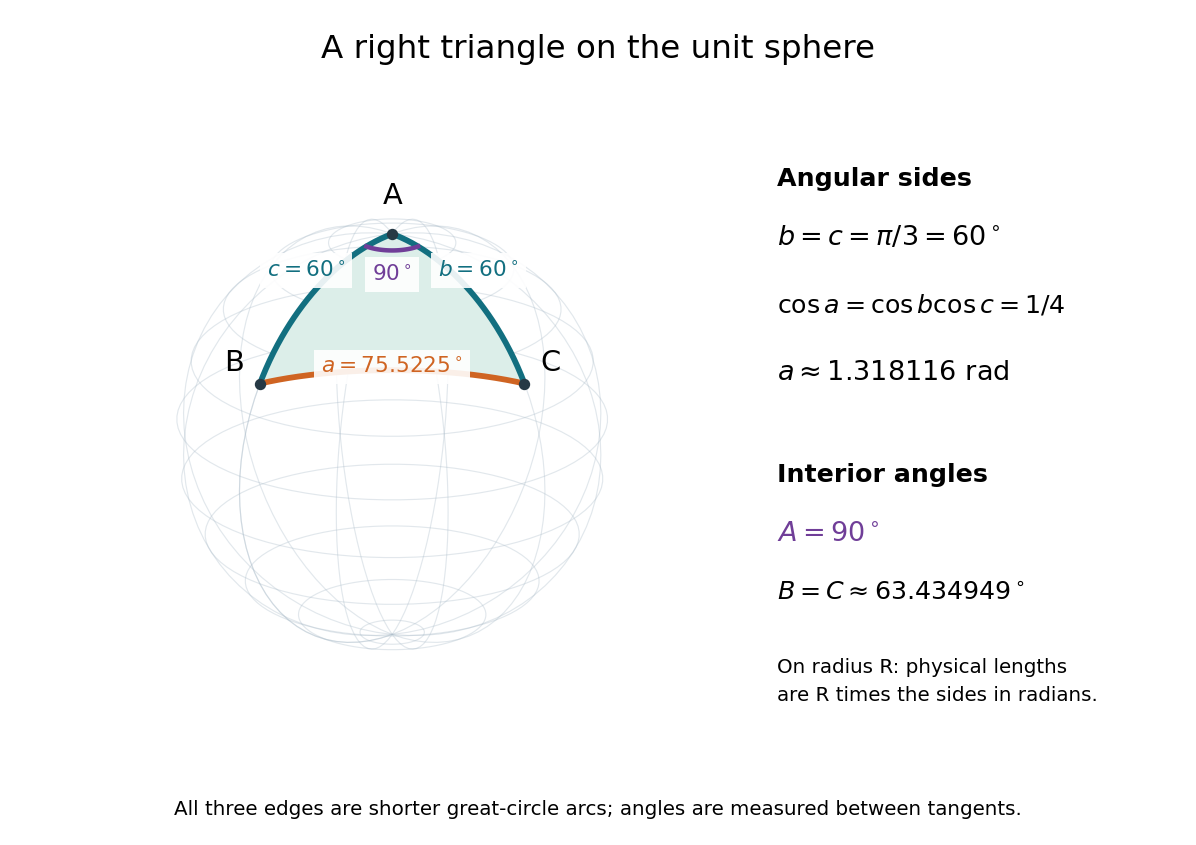
For a worked example on the unit sphere, take the verticesAt , the outgoing unit tangent vectors are and , so the interior angle is a right angle. The vertex dot products give . The spherical law of cosines then reduces to the right-angle identity , givingTo find , use the relabelled spherical law of cosines:The physical side lengths on a sphere of radius are and . For example, on a toy sphere with metres they are approximately , and metres; the interior angles stay the same. Applying the planar Pythagorean theorem directly to the angular sides would instead give . That flat right triangle calculation does not give the great-circle distance between and .
The familiar law of cosines reappears as a local approximation. With all small in radians, substitute the small-angle approximations and into the spherical law of cosines and keep terms through second order:Multiplication by gives the planar law of cosines for the physical side lengths. For a fixed small surface triangle on a progressively larger sphere, the angular sides shrink and this approximation improves. Thus the curved and flat formulas fit together: the Pythagorean theorem is recovered locally when is a right angle.
Articles by others on the same topic


The Spherical Law of Cosines is a fundamental theorem in spherical geometry, which deals with the relationships between the angles and sides of spherical triangles (triangles drawn on the surface of a sphere). Specifically, it is used to relate the lengths of the sides of a spherical triangle and the cosine of one of its angles.