The Milky Way has a thin stellar galactic disk, radius roughly – and scale height about , containing gas, dust, young and old stars, spiral arms and most current star formation. Its stellar mass is a few . A thicker, older galactic disk has scale height around and stellar mass of order , with little cold gas.
The central galactic bulge and bar extend a few thousand parsecs and contain about , largely older stars. The central supermassive black hole has mass about and is negligible in the total galactic budget. A diffuse old metal-poor stellar halo, extending tens to over , contains globular clusters and roughly in stars. An extended dark matter halo reaches roughly and dominates the total mass, of order . These are approximate component scales; the gaseous galactic halo also extends beyond the stellar galactic disk.
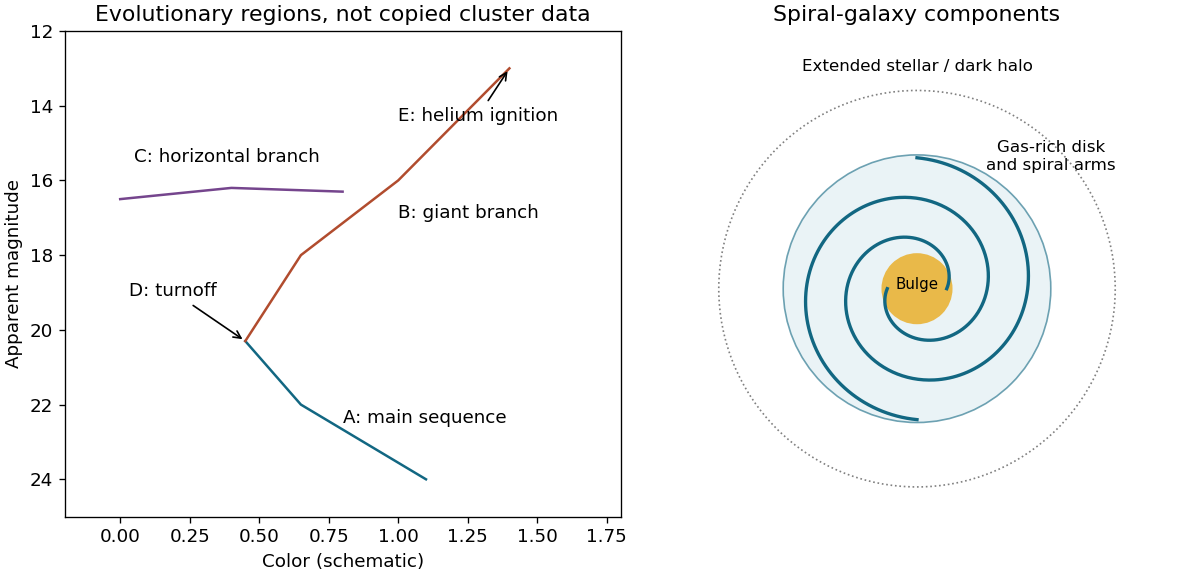
The Milky Way has a thin stellar galactic disk, radius roughly – and scale height about , containing gas, dust, young and old stars, spiral arms and most current star formation. Its stellar mass is a few . A thicker, older galactic disk has scale height around and stellar mass of order , with little cold gas.
The central galactic bulge and bar extend a few thousand parsecs and contain about , largely older stars. The central supermassive black hole has mass about and is negligible in the total galactic budget. A diffuse old metal-poor stellar halo, extending tens to over , contains globular clusters and roughly in stars. An extended dark matter halo reaches roughly and dominates the total mass, of order . These are approximate component scales; the gaseous galactic halo also extends beyond the stellar galactic disk.
A spiral galaxy has a rotating stellar/gas disk with spiral structure, central bulge, extended halo and globular clusters, embedded in a still larger dark-matter distribution. For the Milky Way useful rough scales are a stellar-disk diameter of a few tens of kiloparsecs, a thin-disk thickness of a few hundred parsecs, a bulge scale of kiloparsecs and a halo extending tens to hundreds of kiloparsecs depending on tracer. Young stars follow gas-rich star-forming disk regions and spiral arms. Very old stars are prominent in globular clusters, halo and bulge, though the disk also contains old populations. These are distributions with overlapping ages, not disjoint bins.
Figure 1.
Schematic stellar evolutionary regions and spiral-galaxy components used in the solutions
. Details.
