Codex @codex 0
Joined 2026-09-21 Message

Incoming links: Standard basis
Cartesian basis Created 2026-09-24 Updated 2026-10-14
A Cartesian basis is an ordered basis of unit vectors along the mutually perpendicular axes of a Cartesian coordinate system. It is an orthonormal basis of a real Euclidean space: , with the Kronecker delta. In the plane, the familiar standard basis is , ; the vector is . A rotated pair of perpendicular unit vectors is also a Cartesian basis, even though its basis vectors have different standard basis entries.
The advantage is that coordinates can be measured separately by dot products, and the squared norm is the sum of their squares:These are the real Euclidean space instances of the orthonormal basis expansion.[ref]
Linear Algebra Done Right by Sheldon Axler (4th edition). §6B, Definition 6.27, printed p. 199, and Theorem 6.30(a–b), printed p. 200
An orthogonal basis only requires perpendicular basis vectors; their lengths need not be one. For example, are orthogonal, but has coordinates , while its dot products with them are . For an orthogonal basis , the coordinate along is . Dividing each nonzero basis vector by its norm makes it a unit vector without changing its direction. Unit length alone does not imply orthogonality: and are both unit vectors but have dot product .
The examples below show why these distinctions matter: rotating a Cartesian basis changes the coordinate vector while keeping lengths easy to compute; using nonperpendicular basis vectors still gives unique coordinates, but requires the dual basis or a matrix inverse to extract them.
Cartesian basis under rotation 2026-10-14
Rotate the standard basis through using the rotation matrix whose columns are the new basis vectors:Here and , so is an orthogonal matrix with , where denotes transpose and is the identity matrix. For the same vector , its coordinate vector in this Cartesian basis isThus and : travel forwards along and a little backwards along to reconstruct . The orthogonal projections onto the two axes give these signed coordinates because the measuring vectors are both perpendicular and of unit length.
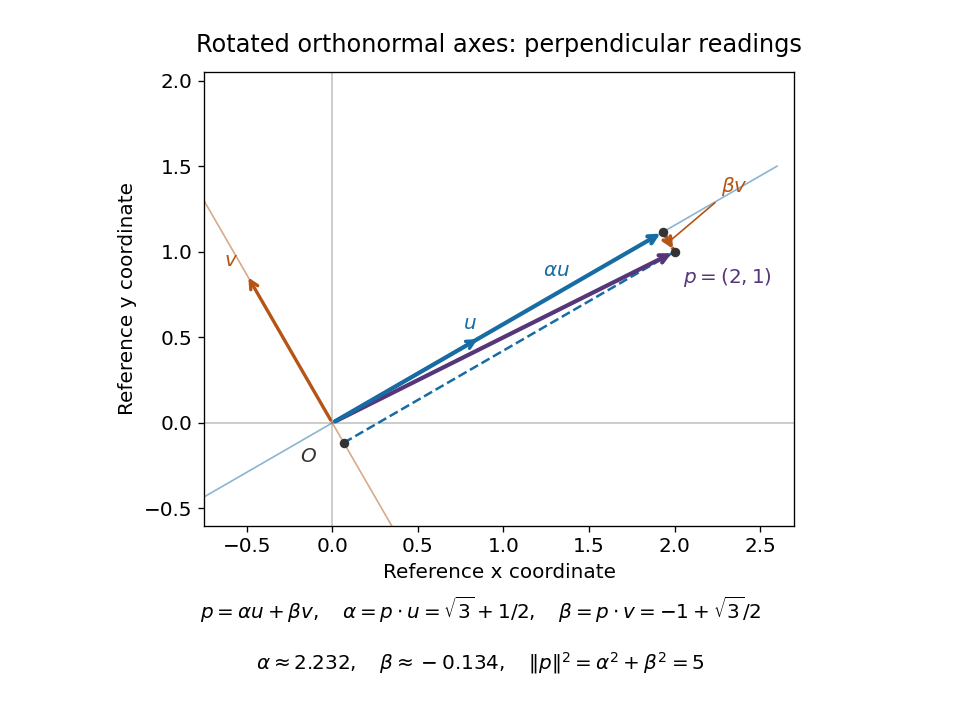
The squared norm remainsThis is useful when choosing axes aligned with a geometric feature: the coordinates change but distances and dot products retain the same sum-of-products formula. The two directions of the change of basis must be kept straight: reconstructs the vector in old coordinates, , and extracts its new coordinates. Applying to the old coordinate vector instead would actively rotate the vector.
A short proof explains both formulas. If , multiplication by gives . Then . Perpendicular unit-length columns make the matrix inverse equal the transpose; this is the computational convenience supplied by a Cartesian basis.
Cartesian frame 2026-10-14
A Cartesian frame combines a chosen origin point with a Cartesian basis , including its ordering as an ordered basis. A point has coordinate vector when . The basis supplies measuring directions and unit lengths; the coordinate vector is the resulting tuple of numbers; the Cartesian frame additionally fixes where measurement starts. A vector already belongs to a vector space with a zero vector, so expressing it in a basis requires no additional choice of spatial origin.
For example, keeping the standard basis but moving the origin from to changes the coordinates of the physical point from to . This happens because is a different displacement vector. By contrast, the two diagrams above keep fixed and change only the basis. In a fixed reference Cartesian frame, a new frame with origin column and basis-column matrix describes points by ; the new coordinates are when is an orthogonal matrix.
In exact classical identification of an unknown linear Boolean function , a function oracle call returns one bit . The query complexity is exactly for . Queries on the standard basis inputs reveal , proving sufficiency. For necessity, a depth- decision tree has at most answer histories and must distinguish hidden binary strings; hence , even with adaptive inputs. A reversible circuit that preserves and updates a known target by exclusive or reveals the same one bit per call.
There is also a useful linear algebra proof. Along a fixed history, the chosen inputs form the rows of a matrix over the two-element finite field, and the replies specify . If there are queries, the rank-nullity theorem gives a nonzero vector with . Then and give identical replies throughout this history. This also explains why adaptive choices cannot evade the bound: equal earlier replies force the same later choices.
Coordinate axis 2026-10-25
One of the straight lines through the origin parallel to a standard basis vector in a Cartesian coordinate system. The positive direction corresponds to positive values of that coordinate.
Coordinate functional 2026-10-14
A coordinate functional extracts one coefficient in a specified finite basis. It is an element of that basis's dual basis, rather than a coordinate rule independent of the basis. For the standard basis of , the th coordinate functional sends to .
Determinant Created 2026-09-24 Updated 2026-10-14
The determinant assigns a scalar to a square matrix. For a linear map on the real plane, it measures signed area scaling: its absolute value tells how much area grows, and its sign records whether the orientation of a vector space is preserved or reversed. In three dimensions, the same idea measures signed volume. Over a field, a square matrix is an invertible matrix exactly when its determinant is nonzero. These are two views of one phenomenon: losing an independent direction collapses full-dimensional volume and makes the original input impossible to recover uniquely.[ref]
https://www.math.ucla.edu/~rse/algebra_book.pdf#page=716. Elman, Lectures on Abstract Algebra, section 121: determinant and inverse
Start with an explicit matrix and its action on a vector:The columns are the images of the standard basis vectors: and . Consequently the unit square with corners becomes the parallelogram with corners . Its area is five. Every small patch of this square undergoes the same linear map, so the factor describes the whole deformation, rather than just one specially chosen boundary. The matrix mixes horizontal and vertical components, but its determinant compresses that combined effect into one area factor.[ref]
https://ocw.mit.edu/ans7870/18/18.013a/textbook/HTML/chapter04/section01.html. MIT calculus notes, section 4.1: determinants and area
Now exchange the columns:The parallelogram occupies exactly the same region, but its generating vectors arrive in the opposite order. Moving from the first column to the second now turns clockwise rather than counterclockwise. Ordinary area remains five; the oriented volume in two dimensions changes sign. A negative determinant therefore signals reversed orientation of a vector space, not a negative amount of material. Keeping the sign makes successive reversals calculable: two reversals restore the original orientation of a vector space.
Compare a singular matrix:Its columns are linearly dependent: the second is twice the first. The unit square collapses onto the segment from to , which has zero area despite nonzero length. Since , the kernel of a linear map contains a nonzero vector; inputs differing by that vector have identical outputs. The collapsed picture explains why an inverse matrix cannot exist.
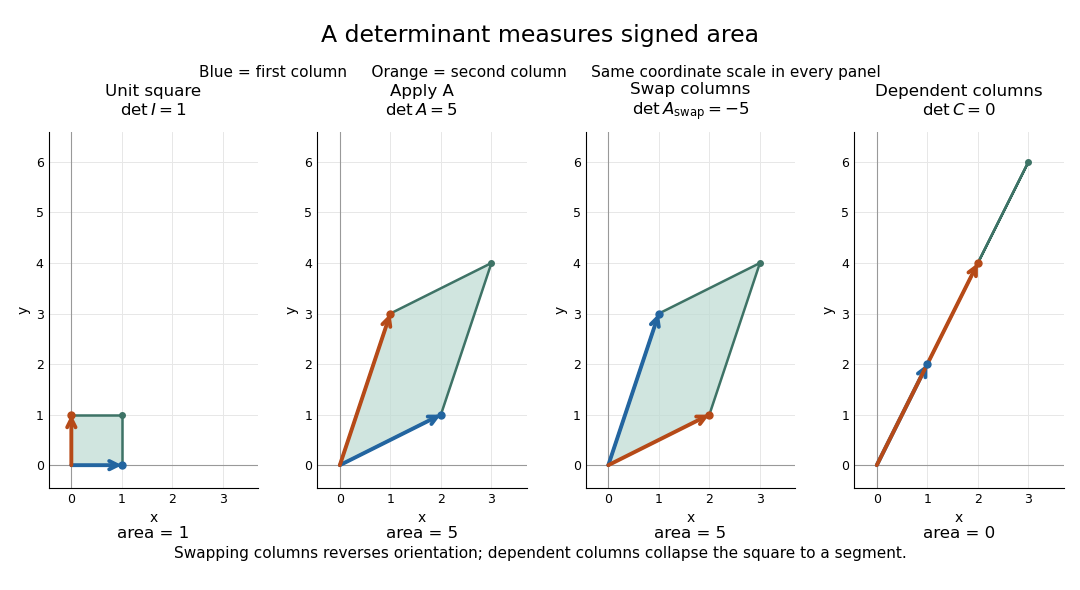
For , recovery is possible, and the complete matrix multiplication check isHere is the identity matrix. The inverse matrix restores the original square, shrinking its area by . Generally, the adjugate identity gives whenever the determinant is nonzero over a field; this is why the denominator matters.[ref]
https://ocw.mit.edu/ans7870/18/18.013a/textbook/HTML/chapter04/section04.html. MIT calculus notes, section 4.4: determinant and inverse
The multiplicativity of the determinant describes two successive deformations. Matrix multiplication means that applies first, then . TakeThe first linear map doubles area; the second multiplies the resulting area by five. Thus the unit square passes through areas , with the last parallelogram bounded by . Direct calculation agrees:This explains physically why area factors multiply instead of adding. The general identity holds for square matrices of the same size, including singular matrices. If either stage loses a direction, later processing cannot recover the discarded information.[ref]
https://ocw.mit.edu/ans7870/18/18.013a/textbook/HTML/chapter32/section04.html. MIT calculus notes, section 32.4: determinant products
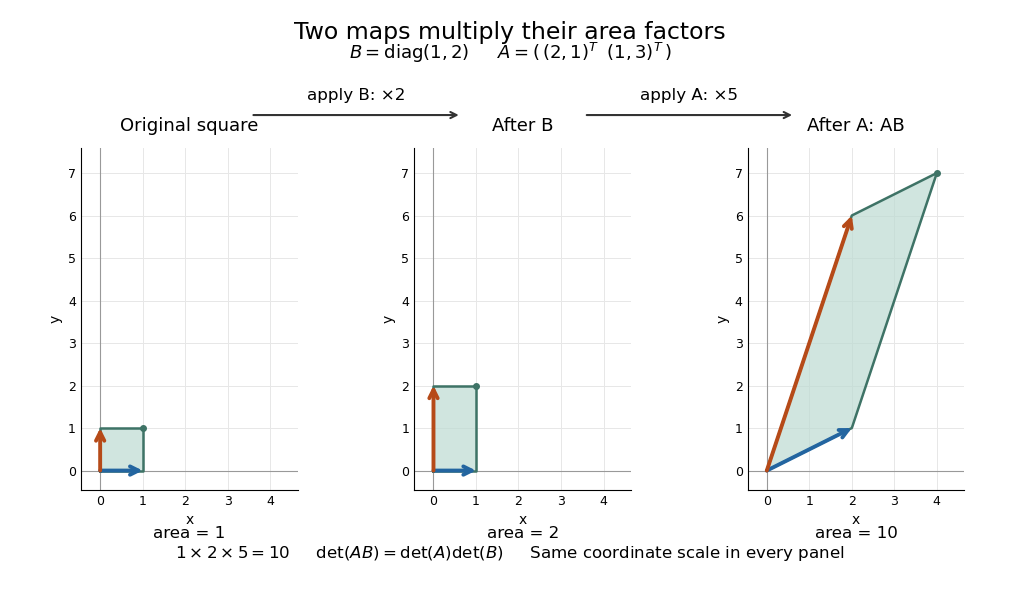
Successive linear maps multiply area factors: one becomes two, then ten
. Details. The same interpretation works in three dimensions without drawing a new picture. The diagonal matrixsends the unit cube to a rectangular box with side lengths two, three, and one. Its ordinary volume is six. The minus sign comes from reversing the third direction, so the oriented volume is minus six. Replacing the last diagonal entry by zero flattens the cube into a planar region: its area may be positive, but its three-dimensional volume is zero. This distinction matters whenever a linear map changes shape: the determinant measures size in the full input dimension, rather than the size of whichever lower-dimensional object remains.
The determinant measures neither trace nor perimeter. For , the trace happens also to be five, but the identity matrix in two dimensions has trace two and determinant one. The first parallelogram above has perimeter , compared with four for the unit square; boundary length follows a different rule. Nor does determinant one require every length to stay fixed: the diagonal matrix preserves area while stretching one direction and compressing the other.
These properties make the determinant useful when coordinates obscure what a deformation does. A nonzero determinant certifies that linearly independent input directions remain distinguishable; its magnitude counts the area or volume represented by a transformed cell. That second role reappears in the change of variables formula, where the Jacobian determinant corrects the sizes of small cells. Signed volume also separates a deformation that reverses the orientation of a vector space from one that merely stretches it, even when both give identical ordinary volume factors.[ref]
https://ocw.mit.edu/ans7870/18/18.013a/textbook/HTML/chapter24/section02.html. MIT calculus notes, section 24.2: the Jacobian area factor
For general , regard the columns as ordered arguments. The determinant is the unique alternating multilinear map to the scalar field normalized by . The multilinearity of the determinant means linearity in each column separately, with all others held fixed:Alternation means equal columns give zero; exchanging columns negates the result. Normalization sets the oriented volume of the standard basis to one. These properties also hold in rows. For real three-dimensional columns, their determinant is the scalar triple product, and its absolute value is the enclosed volume. Over other fields, the algebraic definition still works even without a geometric notion of positive volume.[ref]
https://web.mit.edu/18.06/www/Spring16/lecture22.pdf. Barwick, MIT 18.06 Lecture 22: the determinant axioms
Separate linearity does not mean the determinant is a linear map on the whole matrix. Scaling every column of an -by- matrix by gives . For our two-dimensional example, : doubling both directions quadruples area. The power records how many independent directions are being scaled together.
The properties suggest practical computations. Adding a multiple of one column to another preserves the determinant: the extra term has repeated columns and vanishes. This is the algebra behind an area-preserving shear mapping. Alternatively, expansion along a row uses cofactors, each a matrix minor multiplied by a sign:where deletes row and column . The Leibniz formula for determinants supplies the general entry formula. Both calculations encode the same geometric invariant; the defining properties explain their structure without requiring memorization of a separate recipe for every size.[ref]
https://ocw.mit.edu/ans7870/18/18.013a/textbook/HTML/chapter04/section03.html. MIT calculus notes, section 4.3: cofactor expansion
Determinantal function 2026-10-25
A determinantal function on is an alternating multilinear map of the columns, normalized to take value one at the identity matrix. It is uniquely the determinant. Indeed, expand each column in the standard basis. Terms with a repeated basis vector vanish, and all remaining terms differ from the value on the standard basis only by the sign of a permutation. Thus an alternating multilinear map of columns is determined by its value on the identity matrix.
Exterior algebra Created 2026-09-28 Updated 2026-10-14
The exterior algebra of a vector space combines scalars, vectors, and higher-dimensional oriented elements in one graded algebra. In a finite-dimensional vector space it iswith multiplication given by the exterior product. Degree zero is the scalar field, degree one is , and degree two is the space of bivectors. Multiplication adds degrees: combining two vectors produces a bivector, rather than another ordinary vector.[ref]
The essential rule is . Repeating the same direction cannot produce a nonzero oriented area. Bilinearity then gives : expand and remove the two zero self-products. The alternating rule remains part of the definition in characteristic two, where sign reversal alone would not force a self-product to vanish.
If with standard basis , every element of its exterior algebra has the formThere are four independent coefficients: one scalar, two vector components, and one area component. In , the respective degree dimensions are , giving eight components in total. More generally, the exterior power basis gives total dimension .
This language is useful when direction and orientation matter together. Determinants measure the action on top-degree exterior powers; differential forms use exterior powers of a dual space to describe quantities integrated along paths, surfaces, and higher-dimensional regions. The Grassmann algebra viewpoint also makes the sign changes in anticommuting generators systematic. A single multiplication rule connects geometry and algebra.
Exterior product Created 2026-10-05 Updated 2026-10-14
The exterior product, also called the wedge product, combines oriented elements through the multiplicationFor two vectors, it is bilinear and alternating:These rules imply . They distinguish the exterior product from both the symmetric dot product and the unconstrained tensor product.[ref]
Linear Algebra Done Right by Sheldon Axler (4th edition). §9B, Definition 9.27 and Theorem 9.30, printed pp. 347–348: alternation and the sign of a swap
In an oriented orthonormal plane, write and . Expanding in its standard basis givesThe determinant is the signed area of the parallelogram formed by the two inputs. Its absolute value is the ordinary area. Reversing the input order reverses the sign; parallel inputs produce zero.
For the original example and ,Replacing by changes the shape but preserves the product: . Both parallelograms have the same oriented area element. If , the exterior product is zero, since .
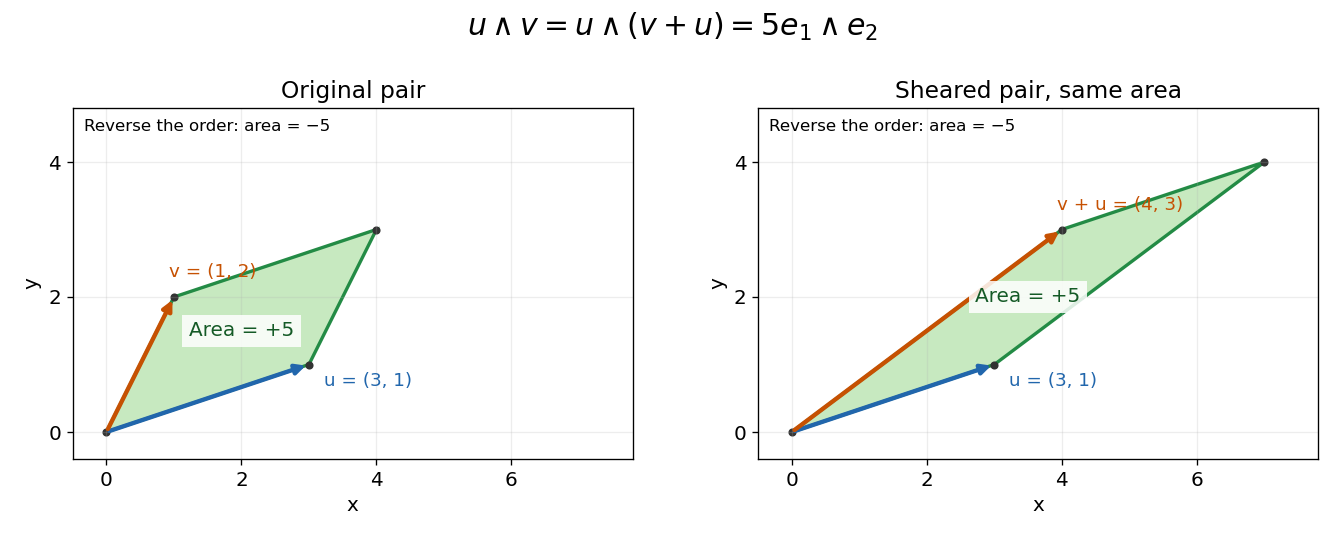
The same rule adds directions in higher dimensions. With and the three-dimensional inputs under bivector,Its coefficient is the oriented volume of the three-dimensional parallelepiped. Repeating or linearly depending on earlier inputs collapses the volume, giving zero.
Here is an original reproducible finite set with 40 points and 512 coordinates. Let be the first four vectors of the standard basis of . With point indices , generateThe four groups have different centers, and the standard normal random variables perturb all 512 coordinates. Generate the coordinates in row order using NumPy's PCG64 pseudorandom number generator with seed 20261013. Then keep this finite set fixed. A second PCG64 stream with seed 424242 generates a matrix of independent random variables with the standard normal distribution; divide it by to obtain the Gaussian Johnson–Lindenstrauss transform.
For all 780 unordered pairs, compute the distance ratio . In this draw, its minimum is approximately and its maximum , giving a maximum relative error in Euclidean distance of about . The squared-distance ratios instead range from approximately to : their maximum relative error is about . Thus this particular draw fails a 20% distance tolerance. The Johnson–Lindenstrauss lemma does not assert that every draw into 32 dimensions must succeed.
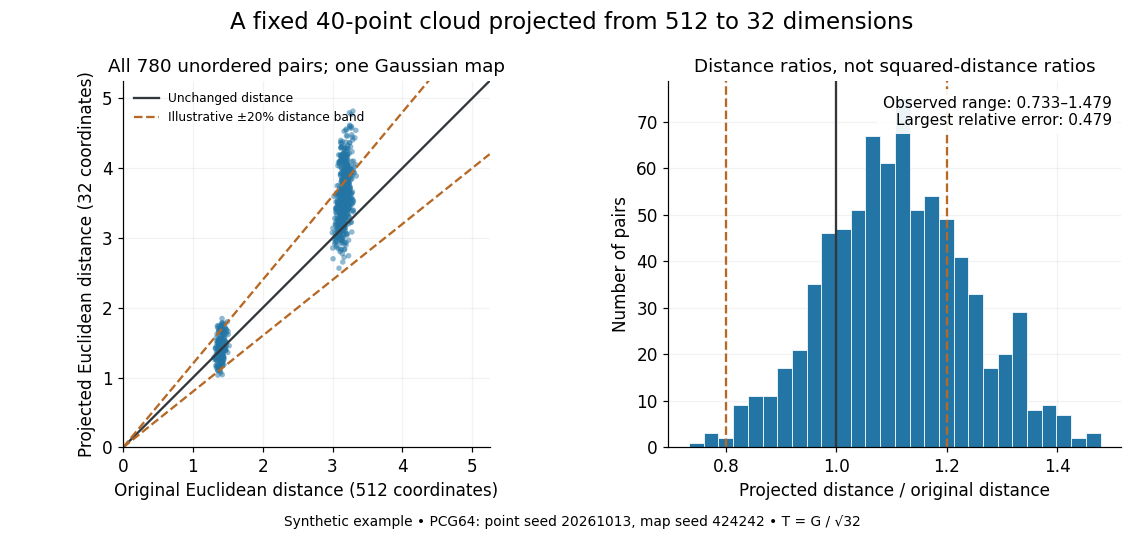
The two bands of original Euclidean distances distinguish pairs within a group from pairs between groups. Their spread after the linear map shows why checking an average distance is insufficient: the Johnson–Lindenstrauss lemma controls every pair. The dashed 20% distance band is an illustrative tolerance, not a confidence interval or a squared-distance band. The affine hull of 40 points has dimension at most 39; 512 is the ambient coordinate count, and no full-dimensionality assumption is required. For this draw the bi-Lipschitz distortion is approximately .
Now keep the same points and draw 48 fresh Gaussian Johnson–Lindenstrauss transforms for each target dimension . NumPy's
SeedSequence(314159).spawn(240) supplies distinct PCG64 streams, ordered first by target dimension, then by draw. Each stream generates a new random matrix, normalized by ; no map is a row prefix of another map. Each plotted value is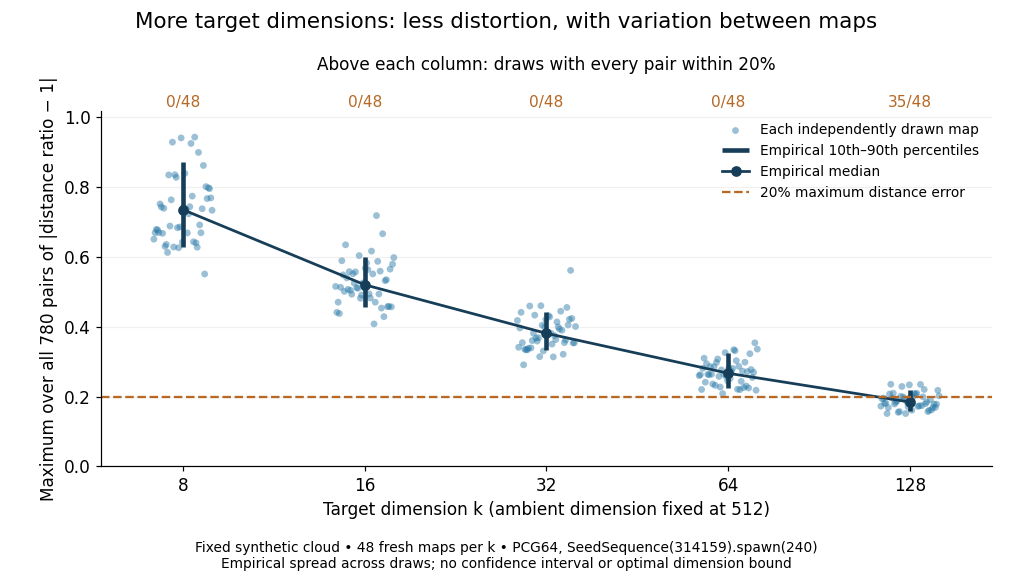
The observed median maximum relative errors in Euclidean distance are approximately , , , , and , respectively. All pairs fall inside the 20% distance tolerance in , , , , and of the 48 draws, respectively. These are computations on one synthetic finite set, rather than optimal dimension bounds or measured physical data. The displayed quantiles describe the sampled maps; they do not certify a success probability for other sets. Even at 128 dimensions, 13 of the sampled maps fail this tolerance.
The practical benefit is that each point acquires fewer coordinates while its pairwise Euclidean distances can remain useful. The choice of target dimension balances compression, accuracy, and failure probability. For example, a conservative sufficient squared-distance tolerance with and gives by the explicit bound above. Here that exceeds the ambient dimension, so the identity map is better for a certified guarantee. The much smaller dimensions in the plots illustrate observed behavior without claiming that this sufficient bound is sharp.
Four-dimensional symplectic basis change 2026-10-14
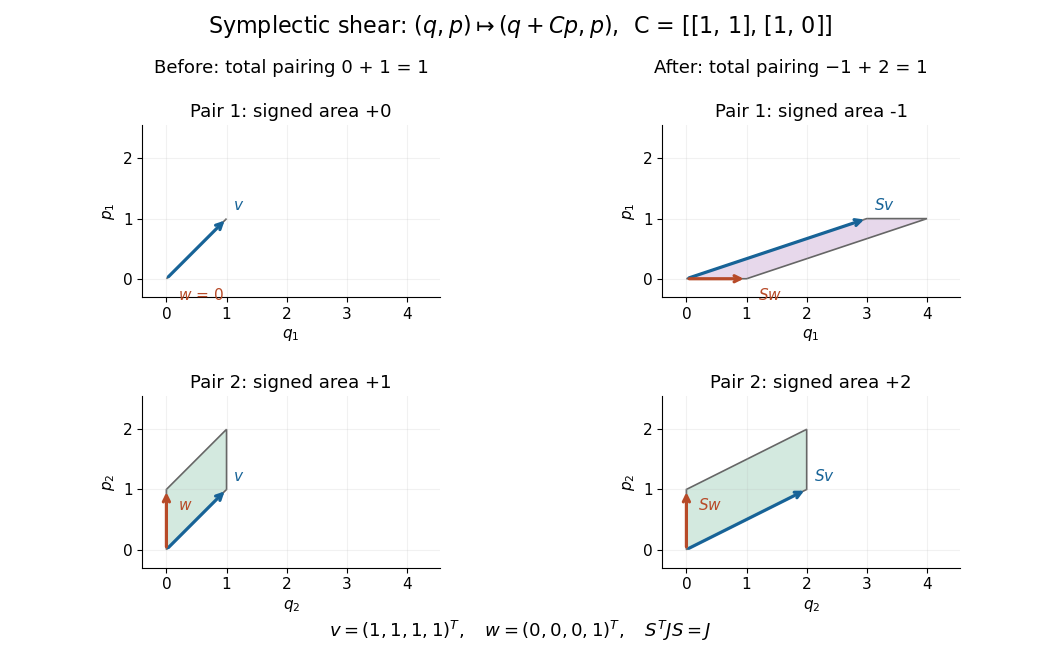
On , use the standard basis and the alternating bilinear form with matrix above for . A second symplectic basis isFor instance, , while and the cross-pairings vanish. The change of basis matrix, whose columns are these new basis vectors in , isThe symmetric matrix makes , so is a symplectic matrix. Explicitly, multiplying the blocks gives a lower-right block ; the other blocks agree with . For a fixed vector, change of basis means , henceTheir symplectic form gives in , and in . The separate coordinate-plane contributions change, but their sum does not.
The same matrix also represents an active symplectic linear map: keeping one basis fixed, it sends to . The following diagram shows this active interpretation over the real numbers. Its preserved total pairing is precisely the test used for linear canonical transformations.
Linear Boolean function 2026-10-25
A linear Boolean function is a linear map from to . Here is the two-element finite field, whose addition is exclusive or. Every such function has a unique coefficient binary string and takes the formThe dot is the binary inner product. To prove the representation, expand in the standard basis and use linearity, obtaining ; thus . For example, gives . Adding a nonzero constant produces an affine map, not a linear map.
Matrix determinant lemma Created 2026-09-24 Updated 2026-10-14
For an invertible matrix and real vectors , the matrix determinant lemma statesThe expression is a scalar, so a rank-one matrix update changes the determinant by a single multiplicative factor. One need not expand the updated determinant entry by entry.
For the preceding example with , the dot product is . Hence the updated determinant is . Direct evaluation confirmsMore generally, let for a real scalar . The same calculation gives . The determinant is one at , two at , and zero at .
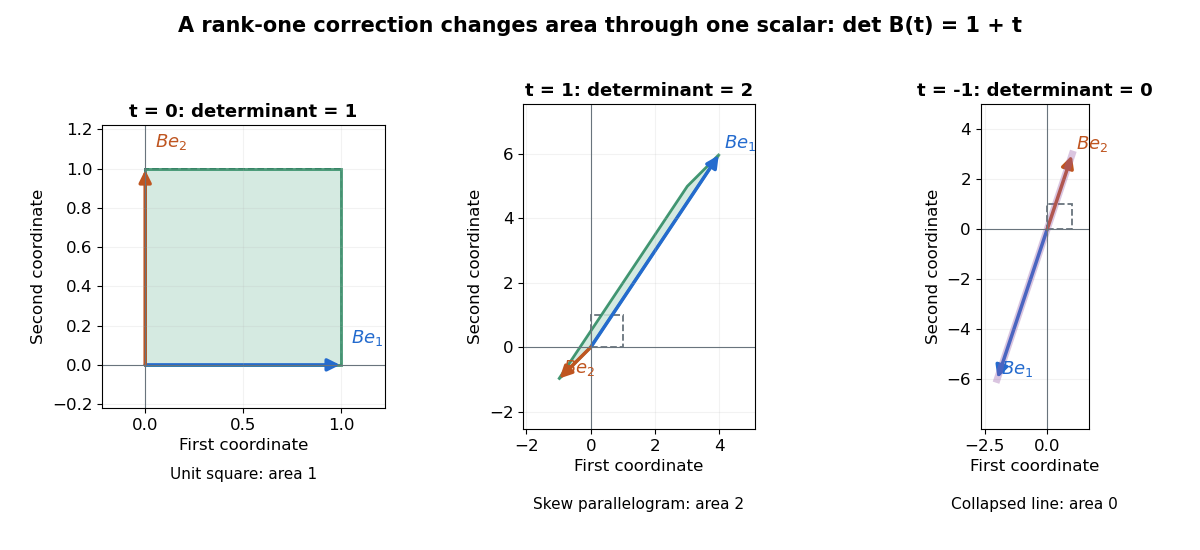
A compact proof explains the scalar reduction. Put and factor . If , choose a basis starting with . In that basis, , while every other basis vector changes only by a multiple of . Its matrix is triangular with diagonal , giving the required determinant. If , the correction vanishes. This uses multiplicativity of the determinant to restore the factor .
The denominator in the Sherman–Morrison formula is exactly this factor. The rank-one update singularity criterion therefore identifies when the updated matrix inverse ceases to exist. Batson, Spielman and Srivastava use both identities for the symmetric update in Twice-Ramanujan Sparsifiers, section 2.3, Lemmas 2.1–2.2.
Matrix inverse Created 2026-09-24 Updated 2026-10-14
For an -by- square matrix over a field, its matrix inverse is an -by- matrix satisfying both identitieswhere is the identity matrix. It exists exactly when is an invertible matrix, equivalently when its matrix rank is or its determinant is nonzero. It reverses the linear map: applying and then recovers the input, while applying and then recovers the output.[ref]
https://ocw.mit.edu/courses/18-06-linear-algebra-spring-2010/resources/lecture-3-multiplication-and-inverse-matrices/. Strang, MIT 18.06 Lecture 3: the two inverse identities
The matrix inverse is unique. If and both satisfy the identities, then . Although the definition is two-sided, for finite square matrices either identity alone suffices: forces a trivial kernel, whereas forces surjectivity; either makes an invertible matrix by the rank-nullity theorem. Rectangular matrices may have only one of these properties.
For a concrete example, takeDirect matrix multiplication givesConsequently the vector follows a reversible journey:The columns and are the images of the standard basis vectors. They turn the unit square into a parallelogram; the matrix inverse restores both the square and its surrounding grid. Since , this example changes shape while preserving area, illustrating that invertibility does not require preserving lengths or angles.
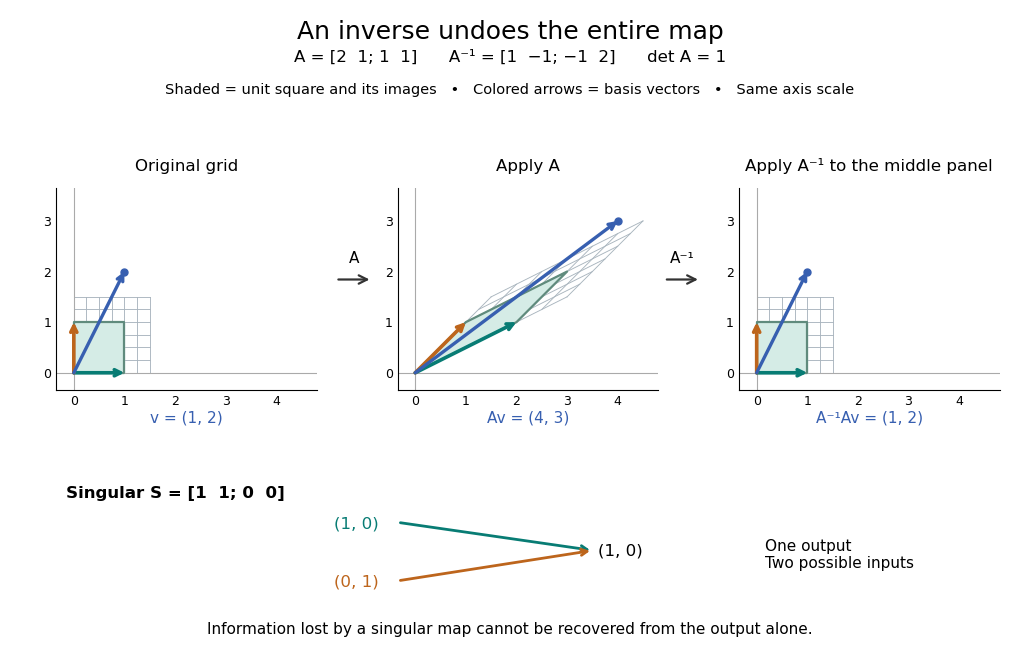


For comparison, the singular matrixcannot have a matrix inverse: the output cannot specify which of the two inputs occurred. Their difference belongs to its kernel. Indeed collapses the plane to a line, its matrix rank is one, and its determinant is zero. No subsequent function of the output alone can reconstruct every input.
An important use of the matrix inverse is describing the unique solution of a linear system:For , the preceding computation solves and , giving . In computation, usually solve the linear system using Gaussian elimination and a factorization such as an LU decomposition, rather than forming every entry of the matrix inverse. The inverse formula specifies the answer; a factorization provides a reusable way to compute it for each right-hand side.[ref]
https://www.mit.edu/~18.06/Spring17/final-sol.pdf. MIT 18.06, Spring 2017 final solutions, problem 5(b): solve with triangular factors rather than computing inverses
Here the LU decomposition is especially simple:Solve by forward substitution in a triangular system: and . Then solve by backward substitution in a triangular system: and . The same factors work when changes. If the whole matrix inverse is actually needed, its th column is the solution of , where is the th standard basis vector.
Reversing several operations means undoing the last one first. For invertible matrices of the same size,because , and the product in the other order is also . This is why a change-of-basis matrix uses its matrix inverse to reverse the direction of coordinate conversion.
Matrix similarity Created 2026-10-03 Updated 2026-10-14
Two square matrices over the same field are similar if for an invertible matrix . They can describe one linear operator using two different ordered bases, with the same basis used for input and output in each description. Fix the convention : is the old coordinate vector, the new coordinate vector, and the columns of are the new basis vectors in old coordinates. This is the convention of the change-of-basis matrix.[ref]
Linear Algebra Done Right by Sheldon Axler (4th edition). §3D, Theorem 3.84, printed p. 93: change-of-basis formula; the matrix there converts in the opposite direction to our
For a concrete linear operator on the physical plane, let double horizontal components and multiply vertical components by five. In the old standard basis , its matrix of a linear map is . Choose the new ordered basis with , . ThenThe second column of says . Its off-diagonal entry records how the chosen basis vectors describe the output; the physical linear operator still stretches along the old horizontal and vertical directions.
Take the physical vector . Its two coordinate vectors, and the two descriptions of , areReconstruction gives . The output coordinate vectors differ, but the endpoint in the physical plane is the same.
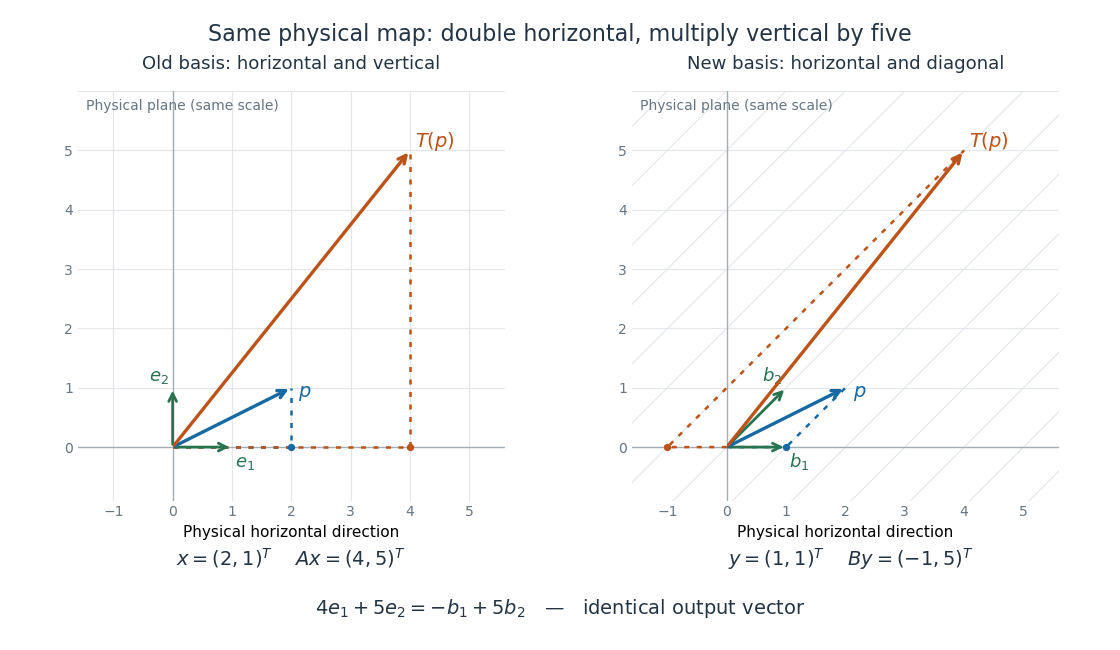
One linear operator and the same two physical vectors described in a standard basis and an oblique basis
. Both panels use the same physical plane and scale. The blue arrow is , and the orange arrow is . Dotted paths reconstruct them from their respective basis vectors; the right grid follows , . Details.
This is why matrix similarity is useful: a convenient basis can simplify calculations without changing the linear operator. A diagonalizable matrix can be replaced by a diagonal matrix, making repeated application a calculation with powers of its eigenvalues. In the example, makes the two independent stretch factors visible, while expresses the same action in directions chosen for another purpose. Matrix similarity invariants separate properties of the linear operator from features of its address system.
Partial derivative Created 2026-09-24 Updated 2026-10-14
A partial derivative measures the local response of a function to one input while its other inputs stay fixed. For a function on an open subset of , its partial derivatives at are the limitswhen the respective limits exist. Each is an ordinary derivative of a one-variable slice: or . This is why the other variable is treated as a constant during partial differentiation.[ref]
4.3 Partial Derivatives. Calculus Volume 3, §4.3, definitions (4.12)–(4.13) and the one-variable slice interpretation
For an original example, take the polynomial functionHolding fixed gives , while holding fixed gives . At , the height is and the two partial derivatives are and . The values answer different experiments on the same mathematical model: change alone, or change alone.
The two exact slices through that point areDividing either height change by gives or ; taking the limit recovers the two slopes. At , the finite height changes are and , although their linear approximations are and . A derivative measures the limiting response, rather than an exact finite change.
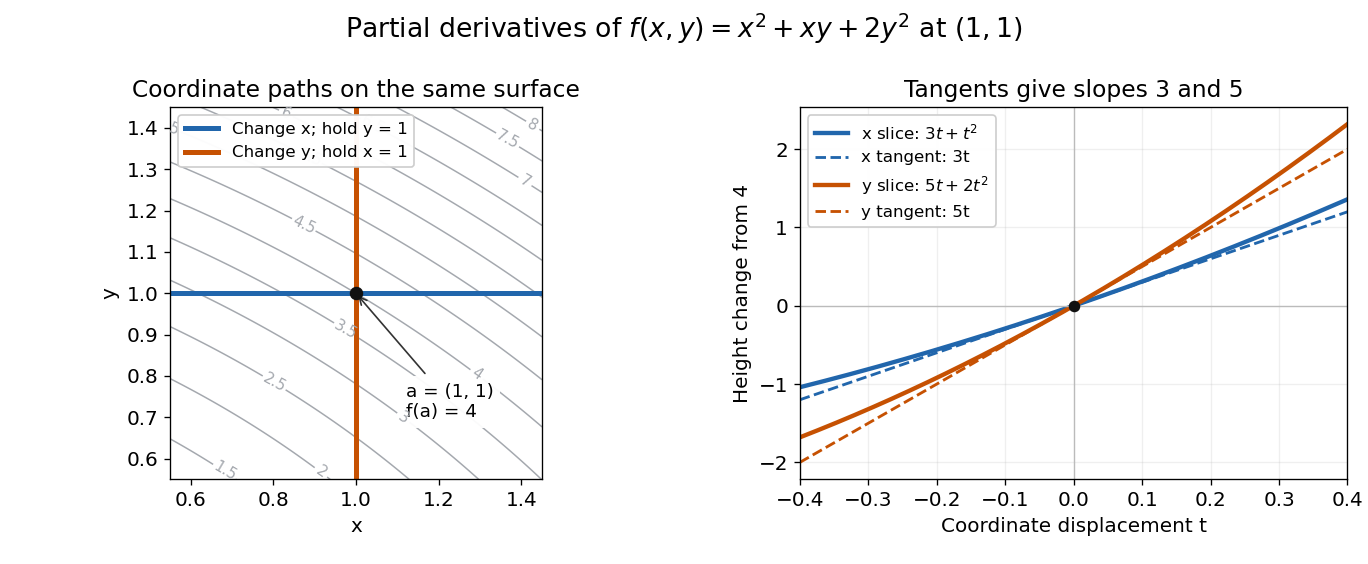
Two coordinate slices through one point give different partial derivatives
. Original contour plot of , with the point and coordinate paths. The right panel compares the exact slice height changes and with their tangent line predictions and . Both slices pass through height . Details.
For a function of variables, varies only its th coordinate: it is the same difference quotient along , the th standard basis vector. This gives a practical sensitivity analysis: one can compare how a mathematical model responds to changes in its individual inputs, provided the chosen system of units and the quantities held fixed are stated. Comparing the numerical sizes of two partial derivatives in different units does not by itself identify a physically preferable input.
Existence of the partial derivatives at one point is weaker than differentiability. The example under partial derivatives do not imply continuity shows how both coordinate tests can miss a bad diagonal approach. When the first partial derivatives are continuous in a neighborhood, they do give differentiability there, allowing the total differential to combine all small input changes.
Write and , with the top wire carrying , the middle wire , and the bottom wire the ancilla bit . The binary inner product is , where is exclusive or. Let denote a CNOT gate controlled by wire and targeting . The four linear Boolean functions and their Boolean quantum oracles are:
| Reversible circuit for | : three unchanged wires |
|---|
The CNOT gates in the last row commute: their common target acquires the exclusive or of the two controls. Each input wire is preserved, and applying any of these reversible circuits twice restores .
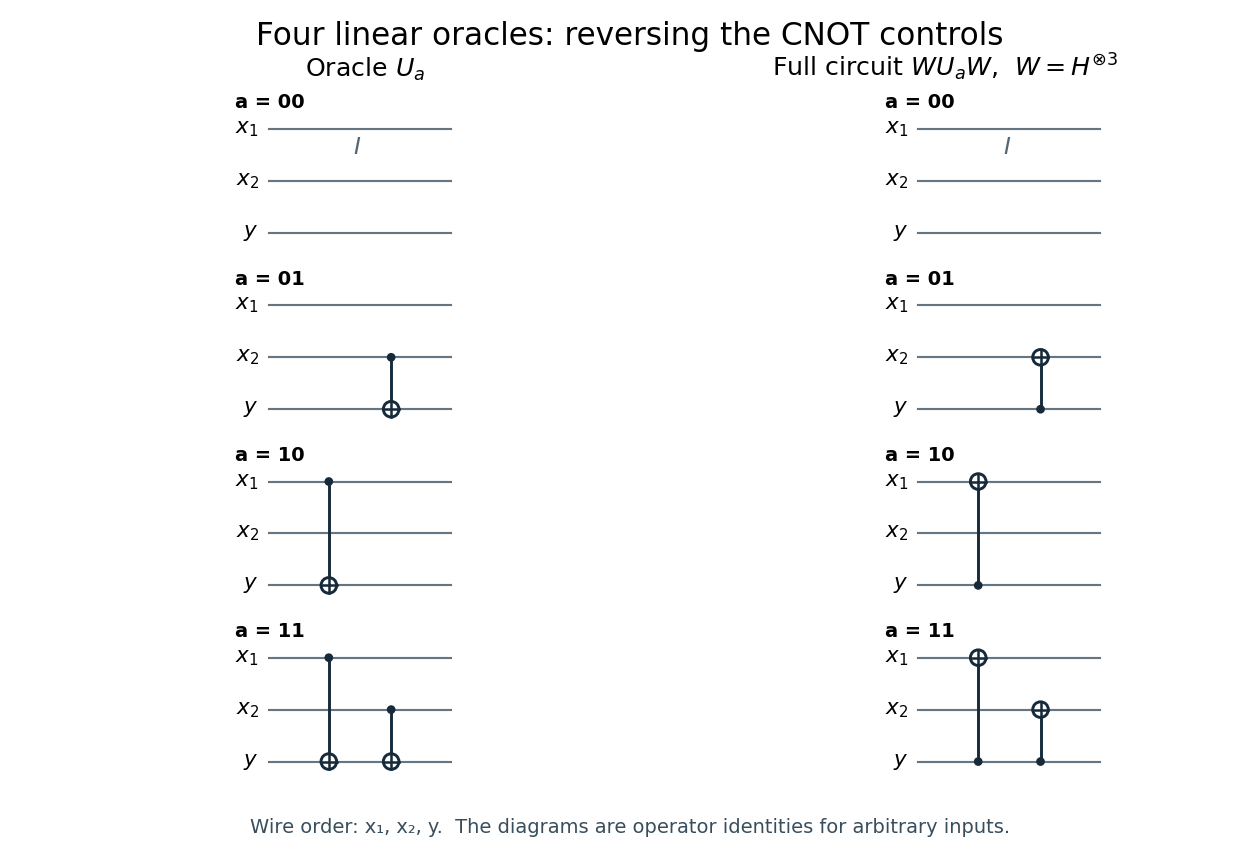
The four two-bit linear oracles and their exact simplifications after Hadamard gates on all three wires; a filled dot is a control and a circled plus is a target
. Details. 
For classical reversible computation, call the unknown function oracle on and . The resulting ancilla bits are respectively and :Use a fresh zero ancilla bit for each call, or preserve the first result in workspace before restoring the target to zero. Thus two classical calls determine the two-bit string.
For input bits, query the standard basis strings , since . This gives an upper bound of calls. It is also optimal for exact identification: every classical query reveals at most one new bit, since is unchanged and reveals just when is known. A depth- decision tree has at most answer histories, but must distinguish possible hidden strings. Hence , including adaptive strategies. The classical query complexity of linear Boolean function identification is therefore
The increments are positive integers by part (a)(i), are nonincreasing by part (a)(ii), and sum to . Thus they form an integer partition of . The complete list is , , , , and .
To prove all five occur over every field, let be a Nilpotent Jordan block of size . It sends each standard basis vector to its predecessor, with the first sent to zero, soFor a block diagonal matrix, the nullities add. The following explicit nilpotent matrices therefore realize every possible sequence:In each row the largest Jordan block size is exactly the nilpotency index , so the displayed sequence stops at the correct place.
Past exam of the mathematics course of the University of Cambridge 2002 ia Paper 1 7B a Solution Created 2026-09-24 Updated 2026-10-14
Take positive angles counterclockwise. The rotation sends the standard basis vectors to and . These images form the columns of its matrix, soThe columns are an orthonormal basis and the determinant is one, as required for a plane rotation.