The Stejskal-Tanner equation relates diffusion-sensitive echo attenuation to a rectangular gradient-pair experiment:It assumes free Gaussian diffusion with a constant scalar diffusion coefficient , ideal refocusing and two equal nonoverlapping rectangular gradient pulses of magnitude and duration , whose starting times are separated by . The gyromagnetic ratio is angular. The baseline is an otherwise matched echo without the applied diffusion-encoding gradients. These definitions are part of the formula, rather than optional choices of notation.[ref]
Spin Diffusion Measurements: Spin Echoes in the Presence of a Time-Dependent Field Gradient by E. O. Stejskal and J. E. Tanner. Pages289–290: Theory and rectangular-gradient case
The finite-duration term follows directly from the encoding history. Write . The effective encoding rises linearly from zero to , stays constant for , then falls linearly to zero. Each ramp contributes to the diffusion weighting b-value, soThe two physical gradients can have the same polarity: the intervening pulse reverses the effective phase-encoding sign.
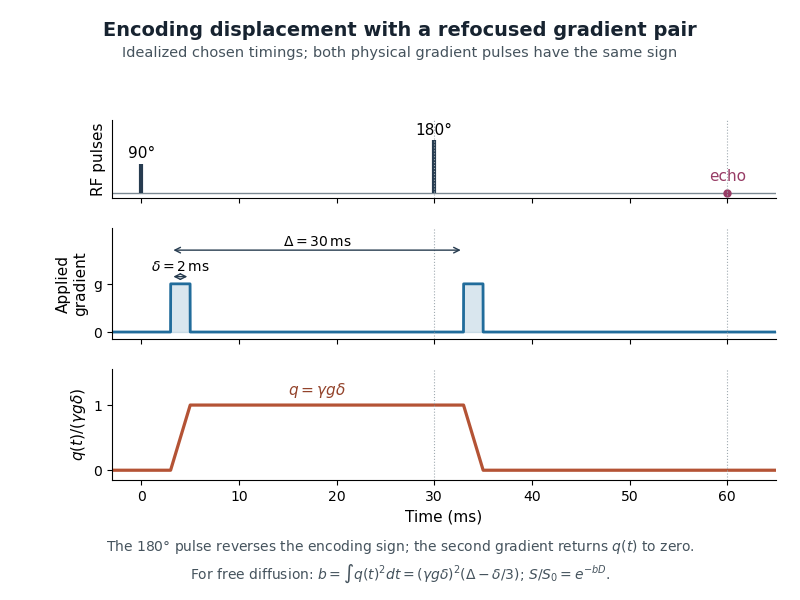

For the illustrated and , the normalized integral is , rather than . This isolates the pulse-duration correction without assigning an unmeasured gradient amplitude.
The 1965 work combined theory with apparatus tests, including slow self-diffusion in dry glycerol.[ref]
Spin Diffusion Measurements: Spin Echoes in the Presence of a Time-Dependent Field Gradient by E. O. Stejskal and J. E. Tanner. Pages288 and291–292: motivation, apparatus and experiments
Restricted diffusion, flow, background gradients and measurement noise require their own interpretation; fitting a single attenuation to this equation does not establish all of its assumptions. Articles by others on the same topic
There are currently no matching articles.