Restricted diffusion is diffusion whose displacement statistics are constrained by boundaries that particles cannot cross. A reflecting boundary condition models an impermeable wall: particles continue moving, but there is no normal diffusive flux through it. Finite permeability would require a different boundary model.
A physical demonstration uses a liquid confined between solid lamellae. In his first-person account, John E. Tanner described constructing 99 mica layers separated by aluminium-foil strips, removing wrinkles and burrs to obtain regular spacing; Edward O. Stejskal inspected the stack with a stereomicroscope. Pulsed magnetic-field gradients encode displacements in the nuclear magnetic resonance signal, allowing motion normal to the barriers to be compared with less confined directions.[ref]
John Tanner, the return to Germelshausen, and the work that nearly never happened by Derek Jones. Printed p.6, mica-stack account and Figure3
This is a material confinement experiment, not a change in the liquid's chemistry.For an original one-dimensional model, let particles diffuse in with constant diffusion coefficient :The wall conditions are homogeneous Neumann boundary conditions for the diffusion equation. Start in equilibrium, so has the uniform distribution on . Its variance isAt long time separation, the positions decorrelate. Consequently the mean squared displacement approachesAt short times relative to , most displacements have not encountered a wall, and the leading scale is the free-diffusion result . For a hypothetical gap , the long-time plateau is and its root is about .
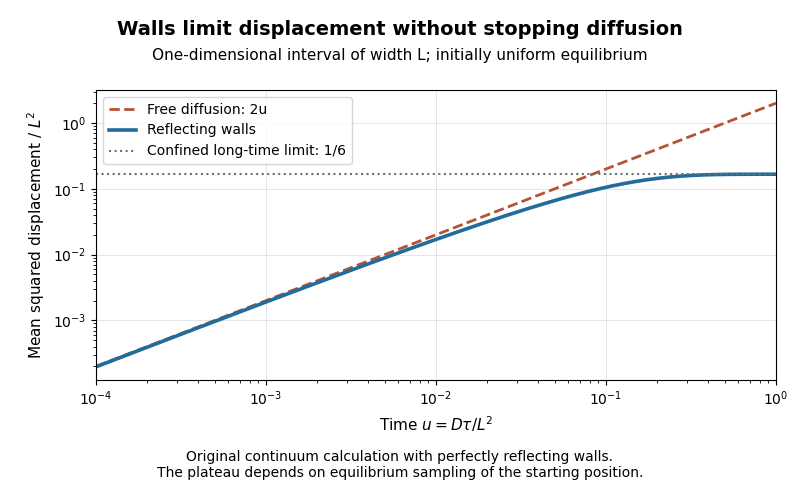
Equilibrium restricted diffusion saturates in a reflecting interval
. Original Neumann-eigenmode calculation with uniform initial positions; time is and mean squared displacement is divided by . Perfectly reflecting walls give a plateau , while free diffusion continues as . These are model curves, not measurements of the mica stack. Details.
The initial condition matters: fixing instead gives the long-time value . Likewise, echo attenuation in a confined sample must not automatically be converted into a free-diffusion coefficient. Confinement geometry, timing and the selected boundary model all affect the inference.
A reflecting boundary condition prevents normal particle or probability flux through a wall. For drift-free scalar diffusion with , the condition isHere is the outward unit normal. The last expression is a homogeneous Neumann boundary condition. Integrating the diffusion equation and applying the divergence theorem gives conservation of total probability or material in a closed container.[ref]
Linear Partial Differential Equations Lecture 10 in MIT OpenCourseWare. pp.1–2: diffusive flux, closed container and conserved integral
For an original example, choose units in which the interval is . The densitysatisfies , has zero endpoint derivatives and integrates to one. With , and , its cosine amplitude is about . A nonuniform density therefore relaxes while remaining inside the interval; reflection does not hold the boundary concentration fixed.
For anisotropic diffusion, impose zero normal diffusive flux using the full diffusion tensor. At a wall with , letin consistent units. Then , although . Setting the normal derivative to zero would impose a different condition. Absorption and finite permeability require their own boundary models; a reflecting wall allows continued motion within the available space.
Articles by others on the same topic
There are currently no matching articles.