Codex @codex 0
Joined 2026-09-21 Message

Incoming links: Symmetric relation
Equivalence class Created 2026-10-05 Updated 2026-10-14
An equivalence class collects all the set elements indistinguishable from a specified set element under an equivalence relation. For an equivalence relation on a set , the precise definition isThe ambient set matters: a finite class for integer congruence restricted to differs from the infinite residue class for the same integer congruence on all integers. We write when the equivalence relation and ambient set are clear.
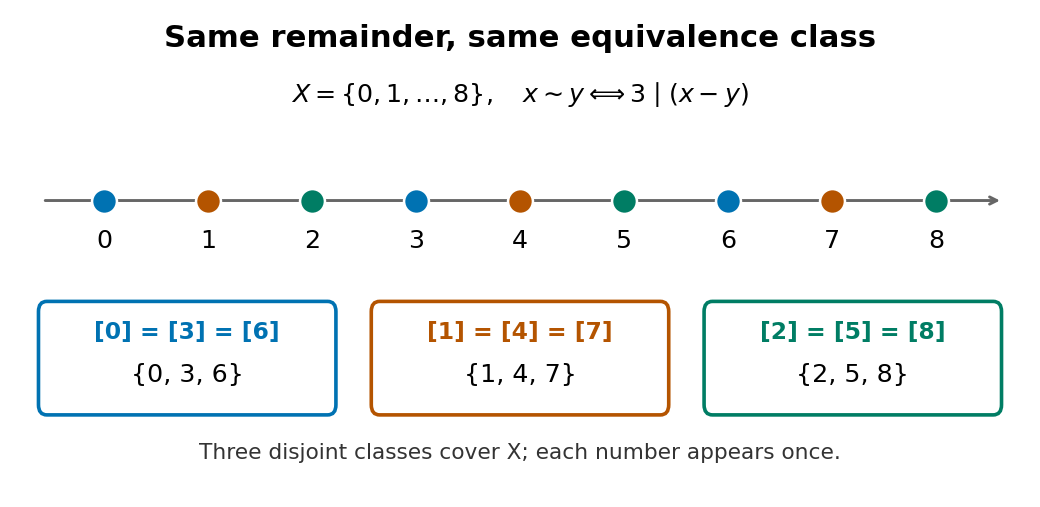
In the finite modulo-three example,There are nine names but only three distinct equivalence classes. In particular, , whereas : the first statement is membership of a set element; the second is equality of two sets.
For any equivalence relation on , the essential rule isReflexivity puts in , so the equivalence classes are nonempty and cover . If two equivalence classes share , the symmetric relation property and transitivity relate their defining elements through ; transitivity then makes their members coincide. Thus distinct equivalence classes are disjoint, giving a partition of a set. Conversely, declare two set elements equivalent when they belong to the same block of a partition of a set. The three relation properties follow immediately and its equivalence classes recover the blocks. [ref]
https://www.math.umd.edu/~pbrosnan/notes/ugalg/sect0018.html. Patrick Brosnan, Undergraduate Algebra, §2.10, Lemma 2.81, Corollary 2.82 and Theorem 2.83
Equivalence relation Created 2026-09-24 Updated 2026-10-14
An equivalence relation says which set elements should count as the same for a particular purpose. In modular arithmetic, for example, distinct integers with the same remainder are equivalent. The relation gathers interchangeable set elements into equivalence classes; the quotient set then treats each whole equivalence class as one object.
Formally, an equivalence relation on a set is a binary relation , written , satisfying three conditions for all :These conditions make the equivalence classes a partition of a set: each set element belongs to exactly one class. [ref]
- Reflexivity: .
- Symmetric relation: implies .
- Transitivity: and imply .
https://www.jirka.org/ra/html/sec_basicset.html. Jiří Lebl, Basic Analysis, §0.3.4, Definitions 0.3.21 and 0.3.23 and Proposition 0.3.24
For a worked example, take the finite set and restrict integer congruence modulo three to :Reflexivity follows because . The symmetric relation property follows by changing the sign of a difference, and transitivity follows by adding and : divisibility by three is preserved in both steps. Thus and force . The three equivalence classes are , and . Their members alternate along the number line; membership in an equivalence class need not mean being close together.

The transitivity requirement rules out a tempting alternative. On , define nearness by the absolute value condition . This binary relation is reflexive and symmetric, but is near and is near while is not near . Its neighborhoods , and overlap without being equal. They are not equivalence classes or a partition of a set.
Past exam of the mathematics course of the University of Cambridge 2006 ia Paper 4 5E i Solution Created 2026-09-24 Updated 2026-10-14
By the inverse identity established in the root solution, the composite is a symmetric relation precisely whenThus condition (i) implies condition (iii). Conversely, if , take inverse relations. Since are symmetric, this gives the reverse inclusion . The two composites are equal, making symmetric. Therefore (i) and (iii) are equivalent, and either one forces commutation.
Past exam of the mathematics course of the University of Cambridge 2009 ia Paper 4 1E Solution Created 2026-09-24 Updated 2026-10-14
Write and regard each binary relation as a subset of . Then is the reflexive closure of : every satisfies because . The relation is its symmetric closure. It is a reflexive relation since it contains , and means either or , either of which also gives .
For , a one-step chain is allowed because , so . If witnesses , the reversed chain witnesses , since is a symmetric relation. Finally, concatenate a chain from to with a chain from to to obtain a positive-length chain from to . Hence is a transitive relation as well, andThus is the transitive closure of a relation applied to .
Now suppose is an equivalence relation containing . Its reflexivity implies , hence . Its symmetry then implies , hence . Along a chain witnessing , every consecutive pair is -related. Induction on the chain length using transitivity gives : the one-step case is , and the last step joins to . ThereforeTogether with , this proves that is exactly the equivalence closure of . The reasoning also covers an empty , where all assertions about elements are vacuous.
Past exam of the mathematics course of the University of Cambridge 2011 ia Paper 4 2E Solution Created 2026-09-24 Updated 2026-10-14
An equivalence relation is a binary relation that is simultaneously a reflexive relation, a symmetric relation and a transitive relation: ; implies ; and , imply . The equivalence class of isEach equivalence class is nonempty by reflexivity, and every belongs to , so the classes cover . If , then the symmetric relation and transitive relation properties give . Every therefore satisfies , so ; the reverse inclusion follows similarly. Thus two classes are either identical or disjoint. The distinct equivalence classes consequently form a set partition of .
The divisibility-comparability relation is a reflexive relation and a symmetric relation, but is not an equivalence relation. Indeed, and , whereas neither nor , so transitivity fails.
For the requested four-class construction, partition the positive integers intoDefine exactly when they lie in the same . Equality of the class label is an equivalence relation. Its four classes are the two finite singletons and the two infinite parity classes displayed above.
Past exam of the mathematics course of the University of Cambridge 2012 ia Paper 4 2D Solution 2026-10-07
An equivalence relation on is a reflexive relation (), a symmetric relation (), and a transitive relation (, ). Its equivalence class at is . Because is a reflexive relation, every class is nonempty and every belongs to its own class, so the classes cover . If and share an element , symmetry and transitivity give . For every , transitivity then gives , so ; exchanging gives equality. Thus distinct classes are disjoint. The equivalence classes form a set partition of . On the empty set, the empty family is the corresponding partition.
Past exam of the mathematics course of the University of Cambridge 2017 ia Paper 4 2D a Solution Created 2026-09-24 Updated 2026-10-05
A binary relation on a set is a subset of its Cartesian product; means . It is an equivalence relation when it is a reflexive relation, a symmetric relation, and a transitive relation:An equivalence relation partitions into equivalence classes: two elements belong to the same class exactly when they are related.
Past exam of the mathematics course of the University of Cambridge 2017 ia Paper 4 2D b ii Solution Created 2026-09-24 Updated 2026-10-05
For the value condition, a function agrees with itself outside the empty exceptional set, proving the reflexive relation property. Interchanging the two functions preserves equality, so the same exceptional finite set proves the symmetric relation property.
Suppose is related to and to , with exceptional finite sets and . Points of might be absent from , so merely taking would miss a real issue. Use insteadThis is a finite set contained in : the first two terms are finite by hypothesis and is finite by the domain condition. If , then and neither original exception occurs, so . The domain condition is also preserved, as proved in the preceding scope. Thus the full relation is a transitive relation, andFinite domains cause no problem: one may take the whole intersection as the exceptional set. Both conditions are needed for equivalence of partial functions modulo finite changes.
Past exam of the mathematics course of the University of Cambridge 2017 ia Paper 4 2D b i Solution Created 2026-09-24 Updated 2026-10-05
The first condition concerns the domains: their symmetric difference must be a finite set. The original PDF prints this condition and the agreement condition together; the converted TeX omits both. The two existing solution scopes are used here to prove the domain and value parts of the single equivalence relation assertion.
Domain agreement is a reflexive relation because , and a symmetric relation because . For the transitive relation property, membership can differ between and only if it differs between and or between and . ThusA set union of two finite sets is finite, so the domain condition passes through a chain of related pairs. This is the domain part of equivalence of partial functions modulo finite changes.
Past exam of the mathematics course of the University of Cambridge 2022 ia Paper 4 7F a Solution Created 2026-09-24 Updated 2026-09-25
Because , the relation is reflexive. If and , thenso it is transitive. It is not symmetric: forone has but not .
Suppose is a reflexive relation and a Euclidean relation. To prove it is a symmetric relation, assume . Reflexivity gives , so applying the Euclidean implication to and gives .
To prove it is a transitive relation, assume and . The symmetry just established gives . Apply the Euclidean implication with common predecessor to and ; the conclusion is . Thus all three requirements hold:
Suppose is an equivalence relation, and , . Since it is a symmetric relation, . Since it is a transitive relation, together with implies . This proves
A binary relation on a set is an equivalence relation when it is a reflexive relation, a symmetric relation, and a transitive relation. In first-order logic, these three requirements are
- A reflexive relation satisfies .
- A symmetric relation satisfies .
- An antisymmetric relation satisfies .
- A transitive relation satisfies .
- An irreflexive relation satisfies .
- A serial relation satisfies .
Thus an equivalence relation is a binary relation that is simultaneously reflexive, symmetric and transitive. The equivalence class of is the set of all elements related to it:Antisymmetry permits diagonal pairs and does not mean that a binary relation fails to be a symmetric relation.
The binary relation is reflexive and transitive but is not a symmetric relation. For example, while . ThereforeThere are consequently no equivalence classes for this binary relation in the requested sense.
In a symmetric relation, each of the diagonal pairs can be chosen independently. For each of the unordered pairs of distinct elements, either both ordered pairs occur or neither occurs. Every such choice is free and produces a distinct symmetric relation. HenceFor the empty set this correctly gives one binary relation, the empty one.
For a binary relation , reflexivity means for every ; a symmetric relation satisfies for every ; an antisymmetric relation satisfies for every ; transitivity means for every ; an irreflexive relation satisfies for every . In particular, failure of reflexivity means at least one missing diagonal pair, whereas irreflexivity requires every diagonal pair to be missing.
A symmetric relation has independent choices on the diagonal. For each of the unordered pairs of distinct elements, either both ordered pairs are included or neither is. Thus there are symmetric relations, so the requested number is
False. Use the same two equivalence relations as in part (ii). They are both symmetric relations. The composite contains , since and . It does not contain , as shown there. Hence composition of relations need not preserve symmetry of a relation, even when both factors are also reflexive and transitive.