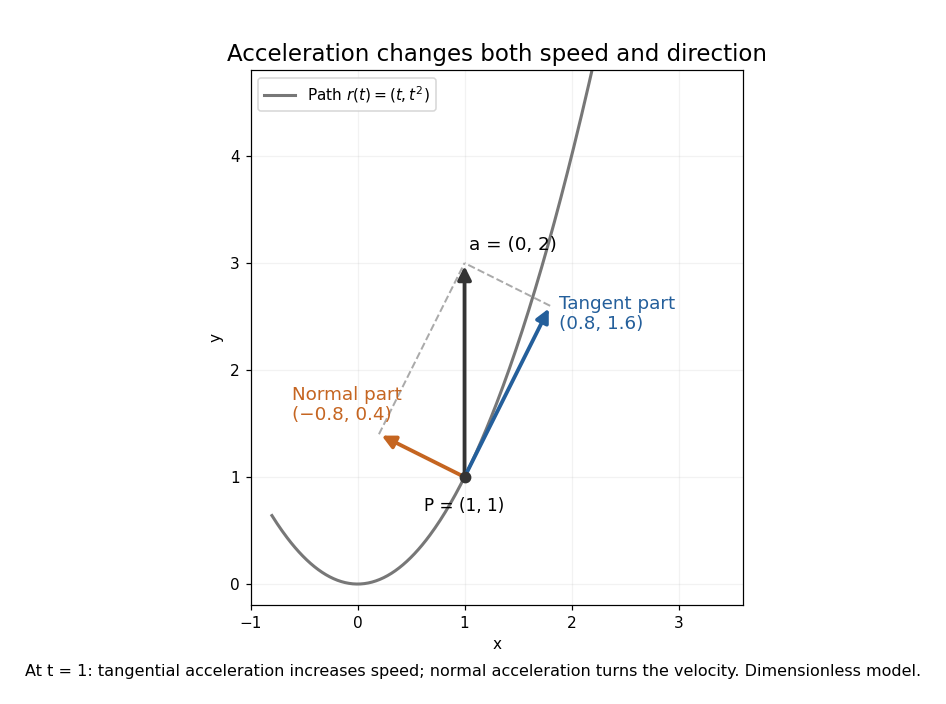
For a twice continuously differentiable regular curve describing motion, let , , and let be the principal normal vector where the curvature is positive. Differentiating the velocity vector givesThe tangential component changes the speed; the normal component changes the direction of the velocity vector. A particle can therefore have nonzero acceleration at constant speed, as in circular motion with constant speed. The formula follows from and the product rule. When , the normal contribution vanishes even though the principal normal vector is undefined there. [ref]
https://ocw.mit.edu/courses/16-07-dynamics-fall-2009/84852a46fa77de9a750245ceb761255a_MIT16_07F09_Lec06.pdf. Widnall and Peraire, MIT 16.07 Lecture 6: intrinsic coordinates, pp. 1–4
In dimensionless coordinates, take . At ,The resulting vector components areBoth increasing speed and turning contribute to the same acceleration.

Articles by others on the same topic
There are currently no matching articles.