A positive resistive electrical load obeys Ohm's law, . Its resistive load line intersects the Thévenin terminal response atprovided . For the Thévenin divider example, gives and ; gives and . At , the voltage is , half the open-circuit voltage.
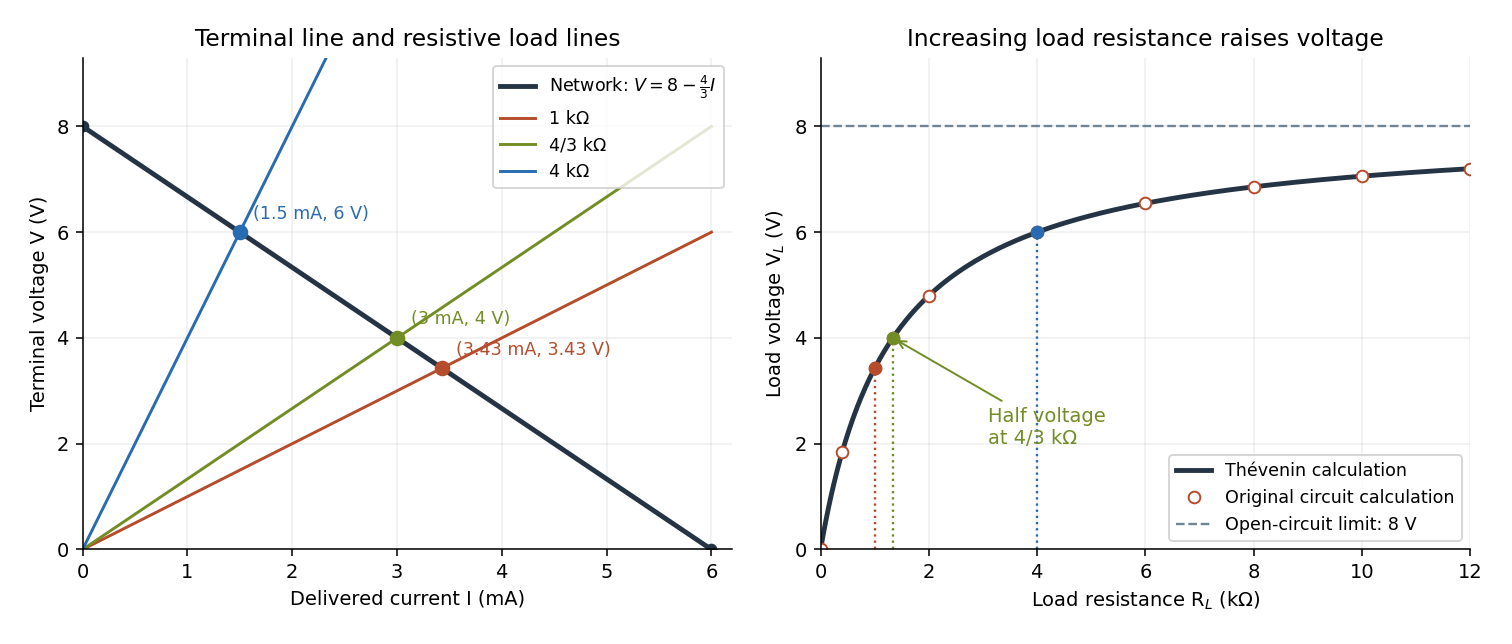

For this positive , increasing reduces the drawn electric current and raises toward . This explains voltmeter loading: a voltmeter itself is an electrical load. The equivalence also applies to a nonlinear electrical load through intersection with its terminal relation, but an arbitrary load need not give a unique operating point. If negative cancels positive , the displayed formula is singular; a real active circuit's limits and dynamics must then be considered.
Articles by others on the same topic
There are currently no matching articles.