Thévenin's theorem replaces the terminal behavior of a linear resistive circuit by an ideal voltage source in series with a Thévenin resistance, whenever its terminal electric potential difference is a well-defined affine function of the delivered electric current. Fix terminals , write , and take positive out of the network at into the electrical load, returning through . ThenThe open-circuit voltage is the intercept at ; is the slope. Thus two parameters predict what happens when many different electrical loads are connected. The Wheatstone bridge detector loading calculation uses precisely this replacement to find the detector reading even when the bridge's two voltage dividers interact through its detector.
For example, a ideal voltage source with above and below a voltage divider junction supplies and at that junction relative to the lower terminal. Attaching a electrical load reduces its voltage to and draws . The equivalent explains why an unloaded divider ratio alone cannot predict a loaded output.
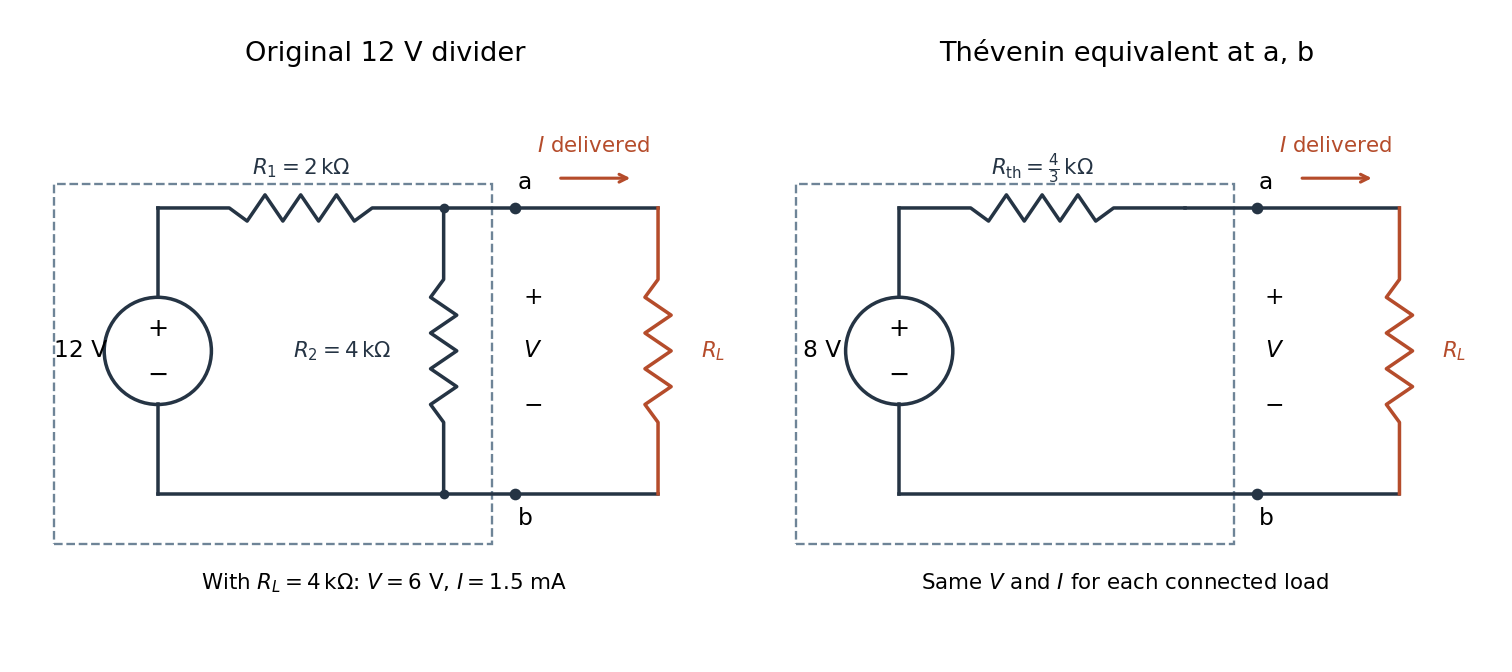
The equivalence concerns the chosen terminals, including the power delivered there. It does not identify internal branch electric currents or internal Joule heating. At open circuit the original divider still draws from its supply, while the equivalent's series branch carries no electric current. [ref]
Thevenin and Norton Equivalents, University of Houston teaching notes. Thevenin and Norton Equivalents, pp. 1–2, “The Idea” and “Important Notes”: equivalence at the specified terminals

