A uniform random permutation of distinct objects gives each of the permutations the same probability. Restricting the order to any fixed subset gives a uniform ordering on that subset. Relative ranks encode such a permutation bijectively by independent choices of an insertion position.
For a uniform random permutation , define as the rank of among , with rank one assigned to the smallest value. Each sequence corresponds to exactly one permutation: insert index in position of the current increasing-value list, then assign the final list the values . The equally likely permutations therefore correspond to the equally likely rank sequences. Consequently the are independent random variables, each with the displayed uniform distribution.
The indicators of successively smaller records are independent and have Bernoulli distributions of parameters . Successively larger records use and have the same laws. For , expectation and variance additivity for independent random variables give and .
For a uniform random permutation of objects, let count its fixed points. Write . Each indicator random variable has expected value , so linearity of expectation gives for every . This average does not require independence: for , fixing two specified objects has probability , greater than the product of their individual probabilities.
For four objects, exact enumeration gives counts for fixed points among the equally likely permutations. Their weighted arithmetic mean is . Exactly three fixed points are impossible: the last object must then also be fixed.
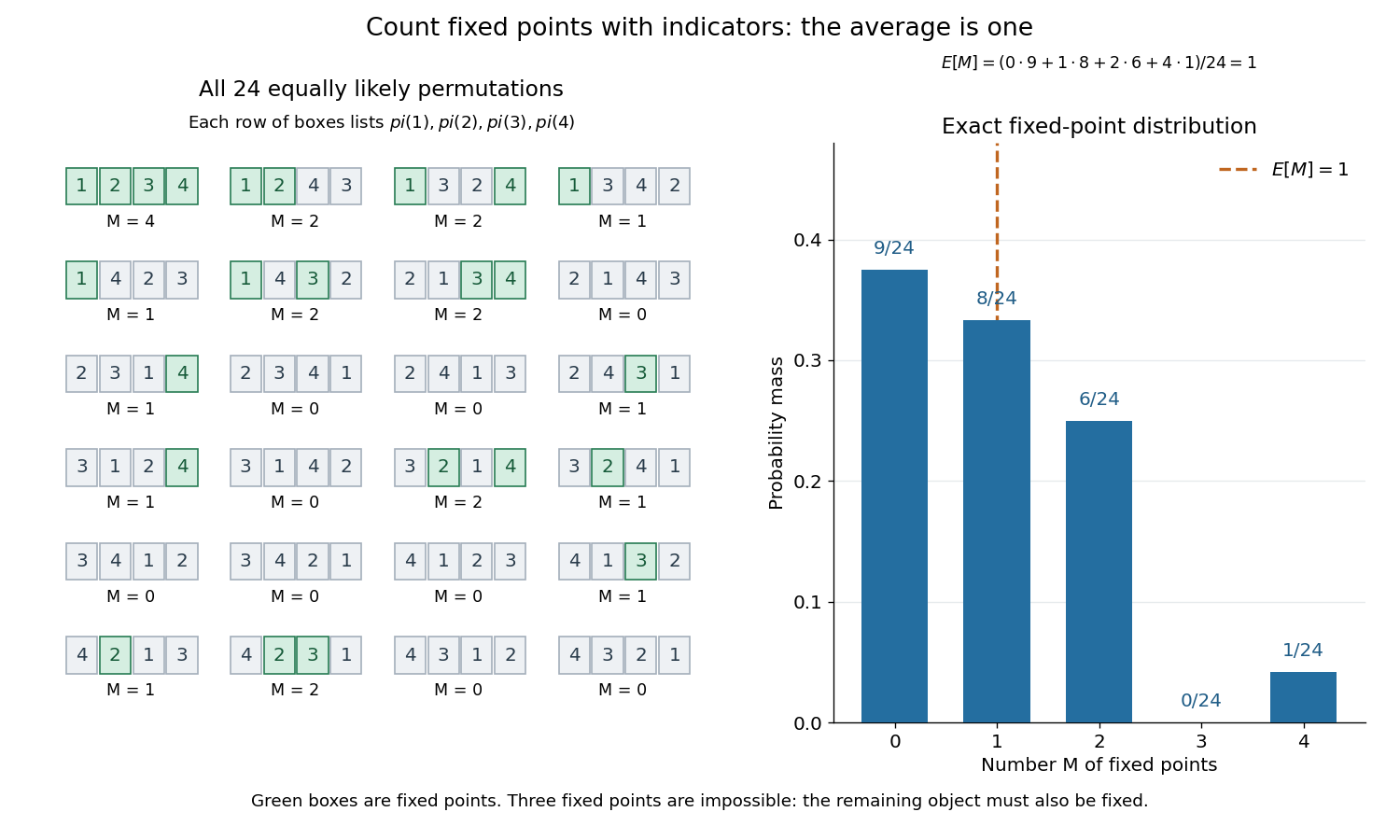
The fixed point count of a uniform random permutation averaged over all permutations of four objects
. Each card lists . Green entries equal their positions and therefore mark fixed points. The probability mass function on the right counts those cards; its expected value is one. Details.
Choose the fixed objects and derange the remaining . Their count is among equally likely permutations. The inclusion-exclusion principle for proves the displayed law, valid for and zero otherwise. With , it includes the all-fixed case and the impossibility of exactly fixed objects. For fixed , the law tends to , the Poisson distribution of mean one.
Articles by others on the same topic
There are currently no matching articles.