A current loop is a closed path carrying electric current. For a thin wire following a closed curve , the volume integral defining its magnetic dipole moment becomes a line integral:The vector area is for a planar current loop. For a nonplanar current loop, use the vector area, rather than the scalar area of an arbitrarily chosen spanning surface. Reversing the electric current reverses without changing the geometry. [ref].
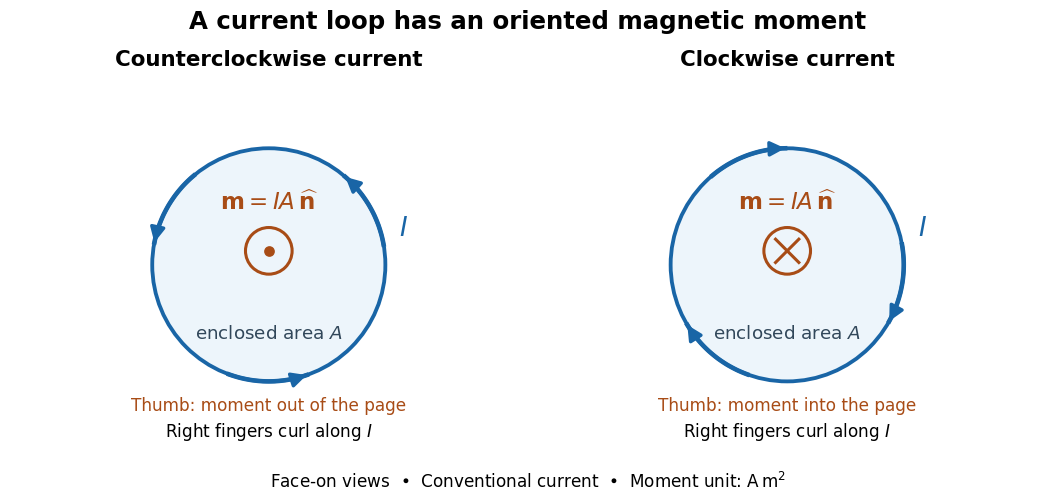
For closely spaced identical turns carrying the same electric current, the magnetic dipole moments add: . Each turn contributes its own vector area; unequal areas or differently oriented turns require a vector sum. As a calculated example, twelve circular turns of radius carrying give . This is an idealized example, not an experimental measurement.
Articles by others on the same topic


A **current loop** is a method used in industrial automation and instrumentations for transmitting analog signals over long distances. The most common type is the 4-20 mA current loop, where a current of 4 milliamperes represents the lowest end of the measurable range (often 0), and 20 milliamperes represents the highest end (often 100%).