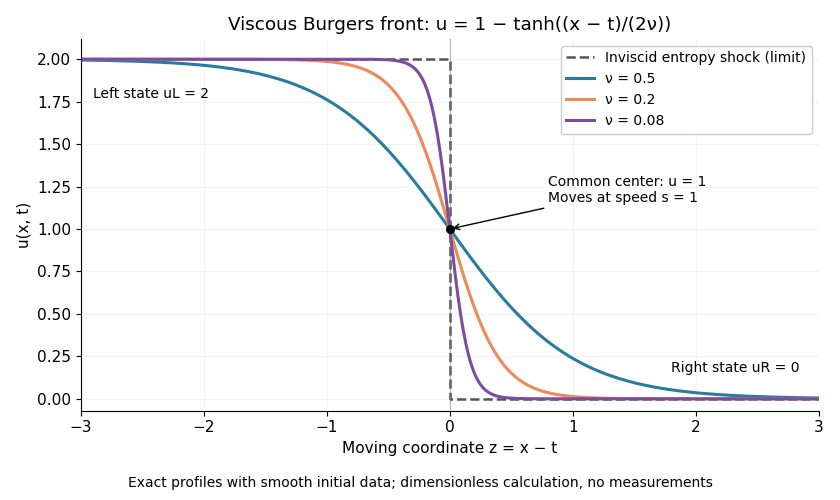
A travelling wave of the viscous Burgers equation can connect constant states through a smooth decreasing layer. Require , , , , and at both ends. Substitution and one integration giveThe speed follows by evaluating the integration constant at both end states. It is precisely the Rankine-Hugoniot condition for conservation law flux . Choosing the center gives the displayed hyperbolic tangent profile. Its characteristic width scales as ; a smaller positive makes a thinner smooth layer.
For an original worked example in dimensionless quantities, take , and :This is an exact classical solution on with its own smooth initial condition and limiting states . It is a family of moving profiles, not the finite- solution starting from an exact discontinuous step. For that different initial condition, the Cole-Hopf transformation supplies the evolution. At , this front starts from the same profile as the Burgers characteristic breaking example: positive diffusion maintains a smooth moving layer while the inviscid profile breaks at .
To check the partial differential equation explicitly, set and . ThenThe independent Rankine-Hugoniot condition check gives , using and . At fixed , the vanishing viscosity approximation tends to the entropy shock for and for . At the center the smooth profiles stay at ; changing the value on the discontinuity does not change the limiting weak solution.

For , the same integrated ordinary differential equation has between the two states when , so it cannot supply an increasing connecting front. The inviscid admissible expansion is the rarefaction wave of the Burgers Riemann problem with positive flux.
Articles by others on the same topic
There are currently no matching articles.