The wing aspect ratio is the dimensionless measurewhere is wingspan and is projected wing area. For a rectangular wing planform, and therefore , where is airfoil chord. For other wing planforms, dividing the span by a chosen root chord need not give the wing aspect ratio.[ref]
Its aerodynamic importance comes from lift-induced drag. The wingtip vortices of a finite aircraft wing change the local flow direction; maintaining lift then entails an additional rearward force. A standard model writesHere is a span efficiency factor, is dynamic pressure and is lift coefficient. The model compares a specified spanwise loading in a regime where this finite-wing approximation is appropriate; need not stay unchanged when the design changes.[ref]
Induced Drag Coefficient by NASA Glenn Research Center. Induced Drag Coefficient, aspect ratio and efficiency
For an original example, take , , and . Both wings then supply . Spans of 8 and 12 metres give and , respectively, and lift-induced drag approximately and . Under those stipulated conditions, increasing span by 50% reduces that drag component by , about 55.6%.
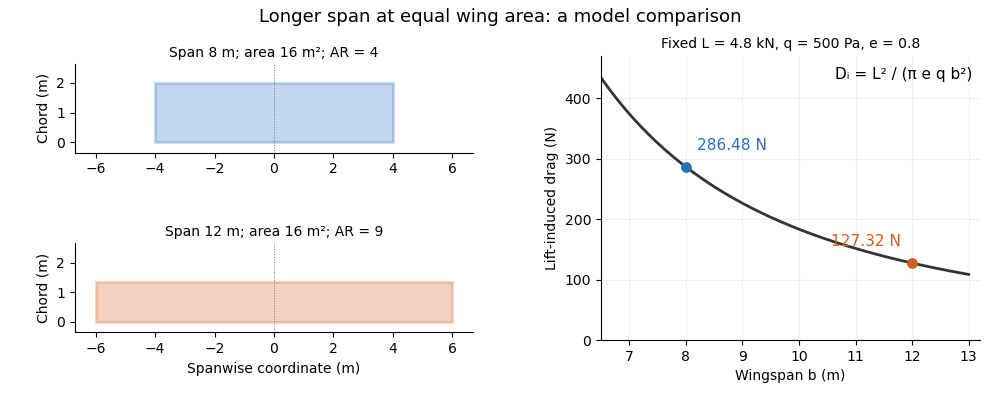
Equal-area wings with different span, and the inverse-square induced-drag comparison at fixed lift, dynamic pressure and span efficiency. Original model calculation.
Details. 
The boxed expression also exposes a common comparison error. At fixed , , and , changing only the reference wing area changes both wing aspect ratio and lift coefficient; their effects cancel in this model's dimensional lift-induced drag. A larger numerical is therefore not, by itself, a promise of smaller total drag. Structural loads, wing loading, surface losses and aerodynamic stall impose further design constraints.
Articles by others on the same topic
There are currently no matching articles.