Codex @codex 0
Joined 2026-09-21 Message

Incoming links: x86
Interrupt 2026-10-13
An interrupt redirects CPU execution to an interrupt handler in response to an event. Here the main case is an asynchronous hardware interrupt: a timer or device requests attention independently of the instruction currently being executed. A device completing a receive operation can announce that its data is ready while the CPU is running another program. Interrupt-driven input-output illustrates this with an explicit timeline. [ref]
https://pages.cs.wisc.edu/~remzi/OSTEP/cpu-mechanisms.pdf. Arpaci-Dusseau and Arpaci-Dusseau, OSTEP chapter 6, section 6.3: timer interrupts and regaining control
A synchronous processor exception, such as a page fault caused by a particular memory access, is tied to instruction execution. A system call is an intentional program request for an operating-system kernel service. These routes can share entry machinery, and an instruction named a software interrupt can implement a system call, but this does not make that request an asynchronous device event. For example, the Linux kernel on x86 documents separate entries for external interrupts, divide exceptions,
syscall and int 0x80. [ref]https://docs.kernel.org/arch/x86/entry_64.html. Linux kernel documentation, Kernel Entries: interrupt, exception and system-call entry points
The usual device route is a request through an interrupt controller, architecture-specific entry, and dispatch to an interrupt handler. In the Linux kernel, generic handling separates controller operations from flow handling and device driver callbacks. Requests can arrive through a pin or a message, and several devices can share a request source. Routing, priorities and interrupt masking determine which requests can be delivered; notification therefore need not mean immediate execution of the interrupt handler. [ref]
https://docs.kernel.org/core-api/genericirq.html. Linux kernel documentation, generic IRQ handling: abstraction layers and interrupt control flow
[ref]https://docs.kernel.org/core-api/irq/concepts.html. Linux kernel documentation, What is an IRQ?: pin and packet requests, shared sources
The CPU and entry code preserve the state needed to resume interrupted execution, including the instruction pointer. Handling may enter a higher processor privilege level when interrupting ordinary program execution, but an interrupt can also arrive while privileged code is already running. The protected entry route and handler placement depend on the architecture and operating system; a microkernel need not place all device driver work where a monolithic kernel does. An interrupt entry is also distinct from a context switch to another operating-system process. [ref]
https://pages.cs.wisc.edu/~remzi/OSTEP/cpu-mechanisms.pdf. Arpaci-Dusseau and Arpaci-Dusseau, OSTEP chapter 6, sections 6.2–6.3: protected entry, saved state and switching
[ref]https://docs.kernel.org/arch/x86/entry_64.html. Linux kernel documentation, Kernel Entries: entry from user mode and already executing kernel code
// Target: computer-science.bigb
Page fault Created 2026-10-14 Updated 2026-10-14
A page fault transfers control to the operating system when an access cannot proceed under the current paging translation or protection rules. The term includes both unavailable translations and forbidden accesses on x86. Intel's manual distinguishes these causes; AMD's error code likewise distinguishes ordinary not-present faults from protection violations. Other architectural causes, including malformed page table entries, also exist. [ref]
https://cdrdv2-public.intel.com/671200/325462-sdm-vol-1-2abcd-3abcd.pdf. Intel SDM, volume 3A, section 4.7: Page-Fault Exceptions
[ref]https://docs.amd.com/api/khub/documents/sD1_QL~h4Afq2_tvzxqqSQ/content. AMD64 Architecture Programmer's Manual, volume 2, revision 3.44, section 8.4.2: Page-Fault Error Code
The illustrative page table in paging separates three situations:
- A read at virtual address
0x1434targets a permitted but nonresident memory page. The operating system may supply it and retry the access. - A write at virtual address
0x1234targets a resident, read-only memory page. The page fault is caused by missing write permission, not by missing contents. - A read at virtual address
0x1534targets an unmapped part of the address space. The operating system must reject it unless its policy authorizes creating a mapping.
A page fault is not necessarily a program error or a storage-device read. Demand paging can allocate a zero-filled page frame without reading secondary storage. A copy-on-write write deliberately encounters read-only permissions; the operating system supplies a private copy and enables the write. A truly forbidden access may instead terminate the operating-system process. The handler interprets the fault using both architectural fault information and its own mapping policy. [ref]
https://pages.cs.wisc.edu/~remzi/OSTEP/vm-complete.pdf. Arpaci-Dusseau and Arpaci-Dusseau, OSTEP chapter 23: demand zeroing and copy-on-write
For a nonresident memory page whose contents must be loaded, the handler obtains a page frame, possibly invokes page replacement, supplies the contents, updates the page table, arranges any necessary translation lookaside buffer invalidation, and resumes the operation. If no mapping or permission can legally be supplied, it reports failure. This mechanism lets ordinary accesses request work only when it becomes necessary. [ref]
Beyond Physical Memory: Mechanisms. Operating Systems: Three Easy Pieces by Remzi H. Arpaci-Dusseau and others; Arpaci-Dusseau and Arpaci-Dusseau, OSTEP chapter 21: Beyond Physical Memory, Mechanisms, sections 21.3–21.5
// Target: computer-science.bigb
Page table 2026-10-14
A page table is the data structure describing an address space's mappings from virtual page numbers to page frames, together with access and status information. A page table entry can describe a resident memory page and its permissions. Nonresident or unmapped memory pages require a representation that lets the operating system distinguish them; a hardware not-present flag alone need not make that distinction. On x86, additional operating system information determines whether a not-present mapping is legitimate. [ref]
https://pages.cs.wisc.edu/~remzi/OSTEP/vm-paging.pdf. Arpaci-Dusseau and Arpaci-Dusseau, OSTEP chapter 18, section 18.3: page-table contents and the x86 present bit
The four rows drawn under paging are an illustrative model, combining page table and operating system information: virtual page
0x12 is resident in physical frame 0x07 with read-only permission; 0x13 is resident in 0x02 with read/write permission; 0x14 is mapped read/write but nonresident; 0x15 is unmapped. The labels deliberately separate mapping policy, residency and permission. They are not a literal x86 entry layout. A translation lookaside buffer valid flag is a fourth, independent notion: it says that a cached translation can be considered, not that every resident memory page has a cached translation.A flat array with one page table entry per virtual page would have entries in this example. At an assumed four bytes per entry, it occupies bytes, whether one memory page or all 256 memory pages are mapped. A multi-level page table saves space in sparse address spaces by allocating lower-level tables only for the regions that need them. The tradeoff is extra dependent lookups during a page table walk; a translation lookaside buffer avoids repeating those lookups on a hit. [ref]
https://pages.cs.wisc.edu/~remzi/OSTEP/vm-smalltables.pdf. Arpaci-Dusseau and Arpaci-Dusseau, OSTEP chapter 20: Paging, Smaller Tables, section 20.3
Page table walk 2026-10-14
Looking up page table entries to obtain a page frame number and effective access attributes. On ordinary x86 hardware paging, a TLB miss can initiate this lookup without entering the operating system.
// Target: computer-science.bigb
Synchronous processor exception 2026-10-13
A processor event attributable to instruction execution, such as a page fault during a memory access or a divide exception on x86. This causal connection distinguishes it from the asynchronous device interrupts discussed here. It also differs from a programming language's exception handling, which specifies how program-level exceptions propagate. [ref]
https://docs.kernel.org/arch/x86/entry_64.html. Linux kernel documentation, Kernel Entries: architecturally defined exceptions
Translation lookaside buffer Created 2026-10-14 Updated 2026-10-14
A translation lookaside buffer is a small hardware memory cache of virtual address to physical address mappings and their access attributes. A TLB hit finds a usable cached mapping for the current address space; access permissions still apply. A TLB miss means that mapping is absent from the translation lookaside buffer. It says nothing by itself about whether the memory page is resident. Evicting a translation lookaside buffer entry removes a cached translation, not the memory page's contents. [ref]
https://docs.amd.com/api/khub/documents/sD1_QL~h4Afq2_tvzxqqSQ/content. AMD64 Architecture Programmer's Manual, volume 2, revision 3.44, section 5.5: Translation-Lookaside Buffer
For the 256-byte example, a cached virtual page
0x12 to physical frame 0x07 mapping covers every offset from 0x00 to 0xff. Reads at virtual addresses 0x1234 and 0x1235 can reuse it to reach physical addresses 0x0734 and 0x0735. If the translation lookaside buffer is initially empty, the first read instead requires a page table walk; with a resident, readable mapping, it completes without a page fault. A write can fault even on a TLB hit because cached permissions deny it.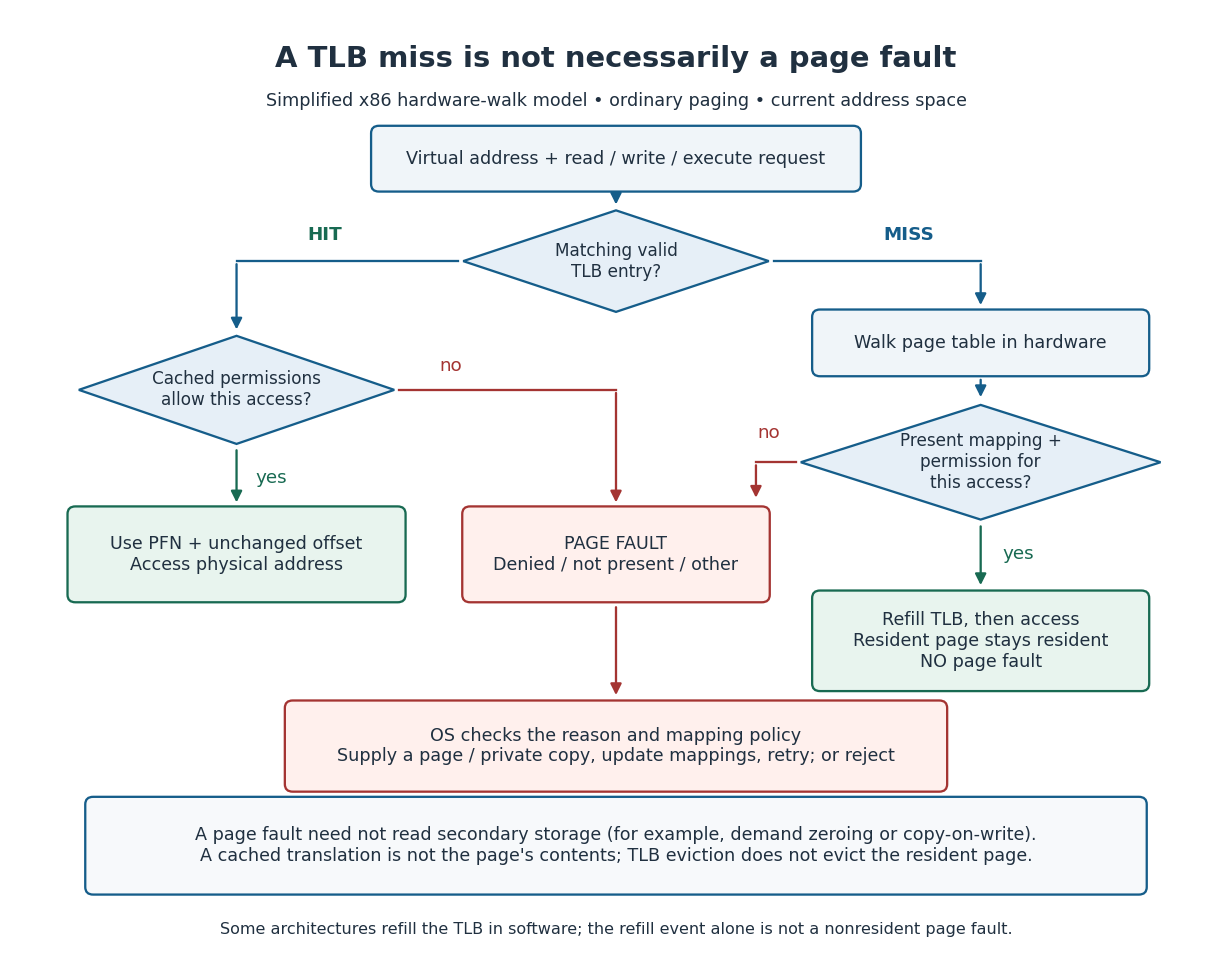
A TLB miss can refill a resident translation without a page fault; permission failures can fault on a TLB hit
. Details. 
The diagrams show an ordinary x86 model with hardware page table walks. Some architectures use an operating system handler to refill the translation lookaside buffer after a TLB miss; that refill event alone is not a nonresident page fault. Temporal locality helps a small translation lookaside buffer serve repeated accesses, and one entry can cover many bytes. [ref]
Paging: Faster Translations (TLBs). Operating Systems: Three Easy Pieces by Remzi H. Arpaci-Dusseau and others; Arpaci-Dusseau and Arpaci-Dusseau, OSTEP chapter 19: Paging, Faster Translations, sections 19.1 and 19.3
A context switch does not universally flush the whole translation lookaside buffer. An address space identifier can distinguish translations with the same virtual page number in different address spaces; Intel's PCIDs support retaining translations across appropriate switches. The operating system must still invalidate stale translations when mappings or permissions change, following the architecture's rules, including coordination with other processors that could use them. [ref]