Zero sound is a collisionless collective Fermi surface deformation sustained by Landau quasiparticle interactions.[ref]
Oscillations in a Fermi Liquid by Lev Davidovich Landau. Opening and section 1, pp.101–103
A useful analogy is a crowd whose members respond to their neighbors' density without repeatedly bumping into them: the restoring interaction can remain effective when collisions cannot relax the distribution within one cycle. Zero sound is collective; it is not a single Landau quasiparticle outrunning every other excitation.
Consider a neutral, isotropic, unpolarized three-dimensional spin-one-half Fermi liquid, with only nonzero. A longitudinal density wave with angular frequency and wavevector magnitude has . The collisionless angular equation for the energy displacement of the Fermi surface isAveraging givesThe bracket decreases from infinity to zero on : each gives one undamped root above the small- particle-hole continuum.[ref]
For an original example, gives . Since here, the Principle of Galilean relativity gives and taking the hydrodynamic limit before gives . Stipulating gives and . These are model choices, not helium-3 measurements. At large , expanding the logarithm gives ; for small positive , the root approaches exponentially closely, so numerical resolution matters. A charged Electron liquid needs its long-range interaction included; this neutral model is not its long-wavelength density mode.
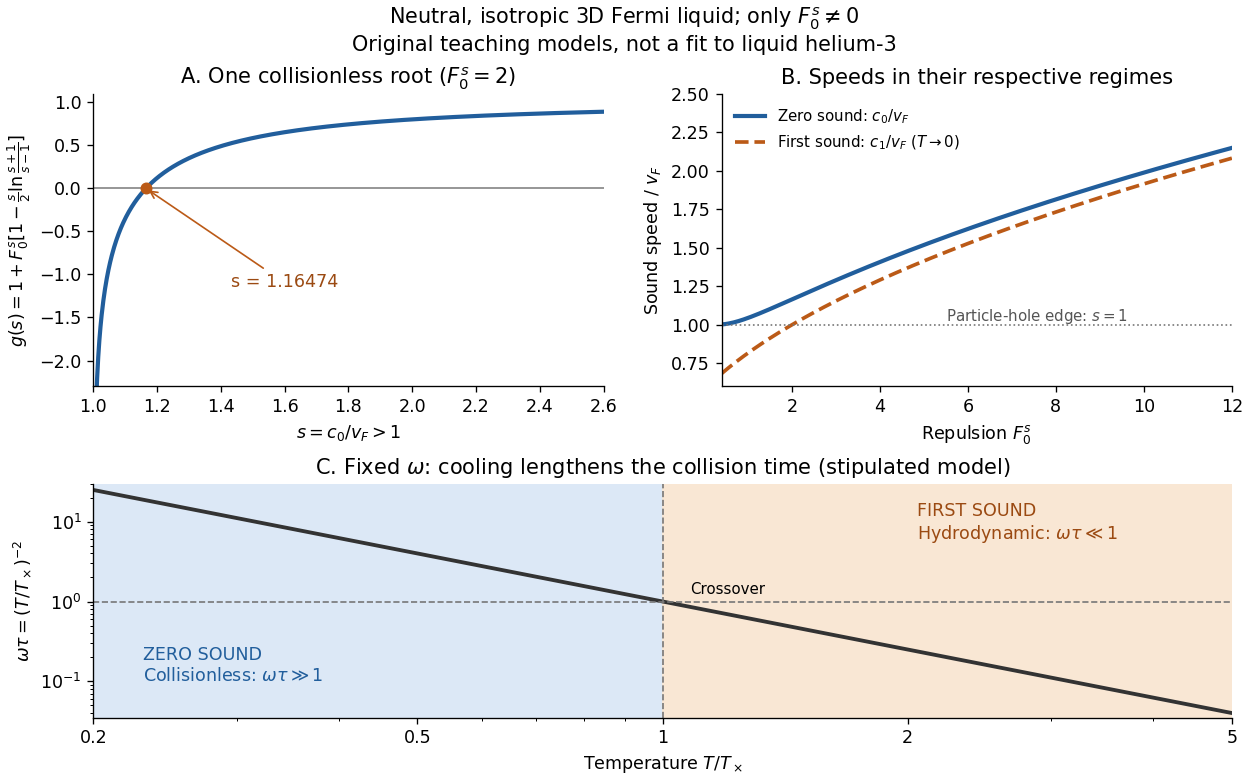
Angular-relaxation collision time distinguishes first sound () from zero sound (). Collisions establish local thermodynamic equilibrium in the former.[ref]
Oscillations in a Fermi Liquid by Lev Davidovich Landau. Sections 2–3, finite-temperature kinetic equation and absorption
For the figure's stipulated law , cooling from to changes from to , without changing the driving angular frequency. The crossover temperature is defined by . Calling zero sound a high-frequency mode therefore means high relative to the collision rate , while its excitation energy must still remain within the low-energy domain of the Fermi liquid.
In 1966, William Russell Abel, Ansel Cochran Anderson and John Charles Wheatley sent acoustic waves through bulk liquid helium-3 at and frequencies and . A quartz delay line and receiving acoustic transducer bounded a liquid gap; shielding reduced electrical pickup. Powdered cerium magnesium nitrate provided magnetic thermometry during a slow warm-up. Pulse amplitudes measured acoustic attenuation; phase difference comparison measured velocity. Calibration pulses checked gain; early received cycles avoided multiple reflections. On cooling through a maximum, acoustic attenuation changed from to with a velocity shift supporting zero sound; is their magnetic temperature scale. Weak acoustic attenuation was harder to resolve.[ref]
Propagation of Zero Sound in Liquid He3 at Low Temperatures by William Russell Abel and others. pp.74–75, Fig.1 and readout/control paragraphs
This 1966 test followed Lev Landau's 1962 Nobel Prize in Physics.[ref]
The Nobel Prize in Physics 1962 by Nobel Prize Outreach. 1962 award to Landau for condensed-matter theory
The experiment concerned normal liquid helium-3, distinct from the later discovery of superfluid helium-3.[ref]
John C. Wheatley by Robert E. Ecke and others. pp.3–4, normal-liquid sound and later superfluid work
Landau's original papers are theoretical calculations, not reports of an apparatus. Articles by others on the same topic


"Zero sound" can refer to different concepts depending on the context. Here are a few interpretations: 1. **Acoustic Science**: In acoustics, "zero sound" may refer to a state where sound waves are absent. This can occur in a vacuum, where there are no molecules to carry sound waves, resulting in complete silence.